
Why Do I Have a Short Fuse? Causes and Birmingham Support
What if your quick temper isn't a character flaw, but actually a biological early warning system telling you that your emotional capacity is overdrawn? You might find yourself wondering, "why do I have such a short fuse," after snapping at a partner over a small comment or feeling an intense surge of heat when your child spills a drink. The deep guilt and shame that follow these outbursts can feel incredibly heavy. It's exhausting to feel like you're constantly walking on eggshells around your own emotions, worried about the next time you might lose control.
We want you to know that change is possible and you aren't alone in this struggle. This article will help you uncover the psychological and biological reasons behind your reactions, offering a clear path toward regaining your calm. We'll explore the common triggers for a quick temper and introduce practical tools, alongside local Birmingham support, to help you start this rewarding journey toward a more peaceful life.
Key Takeaways
- Understand how your brain's alarm system can bypass logic, helping you answer the question "why do I have such a short fuse" during stressful moments.
- Identify the "Stress Bucket" triggers, such as chronic fatigue or unmet needs, that cause small daily irritations to overflow into anger.
- Learn practical tools like the 5-second circuit breaker and grounding techniques to stop a snap before it starts.
- Explore how specialized coaching or counselling in Birmingham provides a safe space to navigate your triggers and begin your journey toward lasting calm.
What Having a 'Short Fuse' Actually Means for Your Brain
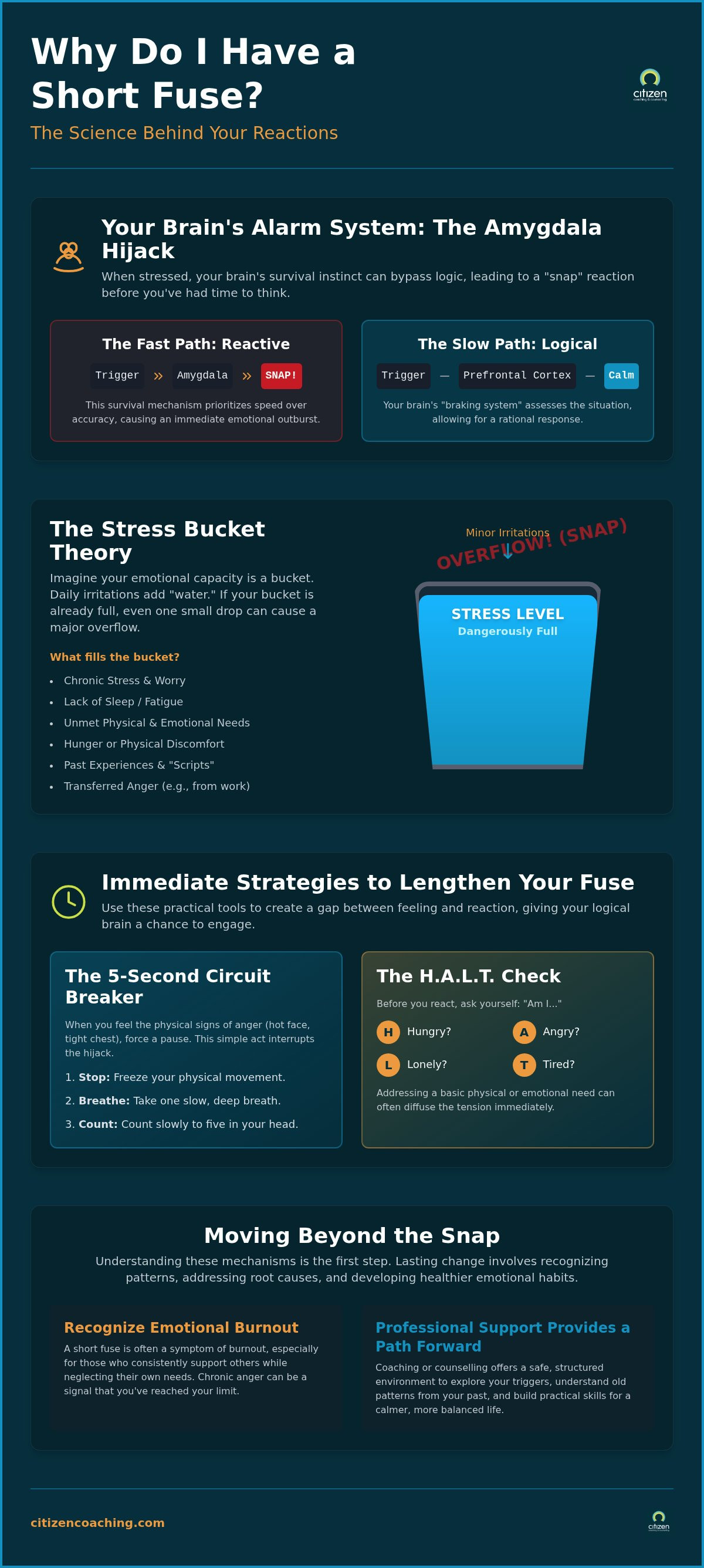
Having a "short fuse" is more than just a personality trait; it's a description of a low threshold for emotional reactivity. When you wonder, "why do I have such a short fuse," you're noticing a physical process where your brain's alarm system, the amygdala, bypasses your logical thinking. This is often called an "Amygdala Hijack." It's a survival mechanism that prioritizes speed over accuracy, making you react before you've had a chance to process the situation properly.
This physiological state often leads to a cycle where your brain actively scans for "anger-related stimuli." Because your system is already on high alert, you might start noticing small annoyances that you would usually ignore. Your brain is essentially looking for things to be frustrated by to justify the tension you already feel. This is a biological response, not a lack of willpower or a character flaw. While extreme cases might relate to Intermittent explosive disorder, many people simply have an overactive alarm system.
The Role of the Prefrontal Cortex
The prefrontal cortex acts as the "braking system" for your emotions. It's the part of the brain responsible for impulse control and rational thought. When you're well-rested and calm, these brakes work effectively. However, chronic stress, lack of sleep, or hunger "thins" these brakes. This makes it much harder to stop a snap once the impulse starts. This is a common reason why you might ask, "why do I have such a short fuse," specifically at the end of a long, tiring day.
Why You Feel 'Snap' Before You Feel Thought
Emotional processing is significantly faster than cognitive processing. Your body often knows you're angry before your mind does. You might experience physical warning signs like a hot face, a tight chest, or a racing heart. These cues happen in milliseconds. By the time your logical brain catches up to the situation, the "snap" has already occurred. Learning to spot these early physical signals is a vital step in regaining control.
The Hidden Reasons You Are Snapping Over Small Things
Imagine your emotional capacity as a bucket. Every small irritation, like a traffic jam or a cold cup of coffee, adds a drop of water. If your bucket is already full, even a tiny drop causes it to overflow. This "Stress Bucket" theory explains why minor issues can lead to major outbursts. When you ask yourself, "why do I have such a short fuse," it's usually because your system has no room left for even the smallest frustration. Understanding the nature of anger reveals that "The Big Three" triggers, sleep deprivation, chronic stress, and unmet needs, often keep your bucket near the brim.
Past experiences also play a significant role. We often carry "scripts" from childhood about how to express or suppress feelings. If you grew up in an environment where outbursts were the only way to be heard, your brain might default to that response today. Recognizing these old patterns is a vital part of The Science of Anger and the first step toward changing your reactions.
Physical and Environmental Factors
Physical discomfort often shortens your fuse. Hunger, constant noise, or a lack of quiet "white space" in your schedule keeps your nervous system on edge. If you're constantly wondering "why do I have such a short fuse" despite trying to stay calm, it might be that your physical environment is working against you. Transferred anger is another common culprit. You might bottle up frustration with a colleague all day, only to snap at your family the moment you walk through the door. If this sounds familiar, you might find it helpful to talk to a professional about setting better boundaries.
Emotional Burnout and the 'Short Fuse'
Many people with a short fuse are actually the "strong ones" in their circles. If you're always supporting others while ignoring your own needs, emotional burnout is inevitable. Chronic anger isn't just a bad mood; it's a signal that you've reached your limit. There's a big difference between healthy frustration and the heavy, constant weight of chronic anger. Acknowledging that you're overwhelmed isn't a sign of weakness. It's the start of your journey toward a more balanced life.
Immediate Strategies to Lengthen Your Fuse Today
If you've been asking yourself "why do I have such a short fuse," the first step is knowing that once you understand the biological reasons why you might snap, you can start using tools to interrupt that process. The 5-Second Circuit Breaker is a simple but powerful way to stop an outburst. By forcing your brain to count slowly to five, you create a tiny gap between the feeling and the reaction. This gives your logical brain a chance to catch up. Another helpful tool is the HALT check. Before responding to a frustration, ask yourself if you're Hungry, Angry, Lonely, or Tired. Often, addressing a basic physical need can instantly lower your reactivity.
Grounding techniques like the 5-4-3-2-1 method are excellent for returning to the present moment. You identify five things you can see, four you can touch, three you can hear, two you can smell, and one you can taste. This shifts your focus away from the perceived threat and calms your nervous system. Research into the causes and symptoms of anger issues shows that these small interruptions can significantly reduce the intensity of a reaction.
Communicating the 'Fuse' to Others
It's helpful to be honest with those around you. Instead of waiting for a snap, try saying, "I'm feeling quite reactive right now." This isn't an excuse for bad behavior, but a warning that your bucket is full. A proactive timeout is very different from storming out; it's a planned pause to breathe and reset before a conversation continues.
Creating a Calmer Environment
Reducing sensory overload at home, such as lowering background noise or dimming bright lights, can prevent your system from feeling overwhelmed. If you're still wondering "why do I have such a short fuse" despite these efforts, an online anger management course provides a structured framework to master these tools at your own pace.
Moving Beyond the Snap: How Professional Support Helps
Understanding why do I have such a short fuse is a powerful first step, but it's only the beginning of your journey. Knowledge gives you the "why," while professional support provides the "how." Learning to interrupt years of reactive patterns often requires a guide who can help you practice new skills in a safe, non-judgmental environment. This isn't about being "fixed"; it's about developing the capacity to handle life's pressures with more ease and confidence.
It's helpful to distinguish between medical intervention and the coaching or counselling support we provide. While medical professionals handle clinical diagnoses or prescriptions, our focus is on practical, developmental tools. When you're trying to figure out why do I have such a short fuse, having a neutral professional to talk to can reveal patterns you might miss on your own. We help you navigate your unique triggers and build emotional resilience without using dense jargon or clinical labels. This approach makes the process feel like a practical tool for growth rather than a daunting medical procedure.
Anger Management in Birmingham
For those looking for local help, the Anger Management Birmingham Group offers a supportive space where you can learn alongside others. Many people find immense relief in realizing they aren't alone in their struggle. Sharing experiences with people who truly understand the weight of post-outburst guilt can be incredibly healing. If you prefer a more private setting, 1-to-1 sessions in Birmingham allow you to explore your specific triggers in depth with a dedicated coach.
The Social Enterprise Advantage
As a social enterprise founded in 2005, Citizen Coaching is committed to making support accessible to everyone. We believe that seeking help is a brave act of self-care. The hardest part is often the initiation of the journey, but it's also the most rewarding step you can take for your relationships and your peace of mind. To find the right fit for your situation, feel free to contact the team today to discuss your needs.
Start Your Journey Toward Lasting Calm
Understanding why do I have such a short fuse is a powerful turning point. You now know that your reactions are a biological response to an overdrawn emotional capacity, not a personal failure. By identifying your "stress bucket" triggers and using tools like the 5-second circuit breaker, you've already begun the process of lengthening your fuse. These small, consistent changes lead to a significant shift in how you experience the world and your relationships.
Citizen Coaching has provided jargon-free, empathetic support to the Birmingham community since 2005. As a social enterprise, we focus on making personal development feel like a practical, accessible tool rather than a daunting intervention. You don't have to manage these intense moments on your own. Our professional team is here to guide you through a safe and non-judgmental process of growth.
The hardest part of any journey is simply beginning. We're ready to help you take that step whenever you feel ready.
Frequently Asked Questions
Is a short fuse a sign of a mental health condition?
A quick temper is often a signal from your body that your emotional capacity is overstretched, rather than a specific medical condition. While it can be linked to stress or burnout, it's frequently a learned response to your environment. If you're asking "why do I have such a short fuse," it's helpful to look at your daily pressures first. We offer non-clinical support to help you understand and manage these reactions effectively.
Can I really change my temper if I've always been this way?
Yes, you can absolutely learn to manage your reactions even if you feel you've always been this way. Your brain is capable of building new neural pathways through practice and specialized coaching. At Citizen Coaching, we've helped people in Birmingham since 2005 transform their emotional habits. The initiation of the journey is often the most difficult step, but with the right tools, a calmer way of living is possible for anyone.
What is the difference between anger and a 'short fuse'?
Anger is a natural human emotion that everyone experiences, but a "short fuse" refers to how quickly you reach that point. It's a low threshold for reactivity where you skip the thinking phase and go straight to a snap. While anger can be a healthy response to unfairness, having a short fuse often feels overwhelming. Our programmes focus on lengthening that gap so you can choose how to respond.
How do I know if I need professional anger management coaching?
You might benefit from coaching if your outbursts are starting to strain your relationships with your partner or children. If you frequently feel deep guilt after snapping or feel out of control over minor issues, professional support can help. Our Birmingham sessions provide a safe, jargon-free space to explore your triggers. If you're constantly asking "why do I have such a short fuse," it's usually a sign that you need new tools.
How long does it typically take to see results from anger coaching?
Many clients notice a difference in their reactivity after just a few sessions as they start using tools like the circuit breaker. However, creating lasting change and unlearning old habits usually takes several weeks of practice. Our structured programmes in Birmingham are designed to encourage steady progress. Every person's journey is unique, but the commitment to beginning is the most important factor in seeing real, long-term results in your daily life.

Article by
Martin Hogg
Counselling and Anger Management in Birmingham. Articles by Martin Hogg, counsellor MBACP (Reg.) and Founder and CEO of Citizen Coaching and Counselling, a social enterprise based in Birmingham, UK. Martin also helps counsellors struggling to set up and grow their Private Practice to gain clarity and confidence in their marketing and systems.
Disclaimer
The information provided on this blog is for general informational purposes only and is not intended to be a substitute for professional medical or mental health advice, diagnosis, or treatment. Reading this content does not create a therapist-client relationship.


