
Supporting Child Mental Health: A Parent’s Guide to Local Support in Birmingham
Imagine it’s a Tuesday evening in Birmingham and your child is sitting at the kitchen table, tears streaming down their face, unable to explain why they feel so overwhelmed. It’s a common moment for anyone supporting child mental health, yet it often leaves you feeling completely helpless. You might worry about being judged or feel frustrated by the fact that NHS waiting lists for specialist care in the West Midlands can now stretch for many months.
We understand that taking the first step to help your child is often the hardest part. You aren't a "bad parent" for feeling stuck, and you don't need a medical degree to make a real difference. This guide provides practical, jargon-free strategies to help you manage your child’s emotional well-being at home immediately. We promise to clear up the confusing terminology and show you how to navigate the local support systems available across our city. You will learn how to spot the difference between normal developmental changes and genuine red flags, alongside a clear map of the friendly, professional help waiting for you in Birmingham.
Key Takeaways
- Learn why "shoulder-to-shoulder" communication can make it easier for your child to open up during everyday activities like walking or driving.
- Understand how to view mental health as a spectrum of emotional well-being rather than just a set of labels or diagnoses.
- Identify common modern triggers, including social media pressure and school anxiety, to better support your child through the unique challenges of the 2026 digital landscape.
- Discover practical routes for supporting child mental health in Birmingham and why seeking professional guidance is a powerful sign of positive parenting.
- Explore how jargon-free coaching offers a friendly, local alternative to traditional clinical therapy for families in the West Midlands.
Beyond the Labels: Understanding Your Child’s Mental Well-being
Mental health isn't a scary label or a clinical diagnosis reserved for a few. It's something every child in Birmingham has, just like they have physical health. It exists on a spectrum that shifts as they grow, move through school, and face new challenges. Some days are bright and full of energy; others feel heavy or uncertain. If you feel anxious or overwhelmed because your child is struggling, please know that your reaction is completely normal. It shows you care.
The current Youth Mental Health Crisis means more families than ever are looking for ways of supporting child mental health. We believe in a jargon-free approach. You don't need to master complex psychological terms to help your child. Our goal is to provide a clear, professional guide that helps you move from a state of worry to a state of calm, confident action. Taking the first step to understand their emotional world is often the hardest part, but you've already started that journey by being here.
Normal Development vs. Mental Health Concerns
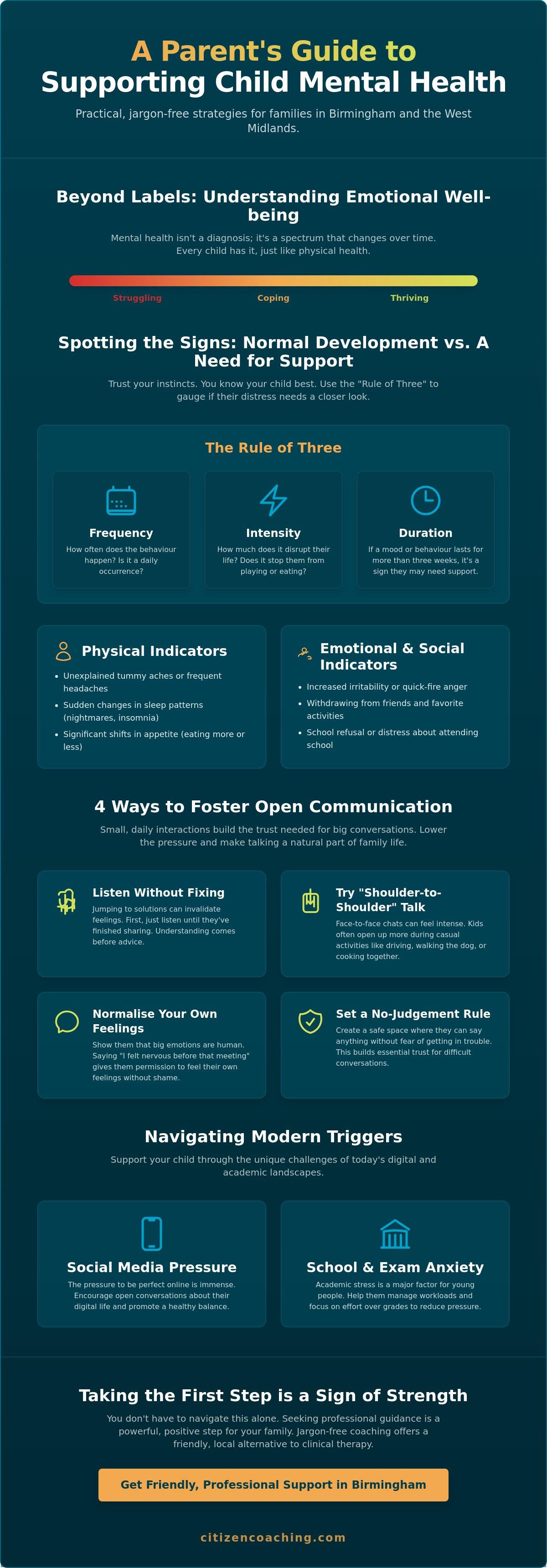
Growing up involves a whirlwind of big emotions. A toddler’s tantrum over a lost toy or a teenager’s sudden need for privacy is usually a sign of healthy development. To help you tell the difference between "growing pains" and something more serious, we recommend using the "Rule of Three." This focuses on the frequency, intensity, and duration of your child's distress.
- Frequency: How often does the behaviour happen? Is it a daily occurrence?
- Intensity: How much does it disrupt their life? Does it stop them from eating or playing?
- Duration: How long has this been going on? If a mood or behaviour lasts for more than three weeks, it's a sign they might need a helping hand.
Common Signs Your Child Might Need Extra Support
Children often lack the words to say "I'm struggling." Instead, they show us through their bodies and actions. Supporting child mental health involves becoming a bit of a detective. You know your child better than anyone else, so trust your instincts if something feels "off."
Physical indicators are often the first things parents notice. This might include unexplained tummy aches, frequent headaches, or a sudden change in sleep patterns, like having trouble falling asleep or waking up with nightmares. You might also see a shift in their appetite, where they either lose interest in food or seek comfort in it more than usual.
Emotional and social indicators are equally telling. Look for increased irritability or "quick-fire" anger that seems out of character. They might withdraw from the friends they usually love or stop asking to go to the park. In our local community, we frequently see this manifest as school refusal in Birmingham schools. If the thought of the classroom causes genuine distress or physical illness, it's a clear signal that they need extra support to feel safe and settled again.
5 Practical Ways to Foster Open Communication at Home
Supporting child mental health begins with the foundation you build at home. It isn't always about big, life-changing talks. Often, it's the small, daily interactions that help a child feel secure enough to share their world with you. When children feel heard, they're more likely to reach out before a small worry becomes a major crisis. This process is about lowering the pressure and making communication a natural part of your family life.
- Listen without fixing: It's natural to want to solve your child's problems immediately. However, jumping to solutions can make them feel like their feelings are something to be "dealt with" rather than understood. Try to listen until they've finished before offering advice.
- Try shoulder-to-shoulder talk: Sitting face-to-face can feel intense for a young person. You'll often find they open up more while you're doing something else, like driving through Birmingham or walking the dog. This side-by-side approach removes the pressure of constant eye contact.
- Normalise your own feelings: Show them that big emotions are a normal part of being human. Mentioning that you felt a bit nervous before a meeting or frustrated when you missed the bus gives them permission to feel their own emotions.
- Set a no-judgement rule: Make it clear that there are times when they can say anything without fear of getting in trouble. This builds the trust needed for the really difficult conversations later on.
If you're looking for more specific local resources, the Birmingham Mental Health Support pages provide a wealth of information for families in the West Midlands. Sometimes, just knowing where to turn can make the process feel much less overwhelming for parents.
The Power of Validation and Empathy
Validation is one of the most effective tools for supporting child mental health. Recent data from NHS Digital indicates that 1 in 6 children in the UK now face probable mental health challenges, making empathetic listening a vital skill. Use "I notice" statements to start conversations. Saying "I notice you've been a bit quiet since school" is much more inviting than asking "Why are you being like this?". It's important to remember that validating a feeling isn't the same as agreeing with a behaviour. You can acknowledge that a child feels "really tough" while still maintaining boundaries. Phrases like "That sounds really hard for you" go a long way in building emotional resilience.
Creating a Safe Space for Big Emotions
Practical routines help children manage their internal world. You might designate a specific "calm down" corner in your house with cushions and books. Establishing a daily check-in, such as "Rose, Thorn, and Bud," allows everyone to share one good thing, one difficult thing, and one thing they're looking forward to. For younger children who might struggle with words, encourage drawing or journaling as a way to express what's happening inside. If you find these conversations are becoming difficult to manage on your own, you might find it helpful to speak with a professional guide who can help your family navigate these challenges together.
Navigating Common Triggers: From School Stress to Social Media
In 2026, the digital world moves faster than ever. For a young person in Birmingham, life is a constant stream of notifications, likes, and filters. This digital landscape often creates a "comparison culture" that didn't exist for previous generations. When children spend hours scrolling, they aren't just looking at photos; they're measuring their own worth against an unrealistic standard. This pressure is a major factor when you're supporting child mental health at home.
School brings its own set of hurdles. Whether it's the pressure of SATs, GCSEs, or the social minefield of the playground, anxiety often shows up in quiet ways. You might notice your child getting frequent headaches, struggling to sleep, or suddenly avoiding certain friends. Bullying has also moved from the school gates to group chats, making it harder for children to find a safe space to switch off. If these school-based worries start to feel overwhelming, the NHS Health in Mind service provides excellent specialist resources for families across Birmingham.
Supporting a Child Through Anger and Frustration
Anger is often a "secondary emotion." It's like the tip of an iceberg. Underneath the surface, your child might actually be feeling scared, lonely, or embarrassed. When "big anger" happens, it's easy to react with frustration, but de-escalation is the most effective tool. We suggest using a "Calm Guide" approach: stay quiet, keep your body language relaxed, and wait for the "emotional storm" to pass before trying to talk.
If these outbursts become a regular pattern, it might be time for outside help. Professional youth counselling Birmingham offers a safe, jargon-free space for young people to explore what's really driving their frustration. Talking to someone who isn't a parent or a teacher can make a huge difference in how they process their feelings.
Building Resilience in a High-Pressure World
Resilience isn't about being "tough." It's about having the right tools to bounce back. Instead of trying to remove every obstacle in your child's path, try teaching them problem-solving skills. Ask questions like, "What do you think we could try first?" rather than giving them the answer immediately. This builds confidence and shows them that they can handle difficult situations.
Practical habits are the foundation of supporting child mental health. Simple changes can have a big impact:
- Digital detox: Set a "phones away" time at least 60 minutes before bed to improve sleep quality.
- Physical movement: Use local spaces like Cannon Hill Park or Lickey Hills for a walk to clear the mind.
- Offline hobbies: Encourage activities that don't involve a screen, such as local Birmingham youth clubs, sports teams, or drama groups.
Consistent routines provide a sense of safety. When life feels chaotic, knowing that dinner happens at the same time or that Sunday is a "tech-free" day helps ground a child. These small steps build a bridge toward better emotional health.
Taking the First Step: When and How to Seek Professional Help
Deciding to seek help for your child is a sign of strength, not a parenting failure. It shows you're tuned into their needs and ready to provide the right tools for their growth. Taking that first step is often the hardest part of supporting child mental health, but you don't have to do it alone. In Birmingham and across the West Midlands, there are established routes designed to guide your family toward the right care.
Working with Schools and GPs in Birmingham
Your local GP is usually the first port of call. To make the most of a short appointment, bring a "mood diary" covering the last 14 days. Note down specific times your child felt anxious or overwhelmed and what triggered those feelings. This practical data helps the doctor understand the situation quickly. You should also reach out to your child's school. Every school in Birmingham has a Special Educational Needs Coordinator (SENCO) or a Mental Health Lead. Ask them specific questions about your child's day:
- How does my child interact with their friends during unstructured times like lunch?
- Have you noticed a change in their participation during lessons over the last term?
- Are there specific subjects or situations that seem to cause them distress?
If your GP suggests a referral to Specialist Child and Adolescent Mental Health Services (CAMHS), be prepared for a wait. NHS figures from 2023 show that waiting times for specialist services can be lengthy in urban areas. Knowing this allows you to look at community support or school-based interventions while you wait for an assessment.
Understanding Different Types of Talking Therapy
Therapy isn't a "one size fits all" solution. It's a friendly, professional way to help your child make sense of their world. Professional support is a vital tool for supporting child mental health before small worries become bigger problems. Here are the most common types you'll find in Birmingham:
- Play Therapy: This is perfect for younger children. It uses drawing, toys, and storytelling to help them express feelings they can't yet put into words.
- CBT (Cognitive Behavioural Therapy): This is a practical approach that looks at how thoughts, feelings, and actions are linked. It gives older children specific techniques to manage anxiety.
- Counselling: A safe, confidential space where a young person can talk about their life without feeling judged.
When you talk to your child about starting therapy, keep it simple. Explain that they're going to meet someone whose whole job is to help children feel happier and stronger. Many parents choose private counselling because it often cuts down the wait from months to just a few days. This faster access can prevent a child's distress from escalating while they wait for a slot in the state system.
If you feel ready to explore how professional support can help your family, you can book an initial chat with our friendly team today.
Specialised Youth Counselling and Support in Birmingham
Citizen Coaching operates as a dedicated social enterprise right in the heart of Birmingham city centre. Unlike traditional clinics, we don't treat mental health as a cold medical procedure. We believe that supporting child mental health requires a different, more human approach. Our city centre location ensures that help is accessible for families across the region, providing a professional space that feels welcoming rather than clinical. This central hub makes it easier for young people to attend sessions around their school or college schedules.
As a social enterprise, our mission is local. Every penny of profit we make is reinvested back into the Birmingham community. This allows us to keep our services sustainable and focused on the people who live and work here. We act as a bridge between struggling at home and finding the practical skills needed to thrive. Our team provides a safe, neutral ground where young people can speak freely without the pressure of a hospital environment. We pride ourselves on being a team of real people who understand the specific challenges facing families in our city.
Why a Jargon-Free Approach Works Best for Kids
Traditional therapy often uses complex language that can make a young person feel like there's something "wrong" with them. We intentionally remove these clinical labels. By ditching the jargon, we reduce the stigma that often prevents teenagers from engaging with support. Our sessions feel more like meeting a mentor or a coach than a doctor, which helps lower their natural defences. We focus on what is happening in their life right now rather than just ticking boxes on a medical form.
- Tools for life: We focus on practical strategies to manage anxiety, anger, or low mood. These are skills they can use immediately.
- Practical focus: Instead of searching for a complex diagnosis, we look for solutions that work in the classroom and at home.
- Friendly environment: Our guides build rapport first, ensuring the young person feels heard and respected as an individual.
This approach transforms the experience from a daunting medical intervention into a positive journey of personal growth. When a child feels they are learning new skills rather than being "fixed," they are far more likely to stay committed to the process. It builds their confidence and gives them a sense of agency over their own emotional wellbeing.
Next Steps for Birmingham Parents
If you're worried about your child, the best thing you can do is start a conversation. You can book an initial assessment with one of our local guides to discuss what's happening. This chat is a chance to explore your concerns in a non-judgmental space and see if our style of coaching is the right fit for your family. We will listen to your story and help you map out a clear plan for moving forward.
It's also vital to remember your own wellbeing. Supporting child mental health is an exhausting journey for any parent, and you can't provide the best care if you're burnt out. Take time to look after yourself while we help look after your child. We're here to guide you through the process, step by step, ensuring you feel supported as a parent too.
The first step is often the hardest one to take, but you don't have to walk it alone. Reach out to our Birmingham team today to see how we can help your family find a clearer, calmer path forward.
Helping Your Child Thrive in Birmingham
Navigating your child's emotional world can feel overwhelming, but you don't have to do it alone. By focusing on open communication and recognizing the triggers that spark stress, you're already building a stronger foundation for their future. Remember that supporting child mental health isn't about finding a quick fix or using clinical labels. It's about steady, compassionate guidance that meets them where they are.
Since 2005, Citizen Coaching has provided over two decades of local expertise to families across Birmingham. As a Community Interest Company (CIC), we reinvest our resources back into local mental health services to ensure every child gets the help they deserve. We believe that professional support should be accessible, which is why our youth counselling is completely jargon-free. Taking that first step is often the hardest part, but we're here to make it feel safe and manageable for your family.
Book a jargon-free initial session for your child in Birmingham today
You're doing a great job, and with the right local support, things will get easier for both you and your child.
Frequently Asked Questions
How can I tell if my child is struggling with mental health or just being a teenager?
You can identify a struggle by looking for persistent changes in mood or behaviour that last longer than 14 days. While teenagers are often moody, mental health issues usually involve a total withdrawal from favourite hobbies or significant changes in sleep and eating habits. If your child stops seeing friends or their school grades drop suddenly, it's a sign they might need professional support to get back on track.
What should I do if my child refuses to talk to me about their feelings?
Don't panic if your child stays quiet, as many young people find direct eye contact and intense conversations overwhelming. Try "side-by-side" communication, such as talking while driving or walking together, which feels less like an interrogation. It's helpful to let them know you're there whenever they're ready. Sometimes, the first step is simply acknowledging that talking is hard and offering them a journal to write their thoughts down instead.
How do I find youth counselling in Birmingham that doesn't have a long waiting list?
You can find faster support by looking at local private providers or community interest companies rather than relying solely on the NHS. While some West Midlands NHS trusts have waiting times exceeding 18 weeks, private services in Birmingham often offer appointments within 7 days. Choosing a local professional for supporting child mental health ensures your child gets the right guide quickly, preventing their worries from escalating while they wait for a slot.
Is it my fault that my child is struggling with their mental health?
It isn't your fault that your child is struggling. Mental health is a complex mix of genetics, brain chemistry, and external social pressures like school or social media. Instead of focusing on blame, focus on being the friendly, steady presence your child needs right now. Taking the first step to seek help shows you're a proactive parent who's committed to finding the best guide for your child's recovery.
What are the first steps to getting a mental health assessment for my child in the UK?
Your first step is to book an appointment with your GP to discuss your concerns. They can provide a physical health check and refer your child to Child and Adolescent Mental Health Services (CAMHS) if necessary. Be specific with the doctor about symptoms you've noticed over the last month. You can also contact your child's school, as they often have direct pathways to local mental health assessment teams in the Birmingham area.
Can a school in Birmingham provide mental health support directly?
Yes, many schools across Birmingham now have access to Mental Health Support Teams (MHSTs) that work directly with pupils. Government data from 2023 shows that about 35% of schools in England have these dedicated teams in place to help with mild to moderate issues. You should speak to the school's Special Educational Needs Coordinator (SENCO) or the designated mental health lead to see what professional support is available on-site for your child.
What is the difference between a child psychologist and a youth counsellor?
A child psychologist usually focuses on clinical assessments, testing, and diagnosing specific conditions. In contrast, a youth counsellor provides a safe, jargon-free space for your child to talk through their emotions and learn practical coping tools. Counsellors act as a guide through difficult periods, focusing on the child's lived experience and helping them build resilience. Both roles are professional, but counselling is often more focused on immediate emotional support and talking therapy.
How much does private youth counselling cost in Birmingham?
Private youth counselling in Birmingham typically costs between £40 and £70 per session according to 2024 local market rates. Some community organisations offer subsidised rates or sliding scales based on your household income to make support more accessible. When you're looking for a counsellor, always ask about their specific experience with young people. This investment often provides much faster access to care, bypassing the long waiting lists found in many statutory services.


