
Stop Shouting at Your Spouse: Birmingham Couples Guide
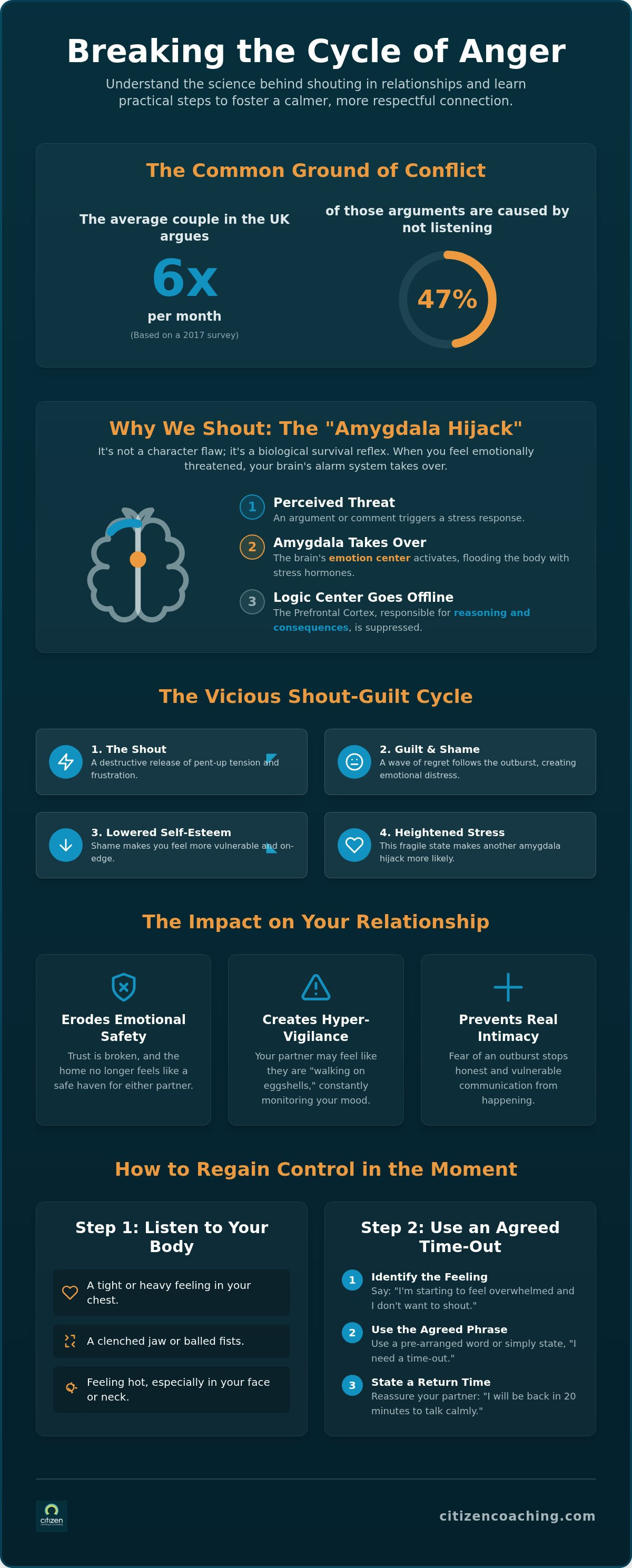
You've just finished yelling, and the house is suddenly quiet, but it isn't a peaceful kind of silence. You see your partner pull away or look down, and that familiar wave of shame hits you. You didn't want to be this person, yet here you are again, wondering how to stop shouting at my wife/husband before the damage becomes permanent. It's incredibly painful to feel like your own temper is a wall between you and the person you love most. You aren't a "bad" person for struggling with this, but you know the current cycle can't continue. According to a 2017 survey, the average British couple argues six times a month, with 47% of those conflicts caused by not listening. You aren't alone in this struggle. This guide offers practical, non-judgmental strategies to help you regain control and rebuild a relationship based on respect rather than fear. We'll explore why your brain flips into "shout mode" and how our Birmingham-based team can help you find a calmer path forward.
Key Takeaways
- Understand why your brain's biological stress response takes over during conflict, making it difficult to think logically once a shouting match begins.
- Learn to identify physical warning signs like a tight chest or hot face so you can use an agreed time-out to stop shouting at my wife/husband.
- Discover how breaking the cycle of yelling restores emotional safety and removes the feeling that your partner is walking on eggshells around you.
- Explore how professional coaching or group sessions in Birmingham can help you move beyond self-help books to create lasting, peaceful changes in your marriage.
Why Do I Shout? Understanding the "Amygdala Hijack"
When you're mid-shout, it often feels like someone else has taken the wheel. This isn't a lack of character; it's a biological process. When you feel threatened, even by a simple comment from your spouse, your brain enters a fight-or-flight state. The amygdala, the part of your brain responsible for emotions, takes over. It sends a flood of stress hormones through your body, preparing you for a battle that isn't actually happening in your living room.
During this surge, the prefrontal cortex, the part of the brain that handles logic and consequences, essentially goes offline. This explains why you might say things you don't mean or struggle with how to stop shouting at my wife/husband in the heat of the moment. Understanding the Amygdala Hijack helps you see that your brain has prioritized survival over communication. The Amygdala Hijack is a survival reflex triggered by perceived emotional threat.
It's normal to feel frustrated occasionally. However, healthy frustration involves expressing a need without demeaning your partner. Chronic yelling cycles are different; they are reactive and leave both people feeling drained. Recognizing that this is a physical response is the first step toward change.
The "Shout-Guilt" Cycle
Shouting provides an immediate, though destructive, release of tension. This hit of relief is quickly followed by a heavy hangover of shame and guilt. While you might think guilt would stop you from doing it again, it often does the opposite. Shame lowers your self-esteem, making you feel more vulnerable and on edge. This heightened state of stress makes your brain even more likely to trigger another hijack during the next disagreement. If you want to learn how to stop shouting at my wife/husband, you must break this loop. Structured support through anger management courses can help you catch the spark before it becomes a flame.
The Real Impact of Shouting on Your Relationship
Shouting does more than just hurt feelings; it slowly erodes the foundation of trust that keeps a marriage together. When you're searching for how to stop shouting at my wife/husband, you're likely noticing that the emotional safety in your home has vanished. Instead of a partnership, the relationship becomes a source of stress. Your spouse might start "walking on eggshells," constantly monitoring your mood to avoid a blow-up. This hyper-vigilance is exhausting for them. It prevents genuine intimacy because they no longer feel safe enough to be vulnerable or honest with you.
The impact often extends beyond just the two of you. Children are incredibly sensitive to parental conflict, even if they aren't in the same room. They pick up on the tension and the sudden volume. According to the Office for National Statistics, emotional abuse was the most common type of domestic abuse reported for the year ending March 2025, affecting about 5.0% of people aged 16 and over. Growing up in a high-conflict home can shape a child's own emotional development and future relationships. Admitting that your temper has become an issue is the bravest thing you can do. It's the essential first step toward healing your family and reclaiming your role as a supportive partner.
Is My Shouting "Abuse"?
It's a difficult question to face. Does your partner look annoyed, or do they look truly afraid? If your yelling is used to silence your spouse, stop a conversation, or control their actions, it has crossed a line into controlling behaviour. Using professional anger management strategies can help you identify these patterns before they cause irreparable harm. If you're ready to start this journey, you can reach out to our team for a confidential chat.
Practical Tools to Stop Yelling in the Moment
Learning how to stop shouting at my wife/husband starts with listening to your body. Before the first word is yelled, your nervous system gives you clear signals. Use a "Body Scan" to check for a tight chest, clenched jaw, or a hot face. These are early warning signs that your brain is moving toward a hijack. If you catch these signs early, you can use the 5-Second Rule: pause and count to five before saying anything. This brief window allows your logical brain to catch up with your emotions, preventing a reactive outburst before it begins.
The Agreed Time-Out
Simply walking out of a room during an argument often makes things worse if there isn't a plan. An "Agreed Time-Out" is different because you've discussed the process during a calm moment. Follow these steps to communicate it effectively when tension rises:
- Identify the feeling: Say, "I'm starting to feel overwhelmed and don't want to shout."
- Use the phrase: Use a pre-arranged word or simply say, "I need a time-out."
- State a return time: Reassure your spouse by saying, "I'm going to take 20 minutes to calm down, then I'll come back to finish this."
- Leave the space: Physically go to a different room or step outside to reset your system.
Physical De-escalation Techniques
When your heart rate climbs during conflict, your ability to think rationally diminishes. Use box breathing, inhale for four, hold for four, exhale for four, hold for four, to physically signal to your nervous system that you are safe. Once you've regained control, use "I" statements like "I feel frustrated when..." instead of "You always..." This prevents your partner from becoming defensive and significantly reduces the urge to shout. These practical steps are essential tools provided by Counselling Anger Management Birmingham Citizen Coaching to help you navigate high-pressure moments.
Long-Term Solutions: Professional Anger Coaching
While reading articles or self-help books is a great start, deep-seated habits often require more than just information. You might find that you understand the theory of how to stop shouting at my wife/husband, but when the pressure rises, you still react. Professional coaching provides a safe space to practice your new skills until they become automatic. It moves you from understanding the problem to actually changing your behaviour in the heat of the moment. This structured approach helps you identify the root causes of your reactions rather than just treating the symptoms.
You have several options for support through Anger Management Birmingham. Individual sessions offer a deep dive into your specific life triggers. However, many people find our group programmes even more powerful. Seeing that other people face the same struggles removes the heavy weight of isolation and shame. If you're unsure how to stop shouting at my wife/husband, the group dynamic offers a unique perspective you can't get from a book. It helps you realise that your temper is a challenge to be managed, not a permanent part of your identity.
Choosing the Right Support in Birmingham
When looking for help, seek a team that prioritises empathy and practical results over complex jargon. You need someone who understands the specific stresses of life in the West Midlands. As a social enterprise founded in 2005, Counselling Anger Management Birmingham Citizen Coaching is built on the idea that support should be accessible and grounded in real-world experience. We don't use cold, medicalised labels; we focus on giving you a developmental "toolbox" that works for your specific personality. This collaborative approach ensures you feel supported rather than judged as you begin your journey toward a more peaceful home. Counselling Anger Management Birmingham Citizen Coaching consists of real people who are ready to help you navigate the obstacles to care. Start by exploring our local Birmingham services to find the path that feels right for you.
Reclaim Your Peace and Connection
Breaking the cycle of yelling is one of the most significant gifts you can give your relationship. By moving past the biological "hijack" and applying practical tools like box breathing and agreed time-outs, you can create a much safer environment. Learning how to stop shouting at my wife/husband isn't about achieving instant perfection; it's about committing to a consistent path of respect and emotional safety.
Counselling Anger Management Birmingham Citizen Coaching has supported residents across the city since 2005. As a social enterprise, we provide non-judgmental, jargon-free support designed for real people facing everyday struggles. Whether you choose a structured group programme or individual coaching, our team will help you build a durable toolbox for a calmer home.
Taking that first step shows incredible strength. You have the power to change the atmosphere in your home, and we're ready to help you begin.
Frequently Asked Questions
Is shouting at my husband or wife considered domestic abuse?
Yes, shouting can be a form of emotional abuse. According to the Office for National Statistics, emotional abuse was the most common type of domestic abuse reported for the year ending March 2025. If yelling is used to control, intimidate, or silence your partner, it has moved beyond a simple argument. Recognizing this impact is a vital step toward seeking the non-judgmental support we provide in Birmingham.
What is the number one cause of yelling in relationships?
The primary cause is often a breakdown in communication combined with high emotional stress. When someone feels unheard or misunderstood, they often raise their volume to compensate. A 2017 survey found that 47% of British couples cite not listening as the main reason for their arguments. This frustration triggers a biological stress response that makes it difficult to stay calm without the right tools.
Can anger management really help me stop shouting?
Professional coaching provides the specific techniques needed to rewire your reactive habits. Many people struggle with how to stop shouting at my wife/husband because they only try to change after an argument has already started. Our Birmingham-based programmes, running since 2005, teach you to catch the physical triggers early. By practicing these skills in a safe environment, you can replace yelling with respectful, effective communication.
How do I apologise to my partner after I have shouted?
A meaningful apology requires taking full responsibility without shifting the blame. Start by acknowledging the fear or hurt your shouting caused without using the word "but" to justify your actions. Explain the specific steps you're taking to change, such as joining a local support group. This shows your partner that you're committed to restoring trust and creating a peaceful home environment for the long term.
How long does it take to change my anger habits?
Most people start noticing a difference in their reactions within a few weeks of consistent practice. Changing deep-seated habits is a journey that requires building new "muscle memory" in your brain. For those learning how to stop shouting at my wife/husband, attending a structured course provides the necessary accountability. It usually takes several months of intentional effort for these new, calmer responses to become your automatic default under stress.

Article by
Martin Hogg
Counselling and Anger Management in Birmingham. Articles by Martin Hogg, counsellor MBACP (Reg.) and Founder and CEO of Citizen Coaching and Counselling, a social enterprise based in Birmingham, UK. Martin also helps counsellors struggling to set up and grow their Private Practice to gain clarity and confidence in their marketing and systems.
Disclaimer
The information provided on this blog is for general informational purposes only and is not intended to be a substitute for professional medical or mental health advice, diagnosis, or treatment. Reading this content does not create a therapist-client relationship.


