
Signs You Need Couples Therapy in Birmingham: Is it Time for Support?
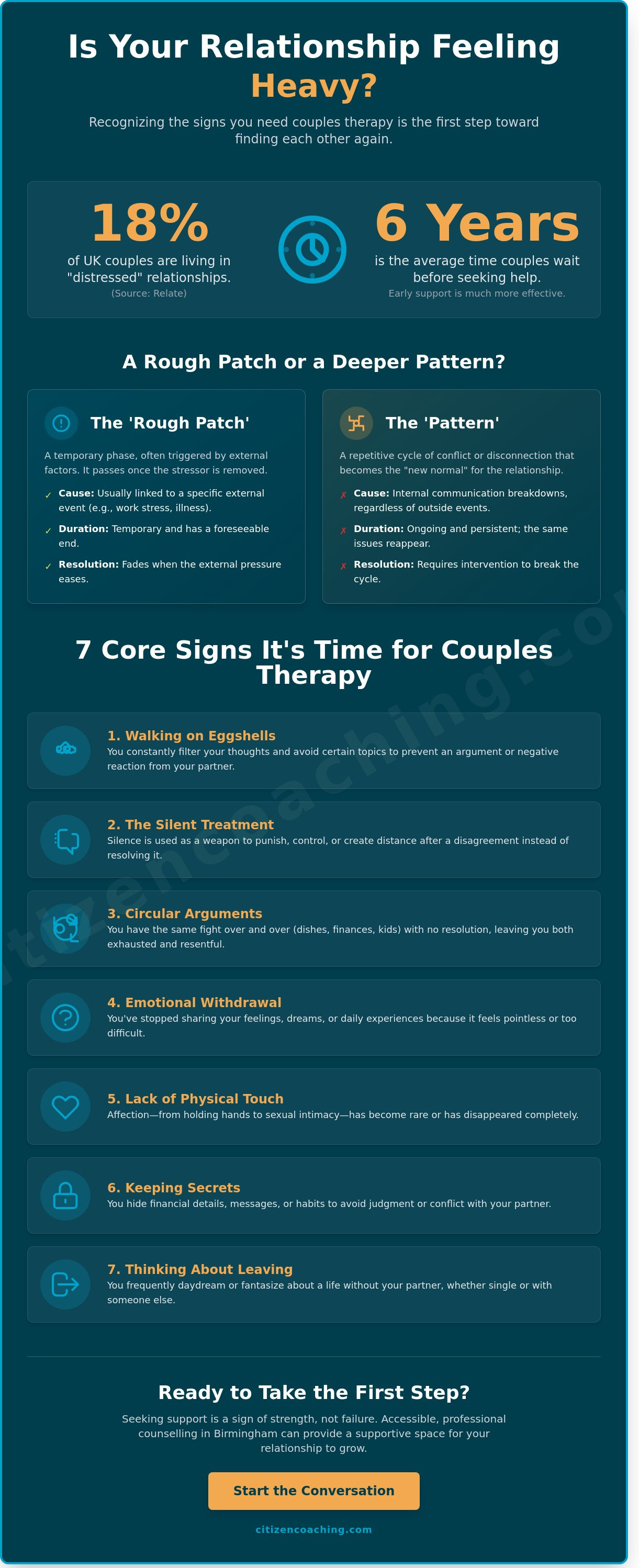
Have you ever spent an entire evening sitting on the sofa next to your partner, yet felt more alone than if you were in the house by yourself? It's a heavy feeling that many people across the West Midlands experience, especially when the home becomes a place of silence or tension. You aren't alone in this struggle. Recent data from the charity Relate suggests that 18% of UK couples are living in "distressed" relationships. Recognising the signs you need couples therapy isn't a sign of failure; it's often the first step toward finding each other again.
We know that admitting things aren't right is difficult. It's exhausting to feel like you're walking on eggshells or trapped in repetitive arguments that never reach a resolution. In this guide, we'll help you discover the subtle and obvious red flags that indicate your relationship could benefit from professional guidance here in Birmingham. We'll look at how to break the cycle of conflict and bridge the emotional distance that's grown between you, so you can move forward with clarity.
Key Takeaways
Understand why feeling "heavy" in your Birmingham relationship is a common challenge and why seeking support is a sign of strength, not failure.
Identify the seven observable signs you need couples therapy using our jargon-free checklist to help you decide if it is time for professional guidance.
Learn to distinguish between healthy conflict and chronic anger to ensure your disagreements are productive rather than destructive.
Discover practical ways to approach the "we need to talk" conversation with your partner using the right timing, setting, and tone.
Explore how accessible, local counselling in Birmingham provides a supportive space for your relationship to grow through simple, honest conversation.
Table of Contents
Recognising the Shift: When Your Birmingham Relationship Feels Heavy
7 Core Signs You Need Couples Therapy: A Relationship Checklist
Accessible Couples Counselling in Birmingham: The Citizen Way
Recognising the Shift: When Your Birmingham Relationship Feels Heavy
Relationships in the West Midlands face pressures that are unique to our part of the world. Whether you are balancing a high-pressure career in Birmingham city centre with family expectations in the suburbs or managing the rising cost of living, life can feel intense. If your partnership has started to feel "heavy," you are not alone. Many couples worry that seeking support is a sign of failure. At Citizen Coaching and Counselling, we see it differently. Choosing to talk to a professional is a sign of strength and a clear commitment to your future together. Often, these heavy feelings come from patterns that are hard to see when you are in the middle of them. Understanding What is couples therapy? can help you see it as a practical tool for growth rather than a last resort.
Our approach is friendly, professional, and grounded in the local community. We don't use complex jargon or cold clinical terms. Instead, we act as a guide to help you find your way back to each other. Taking the first step can feel daunting, but it is the most important move you can make for your mental well-being.
The Difference Between a 'Rough Patch' and a Pattern
A rough patch is usually a temporary reaction to something happening outside the relationship. This might be a stressful new project at work or a period of illness. These stages usually pass once the external stress fades. A pattern is different. It is a recurring cycle that occurs regardless of what is happening in the world. If you find yourselves having the same argument every week for 4 months, you are likely stuck in a pattern. One of the primary signs you need couples therapy is when these cycles become your "new normal." You should look at the frequency of your arguments. If you are unhappy more often than you are happy, it is time to seek support.
Why Birmingham Couples Often Wait Too Long
Many people in our city still feel they should maintain a "stiff upper lip." There is often a fear that friends or family might judge them if they admit things aren't perfect. Local stressors can also mask the real issues. You might blame your mood on the 50-minute daily commute or financial pressures. While these are real challenges, they often hide deeper communication breakdowns. Research shows that couples wait an average of 6 years after problems start before seeking help. By then, they are often in "crisis management" mode. Early intervention is much more effective. It allows you to address the signs you need couples therapy before the damage becomes harder to repair. We are here to help you move from a state of uncertainty toward a clear path forward.
7 Core Signs You Need Couples Therapy: A Relationship Checklist
Deciding to seek support is a brave move. It's often the most difficult part of the process. You might feel that your problems aren't "bad enough" yet, but you don't need to tick every single box on this list to justify asking for a guide. If even one of these patterns feels familiar in your Birmingham home, it could be the right time to reach out. Professional support helps you find your way back to each other before small cracks become deep divides.
Walking on eggshells: You constantly filter your thoughts to avoid an argument.
The silent treatment: Using silence as a way to punish or distance yourself from your partner.
Circular arguments: You fight about the same things, like the dishes or the school run, without ever finding a solution.
Emotional withdrawal: You've stopped sharing your day or your feelings because it feels like too much effort.
Lack of physical touch: This includes everything from holding hands while walking through the Bullring to sexual intimacy.
Keeping secrets: Hiding bank statements, messages, or habits to avoid conflict.
Thinking about leaving: Frequently imagining a life where you are single or with someone else.
Recognising these signs you might need couples therapy is a practical way to assess the health of your partnership. It's about looking at your daily life and being honest about what you see.
Communication Breakdown and the 'Eggshell' Effect
Communication breakdown occurs when the speaker's intent is consistently lost on the listener. This often leads to the 'eggshell' effect. You might find yourself rehearsing what you want to say while stuck in traffic on the A38, only to stay silent when you get home. You're monitoring every word to avoid an explosion or a cold shoulder. The silent treatment is another red flag. It's a form of emotional withdrawal that leaves both people feeling isolated. Our team can help you break these cycles and speak freely again.
The 'Housemate Syndrome' and Loss of Intimacy
Many couples find themselves becoming 'functional housemates'. Your conversations revolve around bills, the weekly shop, or who is picking up the kids from school. You've become a great logistics team, but you've lost the romantic connection. This loss of intimacy isn't just about sex; it's about feeling known and valued. Growing apart is usually just a lack of intentional 'growing together'. If you feel like you're living parallel lives, we can provide the support you need to reconnect. Taking that first step to talk to a professional can help you shift from being mere co-parents or housemates back to being a couple.
Healthy Conflict vs. Chronic Anger: Knowing the Difference
Every couple argues. It's a natural part of sharing a life together. However, how you handle those disagreements is one of the most reliable signs that you need couples therapy. At Citizen Coaching, we have spent years helping people navigate the complexities of anger within their relationships. We often find that anger is actually a secondary emotion. It acts as a protective layer, hiding more vulnerable feelings like fear, rejection, or deep-seated hurt. When you don't have the tools for emotional regulation, those hidden feelings often come out as a shout instead of a conversation.
Our role is to act as a guide, helping you and your partner look beneath the surface of your rows. We help you move away from a cycle of blame and toward a place of understanding. Learning to manage your own emotional responses is a practical skill that can change the entire atmosphere of your home. It's about moving from a state of constant high alert to a place of calm competence.
When Disagreements Turn into Hostility
There is a massive difference between "fighting fair" to solve a problem and "fighting to hurt" to win a point. You can recognise that your arguments have become toxic if they include any of the following behaviours:
Using name-calling or insults to belittle your partner.
Dredging up mistakes from five or ten years ago to "win" the current debate.
Launching personal attacks on your partner's character rather than discussing their actions.
Research from the Gottman Institute identifies contempt as the number one predictor of relationship failure. In fact, their studies show that contempt can predict divorce with 90% accuracy. Contempt is more than just being annoyed; it's a mix of anger and disgust that makes your partner feel worthless. If this has become your "normal," individual anger management coaching can often support the work we do in couples therapy. It gives you a private space to build better self-control and communication habits.
The Impact of Unresolved Resentment
Not all relationship damage is loud. Sometimes, the most dangerous anger is the kind that stays quiet. "Swallowing" your feelings to avoid a row might seem helpful in the short term, but it leads to a slow-burning resentment that poisons your connection. This unresolved tension doesn't just stay in your head; it takes a physical toll on your body. A study published in the Journal of the American Medical Association found that individuals in high-strain relationships had a 34% higher risk of a heart attack compared to those in supportive ones.
Chronic stress from a struggling relationship can lead to high blood pressure, poor sleep, and a weakened immune system. Seeking support is one of the clearest signs you need couples therapy because it shows you're ready to stop the cycle. Therapy provides a safe harbour for both of you. It's a neutral space where you can air your grievances without the ship sinking. We help you unpack that resentment and find a way back to being a team, ensuring that your home feels like a place of rest rather than a battlefield.
Taking the First Step: How to Start the Conversation
"We need to talk." These four words often feel like a heavy weight. For most couples, this sentence triggers a "fight or flight" response. You might have noticed several signs you need couples therapy, but bringing it up feels like opening a door you can't close. It's helpful to remember that this isn't a confession of failure. It's an investment in your future. The goal isn't to point fingers or list mistakes. It's about building a bridge back to the person you love.
Timing is everything. Don't start this conversation five minutes before you leave for work or right before bed when you're both exhausted. Avoid bringing it up in the middle of a row. Choose a neutral time when you're both relatively calm. A walk in the park or a quiet Sunday morning at home works best. Keep your tone soft and your body language open. Focus on "I" statements rather than "you" statements. When you say "I feel like we've lost our spark," it's an invitation. When you say, "You never make an effort," it's an attack.
A Jargon-Free Script for Couples
Starting the chat doesn't require a degree in psychology. You don't need fancy words or clinical terms. Try one of these simple, honest openings:
"I really miss how we used to laugh together, and I'd love some help getting back to that place."
"I've been feeling a bit disconnected lately, and I think talking to someone professional could help us find our way back."
"I value our relationship so much that I want to make sure we're doing everything we can to keep it healthy."
You can even suggest looking at the Citizen Coaching website together. It's a friendly, local way to see that support is just a normal, practical tool for your life together. This helps demystify the process and makes it feel less like a medical intervention and more like a positive step forward.
Dealing with a Reluctant Partner
It's common for one person to feel sceptical. They might worry that a counsellor will "side" with you or that they'll be ganged up on. Remind them that a professional therapist is a neutral guide. They aren't there to judge who is right or wrong. They are there to support the relationship itself.
If your partner is hesitant, suggest trying just one session. Many couples find that even a single introductory session can provide a clear roadmap for change. It isn't a lifelong commitment from day one. It's just a chance to see if the fit is right. If you've been spotting the signs you need couples therapy, taking this small step can lower the pressure and show your partner that the process is about support, not blame.
Ready to find your way back to each other? Book a friendly chat with our team today.
Accessible Couples Counselling in Birmingham: The Citizen Way
Citizen Coaching and Counselling operates as a dedicated Birmingham social enterprise. We provide a space where you can talk openly without fear of judgment. When you recognise the signs you need couples therapy, the prospect of sitting in a clinical room can feel daunting. We change that through our jargon-free promise. Therapy with us feels like a natural conversation between adults. It is not a medical exam or a test you have to pass. Our practitioners use everyday language to help you understand your relationship dynamics more clearly.
Our Birmingham location is designed for your convenience. We understand that local couples lead busy lives. Being situated in the city centre means you can access support without a long, stressful commute. We treat the first session as a simple check-in. This allows you to meet your counsellor and decide if the fit feels right before you make any long-term commitment. It is a low-pressure way to see if our counselling style works for both of you.
Why a Social Enterprise Model Matters
Choosing a social enterprise means your journey toward a healthier relationship also supports your neighbours. All our profits are reinvested back into Birmingham's mental health services. This community-focused approach removes the cold, clinical atmosphere found in many private practices. You receive support from professional, qualified practitioners in a friendly, relaxed environment. We believe that high-quality care should be accessible to everyone in our city. Our model ensures that we focus on your progress and well-being above all else.
Your Path Forward Starts with a Single Step
Taking that first step is the hardest part of the process. We see this every day, and we are here to guide you through the uncertainty. You don't have to figure everything out on your own. While we specialise in helping pairs who have noticed the signs you need couples therapy, we also provide a wide range of other services to support your family's mental health. These include:
Professional anger coaching for individuals
Dedicated counselling for young people
Support groups for various mental health needs
One-to-one personal development sessions
Don't wait for a crisis to seek help. If things feel difficult, reaching out early can make a world of difference. Contact us today to book an initial chat. This informal meeting is the best way to explore your options and see how we can help you build a stronger, happier future together.
Moving Forward Toward a Brighter Future
Recognising the signs you need couples therapy is an act of strength, not a sign of failure. Whether you're dealing with chronic anger that feels impossible to resolve or a quiet distance that's grown between you, acknowledging the shift in your relationship is the first move toward healing. Understanding the difference between healthy conflict and a cycle of resentment allows you to approach the situation with clarity. You've seen the checklist and identified the patterns; now it's time to decide how you want to move forward together.
Since 2005, Citizen Coaching and Counselling has served as a Social Enterprise (CIC) committed to supporting the Birmingham community. We believe that professional guidance should be accessible and entirely jargon-free. Our team focuses on providing a safe, non-judgmental space where you can speak openly and find practical ways to rebuild your connection. We're here to guide you through the process with calm competence and local expertise.
Take the first step and book a friendly, confidential chat with our Birmingham team today. You deserve a relationship that feels light and supportive again, and we're ready to help you find that path.
Frequently Asked Questions
How do I know if it's too late for couples therapy?
It's rarely too late to start if both partners are willing to try. Research from the Gottman Institute shows that couples wait an average of 6 years before seeking help for their relationship problems. Even if you feel a deep sense of resentment, therapy provides a safe space to decide whether to rebuild your connection or separate in a healthy way. If you're still looking for signs you need couples therapy, there's usually a spark of hope that's worth exploring with a professional guide.
What happens in the first session of relationship counselling in Birmingham?
Your first session at our Birmingham centre is a relaxed conversation focused on getting to know you both. Your counsellor will ask about your history, the main challenges you're facing, and what you hope to achieve from the process. We don't use complex jargon; instead, we focus on making you feel comfortable and heard. By the end of the hour, we'll help you set clear goals, so you know exactly what to expect from our future meetings.
How much does couples therapy cost at Citizen Coaching?
Our fees are designed to be transparent and reflect our commitment to providing accessible support in the West Midlands. We don't list a single fixed price because the type of support needed varies from couple to couple. We discuss all costs openly during your initial enquiry, so there are no surprises later. You can contact our friendly team for a current price list and to find a session time that fits your budget and schedule.
Can we come to therapy if only one of us is 'the problem'?
Yes, because relationship issues are almost always about the dynamic between two people rather than one person's mistakes. We don't use labels like "the problem" or take sides during our sessions. Our role is to look at the patterns you've both fallen into and help you understand how you react to one another. By focusing on the relationship as a whole, we guide you both toward healthier ways to communicate and support each other.
How long does couples therapy usually take to see results?
Most couples begin to notice positive changes in their communication after 6 to 8 sessions. The total length of your journey depends on your specific situation and the depth of the issues. Some people find the clarity they need within 3 months, while others prefer long-term support to maintain their progress. We'll regularly review your goals together to ensure the sessions remain a practical and useful tool for your personal development.
Is couples therapy confidential?
Yes, everything you discuss with your counsellor is kept strictly confidential within the limits of UK law. We follow the professional ethical frameworks set out by the British Association for Counselling and Psychotherapy (BACP) to protect your privacy. This means your personal details and the content of your talks aren't shared with anyone else without your permission. We create a secure environment where you can be honest without fear that your business will be shared with others.
What if my partner refuses to come to counselling with me?
You can still attend sessions on your own to work on your part of the relationship. When one person changes their behaviour and reactions, it often causes a positive shift in the entire relationship dynamic. We can help you explore the signs you need couples therapy and develop your own strategies for managing conflict. If your partner sees the benefits you're gaining from the support, they may feel more comfortable joining you for a session later on.
Do we have to be married to attend couples therapy?
No, our service is open to all couples regardless of whether you're married, cohabiting, or in a long-term partnership. We support people from all backgrounds, genders, and sexual orientations. Whether you've been together for 18 months or 20 years, our goal is to help you build a stronger foundation. We welcome anyone who wants professional guidance to improve their connection and move past the hurdles they're facing.


