
Signs of Anger Issues: A Checklist for Birmingham Residents
You’re sitting in stationary traffic on the A38, your hands are gripping the steering wheel so tight your knuckles are white, and you can feel that familiar, hot pressure building in your chest again. It isn't just the commute that's the problem. You might be worried that your temper is starting to strain your relationship with your partner or children, or perhaps you're quietly terrified that one more outburst at work will cost you your position in Birmingham city centre. Living in a state of constant tension is physically exhausting, and it can make you feel like you're a bad person, even when you're just someone who is struggling to cope.
We know that feeling this way is incredibly isolating, but you aren't alone. With roughly 10 percent of people reporting trouble managing their temper at some point, it's a challenge many of your neighbours face. Our goal is to help you understand what's happening so you can move forward. In this guide, we provide a clear, jargon-free checklist to help you identify the common signs of anger issues through your physical, emotional, and behavioural patterns. You'll also discover how to access friendly, professional support right here in Birmingham to help you find a calmer path forward.
Key Takeaways
- Understand the difference between natural frustration and the "tipping point" where your emotions start making decisions for you.
- Recognise the physical "early warning system" and signs of anger issues your body sends out before an outburst occurs.
- Uncover the hidden ways anger affects your Birmingham life, from subtle passive-aggression to tension in the local workplace.
- Learn how to access professional, jargon-free coaching in Birmingham to help you navigate your journey toward a calmer future.
Is It Just Frustration? Understanding the Signs of Anger Issues
Anger is a natural human emotion. It's a survival mechanism that helps us react to threats or unfair treatment. However, there is a clear line between feeling annoyed and experiencing Understanding the Signs of Anger Issues that impact your quality of life. When anger moves from being a temporary feeling to a constant state of being, it becomes problematic. You might notice that your reactions no longer match the situation at hand. This is often the tipping point where anger begins to control your decisions; rather than you controlling your emotions.
Recognizing the signs of anger issues is the most difficult part of the journey. It requires a high level of self-honesty to admit that things have become unmanageable. Many people we support in Birmingham find that once they acknowledge the problem, the weight begins to lift. You aren't alone in this. Taking that first step to understand your feelings is a sign of strength, not weakness. We're here to guide you through that process with a friendly, professional approach.
Healthy Anger vs. Problematic Anger
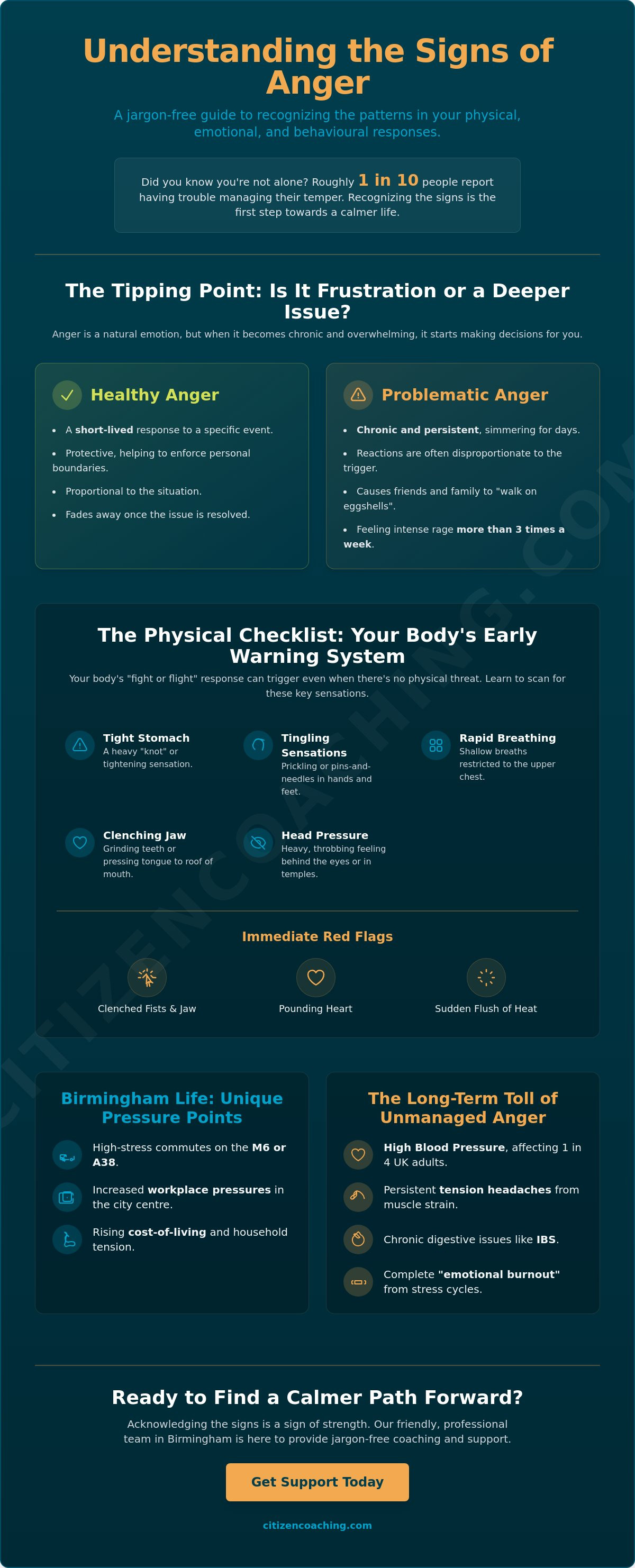
Healthy anger is a protective, short-lived response to a specific injustice or boundary violation. It serves a purpose and then fades away once the issue is resolved. In contrast, problematic anger is chronic. It lingers long after a situation has passed, often simmering under the surface for days. You can use a frequency filter to check your own patterns. If you feel intense rage more than three times a week, or if friends have started walking on eggshells around you, it may be time to seek support.
Why Birmingham Residents May Feel the Pressure
Life in a major city like Birmingham brings unique challenges that test our internal emotional regulation. The daily commute on the M6 or the A38 can easily add 60 minutes of high-stress environment to your day. This isn't just about traffic; it's about the cumulative effect of noise and delays on your nervous system. Workplace pressures in the city center also play a role, as the local economy shifts and demands more from employees.
The cost-of-living crisis is another significant factor. With UK food prices and energy costs rising significantly since 2022, local household tension is at an all-time high. These external factors don't cause anger issues on their own, but they act as catalysts. They drain your emotional reserves, making it harder to stay calm when small things go wrong. Recognizing these triggers is a vital part of learning to manage the signs of anger issues effectively.
The Physical Checklist: How Your Body Signals an Anger Problem
Your body often knows you're becoming angry before your mind has a chance to process the feeling. Think of it as a built-in early warning system. Even when you aren't facing a physical threat, your brain can trigger a "fight or flight" response. This happens because the brain doesn't always distinguish between a physical attack and a stressful work meeting in Birmingham city centre. Your system floods with adrenaline, preparing you for a battle that isn't actually happening. Learning to "scan" your body during family discussions or office hours is a vital skill. It helps you catch the signs of anger issues before they escalate into an outburst.
Try to monitor these five key physical sensations daily to stay ahead of your emotions:
- A "knot" or heavy tightening sensation in your stomach.
- Prickling or tingling feelings in your hands and feet.
- Shallow, rapid breathing that feels restricted in your upper chest.
- Grinding your teeth or pressing your tongue hard against the roof of your mouth.
- A heavy, throbbing pressure behind your eyes or in your temples.
Immediate Physical Red Flags
Some physical signals happen almost instantly. You might find your fists or jaw clenching without you even realizing it. Your heart might start pounding against your ribs, making it hard to focus on what the other person is saying. Many people also describe a sudden "flush" of heat rising up their neck and face, while others might break into a cold sweat. These are clear signs that your nervous system is moving into an overwhelmed state.
Long-Term Health Impacts of Unmanaged Anger
Ignoring these physical signals leads to lasting damage over time. Chronic anger keeps your body in a state of high alert, which is directly linked to high blood pressure. This is a serious concern, as high blood pressure affects roughly 1 in 4 adults in the UK. Constant muscle tension also leads to persistent tension headaches and digestive issues like IBS.
Eventually, the cycle of high-stress episodes leads to "emotional burnout." You might feel completely exhausted, even after a full night's sleep. Understanding The Hidden Signs: Passive and Inward Anger can help you spot these patterns before they become a health crisis. If you recognise these signs of anger issues in your own life, our team can guide you toward more effective ways to manage these physical triggers and regain your sense of calm.
Behavioural Signs: How Anger Disrupts Your Birmingham Life
Anger is rarely just a quiet, internal feeling. For many people in Birmingham, it manifests as physical actions that ripple through their professional and personal lives. You might notice a cycle that feels impossible to break: an outburst occurs, followed by a wave of deep regret, only for the same pattern to repeat a few days later. This "regret and repeat" cycle is one of the most common signs of anger issues we see in our local community.
When these reactions start to dictate how you move through your day, it is a clear indication that your emotions are in the driver's seat. Recognising these behaviours is the first step toward regaining control. It isn't about being a "bad person," it's about identifying signs that it may be becoming a problem for your health and your future.
Social and Professional Red Flags
The workplace is often where behavioural anger first becomes visible. Whether you are working in a busy office on Colmore Row or on a large industrial site in Washwood Heath, the pressure can be intense. According to the Health and Safety Executive 2023 report, work-related stress and conflict account for a significant portion of lost working days in the UK. You might recognise these red flags:
- Frequent Workplace Friction: You find yourself in constant "debates" with managers or colleagues that leave everyone feeling tense.
- Weaponised Communication: You rely on heavy sarcasm or biting remarks to make your point, often disguised as "just a joke."
- Social Withdrawal: You start declining invitations to social hubs like Brindleyplace because you don't trust yourself to stay calm or you simply "aren’t in the mood" for people.
Impact on Relationships and Family
At home, the signs of anger issues often create a heavy atmosphere that affects everyone under your roof. Family members might start "walking on eggshells," a phrase used to describe how loved ones carefully monitor your mood to avoid triggering an explosion. This creates a barrier to genuine connection and leaves your partner or children feeling unsafe in their own space.
This disruption often shows up in small, everyday moments. You might find yourself shouting at the kids over a minor mishap, like a spilled drink or a messy bedroom, with a level of intensity that doesn't match the situation. Alternatively, you might use the "silent treatment" or sulking as a way to punish others. These behaviours don't just solve the problem; they build walls between you and the people who matter most. Recognising that these reactions are disproportionate is a vital part of the journey toward a calmer Birmingham life.
The Hidden Signs: Passive and Inward Anger
Most people think of anger as shouting, slamming doors, or aggressive confrontations. It's often much quieter than that. In Birmingham, many of the clients we guide through our programmes don't recognise their own signs of anger issues because they aren't "exploding." Anger can be a slow leak rather than a burst pipe. When you suppress these feelings, they don't just vanish. They transform into patterns that can be just as damaging to your life and relationships.
Identifying Passive-Aggressive Patterns
Passive-aggression is a way to express frustration without taking the risk of a direct conversation. It's a "sideways" anger that erodes trust over time. You might find yourself deliberately "forgetting" to do a task your partner or colleague asked for. This is often a subconscious way to reclaim power in a situation where you feel unheard. Using words like "fine" or "whatever" to shut down a conversation is another common sign. These subtle digs and backhanded compliments in social settings might feel like small wins, but they create a wall between you and the people you care about.
When Anger Turns Inward
Sometimes anger doesn't go out toward others; it turns back on you. This is often called inward anger. You might notice a constant stream of negative self-talk or find yourself "punishing" yourself for minor mistakes. Some people deny themselves things they enjoy, like a night out or a favourite meal, because they feel they don't deserve them. This suppression is physically and mentally exhausting. Statistics from UK mental health surveys suggest that nearly 25% of adults experience a mental health problem each year, and suppressed anger is a frequent contributor to sudden, intense bouts of anxiety.
The following checklist is for those who tend to "bottle things up." If you identify with these points, you may be dealing with hidden signs of anger issues:
- You stay silent to keep the peace but feel a deep sense of resentment afterward.
- You feel physically tense, with a tight chest or clenched jaw, even when you're not speaking.
- Small, unrelated inconveniences trigger a massive emotional reaction that feels out of proportion.
- You struggle to remember the last time you felt truly relaxed or at ease.
- You feel like a "pressure cooker" just waiting for the final straw.
If you recognise these patterns in yourself, taking the first step to talk about them is a sign of strength. You can find support with our professional coaches who understand how to guide you through these feelings in a safe, non-judgmental way.
Next Steps: Finding Anger Management Support in Birmingham
Recognizing the signs of anger issues is a brave move. It is often the most difficult hurdle to clear. If you found yourself nodding along to the points in our checklist, it's time to remember that help is right here in your city. You aren't alone in this journey. At Citizen Coaching, we specialize in jargon-free support that cuts through the noise. We don't use complex medical terms that leave you feeling more confused. Instead, we offer practical, human-to-human guidance designed to help you regain control.
Why Choose Local Birmingham Support?
There is a unique benefit to working with a coach who understands the local culture and the specific pressures of West Midlands life. Birmingham is a vibrant city, but it comes with its own set of stressors. From the busy atmosphere of the Bullring to the daily grind on the A38, we know what life is like here because we live here too. Our team is part of the community, which makes our coaching feel like a conversation rather than a clinical trial.
We've structured our services to be as accessible as possible for everyone. You can visit us for face-to-face sessions in the city centre or join one of our online courses if you prefer the comfort of your own home. Because we're a social enterprise, choosing us means you're also helping your neighbours. We reinvest our profits directly into Birmingham mental health initiatives, ensuring the city stays resilient and supported.
How to Get Started Today
Taking action doesn't have to be a daunting process. We offer two main paths to help you manage the signs of anger issues effectively:
- 1-to-1 Coaching: This provides a private, confidential space to dig deep into your specific triggers and create a personalized plan.
- Group Sessions: These are excellent for breaking the isolation that often comes with anger. You'll meet others who truly understand your experience in a supportive, non-judgmental environment.
We've worked hard to remove the red tape. You don't need a doctor's note, a referral from a GP, or a formal medical diagnosis to see us. If you feel your anger is impacting your relationships or your work, that's the only reason you need to reach out. Use the checklist from this article as your starting point. It's a great tool to help you explain what you're going through during your first chat with us. When you're ready, the first step is a simple assessment to find the right path for your needs.
Book your initial anger management assessment in Birmingham.
Start Your Journey Toward a Calmer Future
Recognising the signs of anger issues is the first step toward a calmer life. Whether you've noticed physical tension or felt your relationships in Birmingham starting to strain, you don't have to manage these feelings alone. Since we were founded in 2005, our team has provided over 20 years of local experience to help residents understand their triggers. As a Community Interest Company (CIC), we focus on providing jargon-free support that fits your daily reality.
We offer specialist 1-to-1 sessions and group programmes tailored to your specific situation. You deserve a path forward that feels manageable, friendly, and professional. Our team acts as a guide to help you move past the frustration and find balance. It's natural to feel a bit nervous when reaching out; taking that initial step is the most important part of the process. We are here to support you every step of the way.
Take the first step and book your Birmingham anger management assessment today
Frequently Asked Questions
How do I know if my anger is "normal" or an actual issue?
Anger is a healthy emotion, but it becomes a problem when it feels out of control or happens too frequently. Common signs of anger issues include feeling physically explosive, regret after an outburst, or experiencing intense rage more than 3 times a week. If your reactions are starting to damage your relationships or work life in Birmingham, it’s a clear signal that you might need a bit of extra support to manage your feelings.
Can anger issues be a sign of another mental health condition?
Yes, anger is often a "secondary" emotion that hides other underlying feelings. Research from Mind suggests that 1 in 4 people in the UK experience a mental health problem each year, and anger can be a symptom of depression, anxiety, or high stress. Instead of just looking at the anger itself, we look at what’s happening underneath. This helps you understand why your fuse is short and gives you the tools to stay calm.
Do I need a GP referral for anger management in Birmingham?
You don't need a GP referral to start anger management with us in Birmingham. Many of our clients choose to self-refer to avoid the 18 week waiting lists often found in NHS secondary care services. You can simply book an initial assessment directly through our website. This means you can get the help you need quickly, often within a few days, rather than waiting months for a doctor's appointment and subsequent processing.
What is the difference between anger coaching and traditional counselling?
Anger coaching focuses on practical tools and "how-to" strategies for the future, while traditional counselling often looks back at your past experiences to find the root cause. Coaching is usually more structured and goal-oriented. We find that a blend of both works best for most people. You get the immediate techniques to stop an outburst today, along with the deeper understanding to prevent them from happening in the long term.
How long does it usually take to see progress in managing my anger?
Most people start to notice a real difference in their reactions after 6 to 10 sessions. While everyone is different, the first 3 sessions usually focus on identifying your triggers and learning basic de-escalation techniques. It’s not about a quick fix, but about building new habits that last. We guide you through each step, making sure you feel more in control of your responses as each week passes.
Is anger management confidential if my employer is worried?
Your sessions are completely confidential, and we don't share your information with your employer without your written consent. We follow the British Association for Counselling and Psychotherapy (BACP) ethical framework, which protects your privacy. Even if your workplace is paying for the sessions or has suggested you attend, what you say in the room stays between you and your coach. We provide a safe space where you can be honest.
Can I attend anger management sessions online if I can’t get to Birmingham city centre?
You can absolutely attend your sessions online via video call if you can't make it to our Birmingham city centre office. Since 2020, we've delivered over 5,000 hours of remote support to people across the West Midlands. It's just as effective as face-to-face coaching and saves you the travel time. All you need is a private space and a stable internet connection to start your journey toward a calmer life.


