
My Partner Has Anger Issues: UK Guide on What to Do
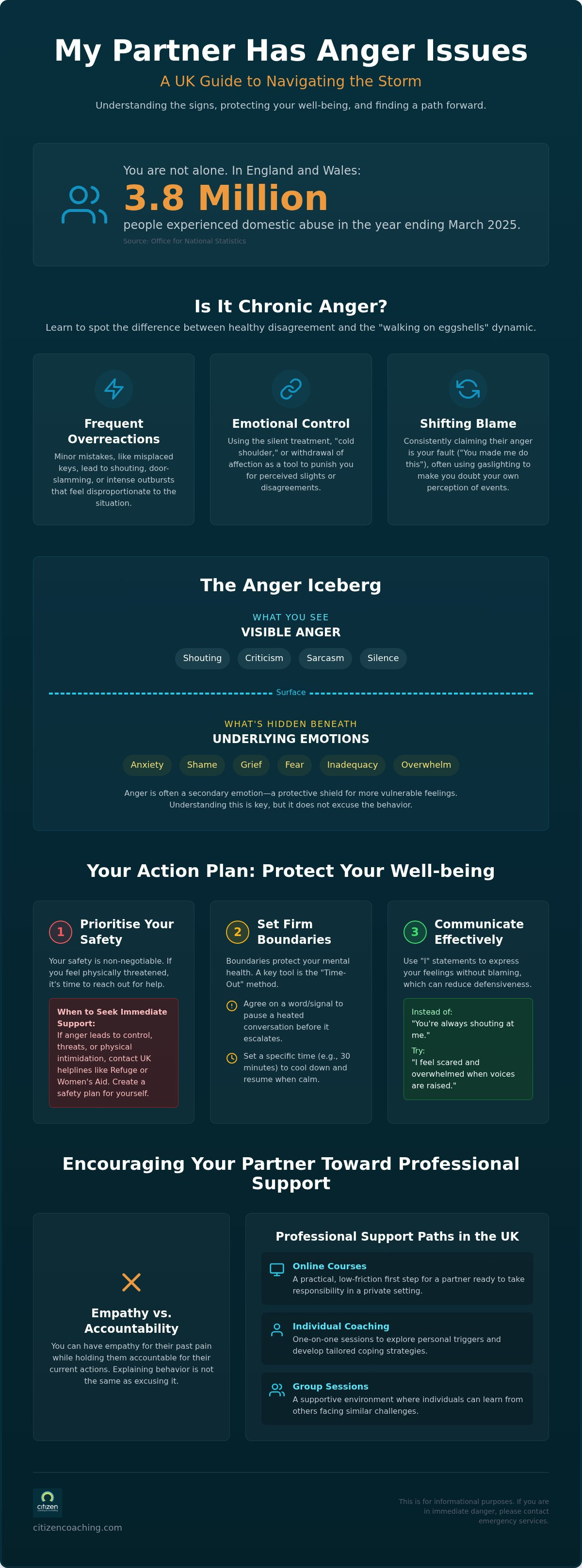
What if the person you love most has become the person you fear upsetting the most? You might spend your evenings scanning their face for signs of a storm or carefully rehearsing your words to avoid a blow-up. If you are constantly asking yourself, "my partner has anger issues what do i do uk," please know that you aren't alone. According to the Office for National Statistics, an estimated 3.8 million people in England and Wales experienced domestic abuse in the year ending March 2025. It's exhausting to live in a state of high alert, and while it's natural to feel responsible for keeping the peace, you deserve to feel safe in your own home.
We understand how heavy this burden feels, and we are here to offer a supportive path forward. This guide will show you how to protect your well-being by setting healthy boundaries and recognizing the signs of chronic anger. You'll also discover practical UK support options, from online coaching to group sessions, designed to help you and your partner build a calmer, more stable life together.
Key Takeaways
- Learn to spot the difference between healthy disagreements and the "walking on eggshells" dynamic that signals a deeper issue.
- Understand the "Anger Iceberg" and how hidden emotions like anxiety or shame often drive your partner's reactions.
- Get clear answers to the question, "my partner has anger issues what do i do uk," including how to set safe boundaries and use the "Time-Out" method.
- Discover how to use "I" statements to communicate your feelings effectively without triggering further defensiveness.
- Explore professional support paths in the UK, ranging from local Birmingham coaching to accessible online courses for your partner.
Recognising Anger Issues and Prioritising Your Safety
Living with a partner who reacts with intensity to small things is emotionally draining. You might find yourself constantly monitoring their mood or choosing your words with extreme care. If you are regularly asking, "my partner has anger issues what do i do uk," it's vital to distinguish between normal frustration and chronic patterns. Healthy anger is a brief response to a specific problem. Chronic anger, however, is a recurring cycle that leaves you feeling small, blamed, or afraid. You aren't responsible for "fixing" their triggers or managing their emotional state for them.
The "walking on eggshells" dynamic is a clear sign that the balance in your relationship has shifted. When you spend more energy avoiding an outburst than enjoying your partner's company, the environment has become toxic. Anger management techniques can help individuals regain control, but the first priority is always your own safety. According to the Office for National Statistics, an estimated 3.8 million people in England and Wales experienced domestic abuse in the year ending March 2025. This shows that while anger is a common struggle, it often overlaps with behaviors that require external support.
Common Signs of Chronic Anger in Relationships
- Frequent overreactions: Minor mistakes, like a late dinner or a misplaced set of keys, lead to shouting or door-slamming.
- Emotional control: They use long periods of silence or "the cold shoulder" to punish you for perceived slights.
- Shifting blame: They claim their anger is your fault, often using gaslighting to make you doubt your own memory of events.
When to Seek Immediate UK Support
If you feel physically threatened, it's time to reach out to national domestic abuse helplines like Refuge or Women’s Aid. You don't have to wait for physical violence to occur before creating a safety plan. This plan might include having a bag packed or a safe place to stay if things escalate. Professional intervention becomes mandatory for safety the moment your partner uses their anger to control your movements, choices, or physical well-being. If you are looking for a low-friction way to start a conversation about change, an online anger management course can be a practical first step for a partner ready to take responsibility.
Understanding the Root Causes Without Excusing the Behaviour
Anger isn't a fixed personality trait or a permanent character flaw. It is often a learned coping mechanism, a way of responding to pain that likely started long before you entered the picture. When you find yourself searching for "my partner has anger issues what do i do uk," it helps to understand the "Anger Iceberg." While the shouting or coldness is visible on the surface, there is usually a mass of hidden emotions underneath. These can include anxiety, shame, or deep-seated grief. For many, anger feels like a safer, more powerful emotion to express than the vulnerability of being hurt or afraid.
In the UK, modern life adds its own layer of pressure. The ongoing cost of living crisis and intense workplace demands can push someone's emotional regulation to its limit. If your partner never learned healthy communication skills in childhood, they might use anger as their only tool for dealing with these stressors. While these factors explain the outbursts, they do not excuse them. Understanding the root cause is about finding a path to growth, not giving them a pass to treat you poorly.
Anger as a Secondary Emotion
Many people find it much easier to feel angry than to admit they feel inadequate or overwhelmed. In our work at Counselling Anger Management Birmingham Citizen Coaching, we often find that when a person identifies their "primary" emotion, the need for anger begins to fade. It's a shift from reacting to reflecting. If your partner can learn to say, "I'm actually feeling very anxious about our finances," instead of slamming a door, the entire dynamic of your home changes.
Accountability vs. Empathy
You can have empathy for your partner's past trauma while still holding them accountable for their current actions. Validating their feelings is helpful, but "explaining away" the behaviour often prevents them from seeking the professional help they need. Balancing support with firm boundaries is essential. You might find advice for partners from Mind useful for maintaining your own perspective while they do the work. Whether they choose Individual vs. Group Anger Management, the goal is to replace old habits with practical tools.
If you aren't sure where to start, we are here to help you navigate these first steps. You can always reach out to our team for a confidential chat about the support options available to you.
Practical Steps: Setting Boundaries and Communication
When you are constantly wondering, "my partner has anger issues what do i do uk," the most effective tool at your disposal is the setting of clear, firm boundaries. Boundaries aren't a way to change your partner's personality. They are the rules for how you will be treated. One of the most practical methods is the "Time-Out" strategy. This is a pre-arranged agreement where either person can call a halt to a conversation if it becomes too heated. You don't just walk away; you agree to return and discuss the issue calmly after 20 or 30 minutes. This prevents the escalation into the destructive patterns we identified earlier.
Consistency is the backbone of any boundary. If you state that you will leave the room when voices are raised, you must do it every single time. If you only enforce the rule occasionally, it sends the message that your boundaries are negotiable. By being consistent, you create a safer, more predictable environment for yourself. Finding an answer to the question "my partner has anger issues what do i do uk" often starts with reclaiming your own space and peace of mind.
How to Initiate a Calm Conversation
Timing is everything. Follow the "HALT" rule: never start a difficult conversation if either of you is Hungry, Angry, Lonely, or Tired. These states lower emotional resilience and make outbursts more likely. When you do speak, use "I" statements to reduce defensiveness. Instead of saying, "You always make me feel scared," try, "I feel anxious when the volume is raised, so I am going to step away now." This focuses on the behaviour's impact on you rather than attacking your partner's character.
Protecting Your Own Mental Health
It is easy to fall into the "caretaker trap," where you feel responsible for managing your partner's triggers. You can't do the emotional work for them. Your focus should remain on your own well-being and maintaining a support network of friends, family, or professionals. At Counselling Anger Management Birmingham Citizen Coaching, we provide a safe, jargon-free space to process your experiences. Seeking Private Counselling Birmingham can help you regain your sense of self while your partner works on their own regulation.
Encouraging Your Partner Toward Professional Support in the UK
Suggesting support shouldn't feel like an ultimatum. Focus on the shared goal of a calmer household. If you are asking "my partner has anger issues what do i do uk," knowing the specific pathways for help is the next logical step. By framing the conversation around your desire for a closer connection, you reduce the likelihood of your partner feeling attacked or shamed.
The UK offers several routes for intervention, including GP referrals. According to NHS Talking Therapies data from January 2026, 88.7% of referrals waited less than six weeks to access support. While this is a valuable resource, many people find that structured Anger Management Courses are more effective than general talking therapies. These courses offer practical, jargon-free tools that focus on immediate behavioural change rather than just discussing past problems. This structured approach helps individuals build a "toolbox" of responses for high-stress situations.
Options for Birmingham and UK-Wide Support
For those who prefer the privacy of their own home, an Online Anger Management Course is a low-friction first step. At Counselling Anger Management Birmingham Citizen Coaching, we operate as a social enterprise, meaning our professional help remains accessible and community-focused. In a first session, your partner can expect a warm, non-judgmental environment where they will learn how to identify physical triggers before they escalate. Group environments are also available, which can significantly reduce the isolation often felt by those struggling with emotional regulation.
Moving Forward Together
Once individual progress is being made, you might consider Couples Counselling to address the impact the anger has had on your bond. It's important to wait until the primary anger issues are being managed so that joint sessions remain safe for everyone involved. Celebrating small victories reinforces that recovery is a shared journey. You've already taken the first step by researching "my partner has anger issues what do i do uk," and professional support is ready when you both are.
Taking the First Step Toward a Calmer Future
Choosing to address the cycle of outbursts is a brave move that protects your future well-being. By moving away from the role of a caretaker and focusing on clear communication, you allow room for genuine growth. When you finally address the question, "my partner has anger issues what do i do uk," you are choosing a path that prioritizes safety and mutual respect over constant tension. You've learned that change is possible when boundaries are consistent and professional tools are put into practice.
As a trusted social enterprise operating since 2005, Counselling Anger Management Birmingham Citizen Coaching provides a supportive path forward for families across the country. We maintain BACP-aligned professional standards across all our services, whether you choose our online UK courses or in-person sessions. Our jargon-free approach is designed to lower the barrier to care, making personal development feel like a practical tool rather than a daunting medical process.
You don't have to navigate this journey alone. Our team is ready to guide you and your partner toward a more stable and respectful life together. Reach out when you're ready to begin this new chapter.
Frequently Asked Questions
How do I tell my partner they need anger management without a fight?
When you're trying to figure out my partner has anger issues what do i do uk, start by choosing a calm moment for the talk. Use "I" statements to explain how their outbursts affect you instead of blaming them. You might say, "I value our relationship and want us to feel closer, so I'd like us to look at support options." Suggesting a low-friction online course can feel less daunting than an intervention.
Can a relationship survive anger issues if both partners are committed?
A relationship can definitely survive and even become stronger if the partner struggling with anger takes full responsibility for their behaviour. It requires a commitment to learning new coping skills and a willingness from both sides to be patient. Once the individual work has started, many couples find that specialized counselling helps them rebuild the trust that was damaged by previous outbursts.
What is the difference between a therapist and an anger coach in the UK?
A therapist generally looks at your past to understand general mental health, while an anger coach provides practical, jargon-free tools for the present. Coaching is often more structured and focuses on "how" to change your reactions right now. This goal-oriented approach is ideal for people who want specific techniques to manage their triggers without getting lost in complex medical terminology or long waitlists.
Is my partner's anger my fault if I know I've 'pushed their buttons'?
No, your partner is the only person responsible for how they choose to react to a situation. Even if you have had a disagreement, reacting with chronic anger is a choice and a learned habit. If you are asking my partner has anger issues what do i do uk, it's vital to stop accepting blame for their emotional state. You can't control their triggers, only your own boundaries.
How long does a typical UK anger management programme take to show results?
Many individuals begin to notice a difference in their emotional regulation within six to ten weeks of consistent work. While deep-seated habits take time to replace, structured programmes provide practical tools that can be used immediately. Success depends on how often the person practices their new techniques. Consistent effort usually leads to a much calmer home environment and more respectful communication within a few months.

Article by
Martin Hogg
Counselling and Anger Management in Birmingham. Articles by Martin Hogg, counsellor MBACP (Reg.) and Founder and CEO of Citizen Coaching and Counselling, a social enterprise based in Birmingham, UK. Martin also helps counsellors struggling to set up and grow their Private Practice to gain clarity and confidence in their marketing and systems.
Disclaimer
The information provided on this blog is for general informational purposes only and is not intended to be a substitute for professional medical or mental health advice, diagnosis, or treatment. Reading this content does not create a therapist-client relationship.


