
How to Support Someone with Anger Issues: A Practical 2026 Guide
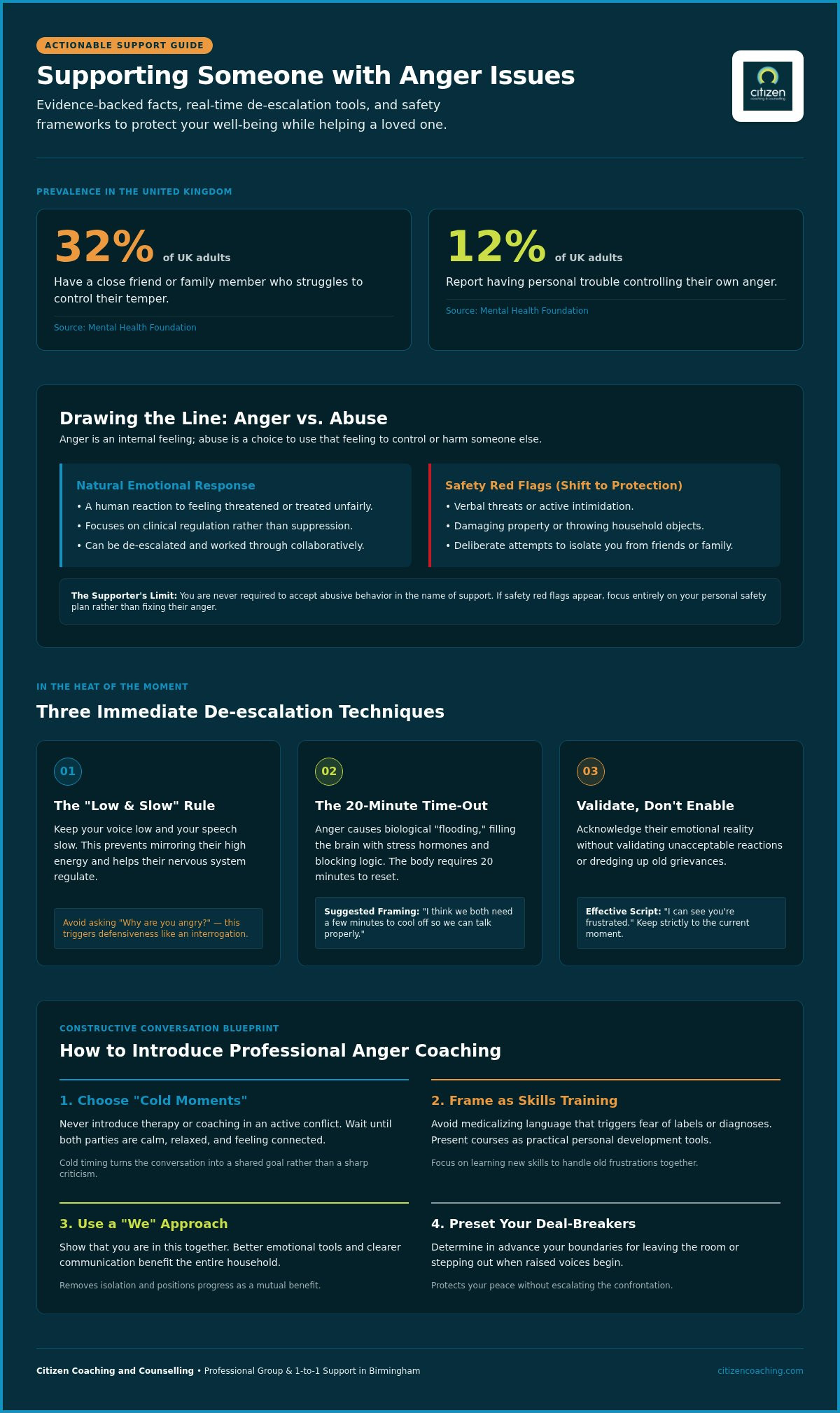
Did you know that 32% of people in the UK have a close friend or family member who struggles to control their temper? According to the Mental Health Foundation, this is a common reality for millions of us. If you want to know how to support someone with anger issues, you're likely tired of walking on eggshells. You might feel responsible for another person's emotions while trying to keep the peace at home. It's exhausting to live in a state of constant alert, fearing the next outburst.
We understand how heavy that burden feels. This guide explains how to help a loved one while protecting your own sense of safety and well-being. We'll show you how to set healthy boundaries, use communication tools that lower the temperature, and find professional coaching options available in Birmingham. You'll learn how to move away from tension and toward a calmer, more supportive environment for your whole family. It's time to find a path forward that works for everyone.
Key Takeaways
- Learn to distinguish between natural frustration and destructive behavior so you can set healthy boundaries that protect your own peace.
- Discover the "Low and Slow" communication technique to understand how to support someone with anger issues during high-stress moments.
- Find out how to use "Cold Moments" to suggest professional support by framing it as practical skills training rather than a medical fix.
- Compare local group and individual coaching options in Birmingham to help your loved one find a supportive environment they feel comfortable in.
Understanding Anger and Setting Healthy Boundaries
Anger is something we all feel. It's a natural human response to feeling threatened or unfairly treated. But it becomes a problem when it's frequent, intense, or leads to destructive behavior. Research from the Mental Health Foundation shows that 12% of UK adults report having trouble controlling their anger. Learning how to support someone with anger issues starts with realizing that your role isn't to fix them or absorb their outbursts. You have a Supporter's Limit. If you find yourself constantly walking on eggshells to avoid a reaction, your own mental health is likely at risk.
Supporting a loved one often involves understanding clinical anger management strategies that focus on regulation rather than suppression. While you can offer encouragement, you are never required to accept abusive behavior in the name of support. It's okay to step back when a situation becomes overwhelming.
The Difference Between Anger and Abuse
It's vital to draw a line here. Anger is an internal feeling. Abuse is a choice to use that feeling to control or harm someone else. Red flags that indicate a need for professional intervention include:
- Verbal threats or intimidation.
- Damaging property or throwing objects.
- Attempts to isolate you from friends or family.
If these behaviors are present, the focus must shift from support to your personal safety.
Establishing Your Own Safety Plan
A safety plan isn't about the other person; it's about you. Decide on your deal-breakers before a conflict starts. If a conversation turns into shouting, your plan might be to leave the room immediately. Knowing how to support someone with anger issues means having a designated "time-out" routine or a safe physical space to de-escalate the environment. You might suggest exploring anger management courses as a way to build these skills in a neutral setting when everyone is calm.
Immediate Strategies for De-escalating Tense Moments
When a situation starts to heat up, your primary goal is to lower the temperature. De-escalation is a tool for safety, not for winning the argument. To understand how to support someone with anger issues, you need to master the "Low and Slow" rule. By keeping your voice low and your speech slow, you prevent yourself from mirroring their high energy. This calm presence can often help the other person regulate their own nervous system and begin to settle down.
It's also helpful to practice active listening. This means acknowledging their feelings without necessarily agreeing with their logic. You might find yourself wanting to ask "why are you angry?" but this is often a trap. Asking "why" can feel like an interrogation and usually makes the situation worse. Instead, stick to observing the current moment. If you're feeling overwhelmed, you can speak with our team about finding a way forward together.
The Power of the 20-Minute Time-Out
When anger spikes, a biological process called "flooding" occurs. The brain is overwhelmed by stress hormones, making logical thinking nearly impossible. A 20-minute break allows the body to physically calm down. When suggesting a time-out, frame it as something you both need. Say, "I want to hear what you have to say, but I think we both need a few minutes to cool off so we can talk properly."
Validating Without Enabling
You can validate an emotion without accepting the outburst. Following guidelines for friends and family supporting someone with anger, try using phrases like "I can see you're frustrated." This acknowledges their reality without validating verbal abuse. Learning how to support someone with anger issues involves staying focused on the current problem. Bringing up past grievances only adds fuel to the fire and prevents a resolution.
How to Talk About Seeking Professional Help
Timing is everything when you're figuring out how to support someone with anger issues. If you suggest help during a heated argument, it'll likely be met with defensiveness or more anger. Instead, wait for a "Cold Moment", a time when you're both relaxed and feeling connected. This makes the conversation feel like a shared goal rather than a criticism. When the timing is right, frame the solution as skills training. Many people avoid seeking NHS guidance on getting help with anger because they fear being labeled or diagnosed by a doctor.
By presenting anger management courses as practical personal development, you lower the barrier to entry. It's about learning new tools to handle old frustrations. Use a "We" approach to show you're in this together. Improving communication helps the whole relationship, not just one person. For local support, you might explore an Anger Management Therapist Birmingham: Finding Professional Support.
Using "I" Statements Effectively
Focus on your own experience to reduce the blame-shift cycle. Use this template: "I feel [emotion] when [action] happens, and I'd like us to look at [solution]." For example, "I feel anxious when voices are raised, and I'd like us to look at some new communication tools." This keeps the focus on the impact of the behavior rather than attacking the person's character, making it easier for them to listen without lashing out.
Addressing the Stigma of Anger Management
Reassure your loved one that seeking help is a sign of strength and commitment. It shows they value the relationship enough to try something new. Unlike traditional clinical settings that can feel cold, coaching is jargon-free and supportive. It’s a practical step toward a happier home life that focuses on growth rather than past mistakes.
Accessing Anger Management Support in Birmingham
Counselling Anger Management Birmingham Citizen Coaching is a local social enterprise that has been helping individuals since 2005. We provide non-medicalized support that focuses on building practical life skills rather than using clinical jargon. If you are researching how to support someone with anger issues, finding a reliable local resource is a vital part of the process. We have designed our programmes to be approachable and grounded, ensuring that anyone can take the first step toward a calmer home life without feeling overwhelmed by complex procedures. Knowing how to support someone with anger issues involves connecting them with professionals who understand the specific needs of our Birmingham community.
We offer a choice between Group vs Individual support tailored to different comfort levels. Local, face-to-face sessions in Birmingham provide a unique opportunity for accountability and building a sense of community with others facing similar challenges. For those who aren't yet ready for in-person interaction, our Online Anger Management Course serves as a flexible, private alternative to begin the journey from home.
What Happens in a Birmingham Anger Management Group?
Entering a group setting can feel intimidating, but we ensure a non-judgmental environment from the very first minute. Participants quickly realize they aren't alone in their struggles. The focus remains on practical tools, such as identifying early physical warning signs and choosing new, constructive responses to frustration. It is a collaborative space where everyone works together to improve their relationships and emotional regulation.
How to Get Started with Counselling Anger Management Birmingham Citizen Coaching
We have simplified our contact process to remove any obstacles to care. Our Birmingham team is professional, neighborly, and ready to guide you through the available coaching options. We operate as a Community Interest Company, meaning we are deeply invested in the wellbeing of our city. You don't need a formal referral; you just need the willingness to start a new chapter for yourself and your family.
Building a Future of Mutual Respect
Finding the balance between empathy and self-protection is the key to knowing how to support someone with anger issues. Throughout this guide, we've explored how healthy boundaries and de-escalation tools can transform a volatile home environment. By choosing the right moment to suggest skills training, you move away from conflict and toward a shared path of growth. It's about replacing the cycle of frustration with a foundation of mutual understanding.
Counselling Anger Management Birmingham Citizen Coaching brings over 18 years of experience to this journey. As a social enterprise, our BACP-aligned professional coaches are dedicated to making support accessible for everyone in our city. We provide the practical framework needed to replace destructive outbursts with constructive dialogue. You aren't alone in this process, and a calmer, more respectful future is within reach for your family.
We're ready to help you navigate this transition with calm competence and steady progress. Your journey toward a more peaceful home starts with a simple conversation.
Frequently Asked Questions
Is anger management the same as therapy or counselling?
No, anger management at Counselling Anger Management Birmingham Citizen Coaching is an educational process rather than traditional therapy. While counselling often explores deep-seated emotional history, our programmes focus on identifying current behavioral patterns and building a practical toolkit. It's about learning new habits to replace old reactions. This skills-based approach is often less daunting for those who are hesitant to start a formal medical journey.
What should I do if the person refuses to get help for their anger?
If a loved one refuses help, your primary focus must shift to your own mental health and boundaries. You cannot force change, but you can choose how you react to outbursts. Understanding how to support someone with anger issues includes realizing that your wellbeing is just as important as theirs. Seeking individual support can give you the strength to maintain your limits and stay safe in difficult dynamics.
How long does a typical anger management course take to show results?
While immediate techniques can help right away, lasting change usually takes six to ten weeks of consistent practice. Most people begin to feel more in control once they've completed a full programme and applied the tools in daily life. Counselling Anger Management Birmingham Citizen Coaching focuses on creating sustainable habits that lead to a calmer home environment over time rather than offering a quick fix.
Can I attend anger management sessions with my partner?
We usually suggest that individuals complete their own coaching or group work before beginning couples sessions. This ensures that each person has their own regulation tools in place first. Once the initial volatility is reduced, our Couples Counselling service can help both of you address relationship dynamics more effectively. This staged approach prevents sessions from becoming another source of conflict and allows for steadier progress toward your goals.
What is the cost of anger management in Birmingham?
Private coaching costs in the West Midlands vary based on the provider. According to local healthcare pricing data from The Vesey, individual sessions in Birmingham typically range from £50 to £90. As a social enterprise, Counselling Anger Management Birmingham Citizen Coaching works to keep support accessible for our local community. We suggest contacting us directly to discuss the most appropriate and cost-effective path for your specific situation.

Article by
Martin Hogg
Counselling and Anger Management in Birmingham. Articles by Martin Hogg, counsellor MBACP (Reg.) and Founder and CEO of Citizen Coaching and Counselling, a social enterprise based in Birmingham, UK. Martin also helps counsellors struggling to set up and grow their Private Practice to gain clarity and confidence in their marketing and systems.
Disclaimer
The information provided on this blog is for general informational purposes only and is not intended to be a substitute for professional medical or mental health advice, diagnosis, or treatment. Reading this content does not create a therapist-client relationship.


