
How to Communicate Without Getting Angry: A Practical Guide
What if the goal isn’t to stop feeling angry, but to slow the conversation before anger speaks for you? If you’ve tried to explain yourself and found the exchange escalating, you’re not alone. Learning how to communicate without getting angry doesn’t mean pretending you’re fine or swallowing what matters. It means making enough space to choose words that reflect what you need.
A sharp reply or going quiet can feel automatic in a tense moment, then leave you wishing you’d handled things differently. You can learn to notice when the heat is rising, pause without shutting down, and express a need or boundary clearly without attacking the other person.
This practical guide will help you find words for difficult conversations, listen without rushing to defend yourself, and repair things if the discussion has already become heated. Whether the tension comes up at home, at work, or in another part of life in Birmingham, calm communication isn’t about hiding anger. It’s about slowing the exchange so you can be honest, heard, and more constructive together.
Key Takeaways
- Spot early signs of escalation, such as a quicker voice, tense body, or urge to interrupt.
- Anger can be expressed honestly without blame or intimidation. Focus on what happened and what matters to you.
- To learn how to communicate without getting angry, notice the rising tension, pause, name your need, and decide whether you’re ready to continue.
- A simple phrase asking for a moment to gather your thoughts can help keep a difficult conversation constructive.
How to Communicate Without Getting Angry: Notice the Conversation Turning
Getting angry doesn’t make you a bad person. Anger can signal that something feels unfair, painful, or important. What matters is how you respond when it appears. Learning how to communicate without getting angry starts with noticing the moment a conversation shifts from sharing ideas to defending yourself. The earlier you spot that change, the more choice you have about what to say next.
What are your early signs of anger?
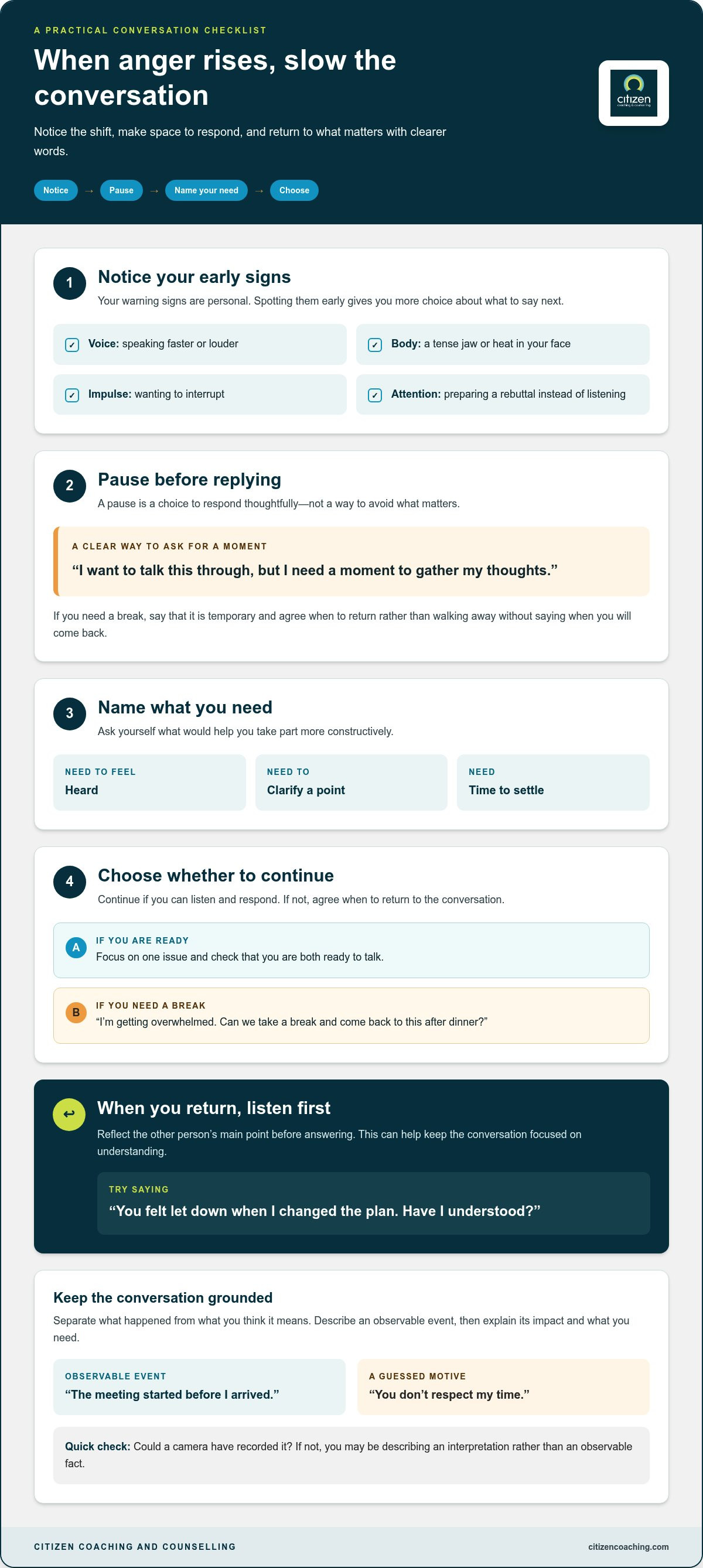
Your warning signs are personal. You might speak faster or louder, tense your jaw, feel heat in your face, or want to interrupt. You may notice your attention moving away from understanding the other person and towards preparing a rebuttal. Think of a recent disagreement: what changed in your voice, body, or thoughts? Recognising your own pattern is more useful than expecting one sign to apply to everyone. You could jot down what happened just before you noticed the change, as well as what helped you regain your composure.
What is the conversation really about?
Bring the discussion back to the immediate issue, then ask what concern sits beneath your reaction. Perhaps the issue is a missed plan, while the deeper worry is feeling overlooked. Separating what happened from what you think it means can prevent assumptions from taking over. Anger management includes finding ways to express concerns clearly; the Anger management overview also describes this broader focus.
Try separating an observation from an interpretation. “The meeting started before I arrived” describes an event. “You don’t respect my time” guesses at the other person’s motive. You can still explain how the event affected you, but sticking to what you know leaves more room for a useful reply. A practical check is to ask yourself whether a camera could have recorded the event. If not, you may be describing an interpretation rather than an observable fact.
A pause is a choice to respond thoughtfully, not a way to avoid what matters. Use it when you notice your own signs of escalation. A brief moment can help you return to the issue with clearer words and a better sense of what you need to say.
Does Calm Communication Mean Hiding Your Anger?
No. Calm communication isn’t about pretending you feel fine or agreeing just to avoid conflict. Anger can point to something that matters to you. The aim is to express it without attacking, frightening, or shutting out the other person. Acknowledge your anger, but don’t let it choose every word.
A useful way to speak is to describe what happened, name your feeling, then say what you need. For example: “When the plans changed without warning, I felt frustrated. I’d like us to let each other know sooner.” This makes your point clear without asking the other person to accept your interpretation or admit bad intentions. The American Psychological Association also offers strategies for controlling anger, including ways to communicate more constructively.
How can you say what is bothering you without blaming?
Replace labels such as “You’re selfish” with a specific action: “You checked your phone while I was explaining.” Then use a first-person statement to describe the impact and make a request: “I felt ignored. Could we put our phones away while we talk?” You’re not demanding agreement about your feelings. You’re giving the other person a clearer chance to understand your concern. Keep the request specific enough that the other person knows what you’re asking them to do.
How do you set a boundary without escalating?
State what you’re comfortable with and what you’ll do if the conversation can’t continue respectfully. Keep it specific and within your control: “I want to discuss this, but I’ll take a break if we start shouting. I’m ready to try again when we can speak calmly.” A boundary isn’t a threat. It explains your next step without trying to control the other person.
Learning how to communicate without getting angry takes practice, especially if difficult conversations tend to follow familiar patterns. The goal isn’t perfect wording; it’s expressing what matters with greater care. Counselling Anger Management Birmingham Citizen Coaching provides group and individual anger management support in Birmingham to help people practise managing emotions. You can read more about anger management support.
What to Do When You Feel Anger Rising Mid-Conversation
Once you notice tension building, you don’t have to solve the whole disagreement straight away. Use a simple sequence: notice what’s happening, pause, name what you need, then decide whether you’re ready to continue. A planned pause can protect a difficult conversation without leaving the issue unresolved.
- Notice: Recognise your own signs, such as rushing to interrupt or struggling to take in what the other person is saying.
- Pause: Give yourself a moment before replying.
- Name your need: Ask yourself whether you need to feel heard, clarify a point, or have time to settle.
- Choose: Continue if you can listen and respond, or agree when to return to the conversation.
What can you say when you need a pause?
Try, “I want to talk this through, but I need a moment to gather my thoughts.” Or, “I’m getting overwhelmed. Can we take a break and come back to this after dinner?” Keep your words direct and steady. A pause works best when you explain that it’s temporary and agree a suitable time to continue, rather than walking away without saying when you’ll return. Mayo Clinic also suggests taking time to think before speaking in its 10 tips to tame your temper.
How can you listen and return to the conversation?
When you resume, focus on one issue and check that you’re both ready to talk. Before answering, reflect the other person’s main point: “You felt let down when I changed the plan. Have I understood?” You can ask one clarifying question without agreeing with their view. Listening first helps you respond to what they mean, rather than only preparing your next argument. If the conversation starts escalating again, return to the pause plan instead of trying to settle every point at once.
What if you said something you regret?
Offer a direct apology: “I’m sorry I raised my voice. I can see it made this harder to discuss.” Avoid adding an excuse. You might ask, “What would help repair this?” Then respect their answer, including if they need more time.
Practise between disagreements by noting what tends to set off your anger and preparing a phrase you can use. Learning how to communicate without getting angry takes practice, and reviewing your patterns can help you decide what to try next time. Citizen Coaching and Counselling offers a structured online anger management course to practise skills over time.
Make Your Next Conversation a Fresh Start
Change doesn’t require you to handle every difficult conversation perfectly. Start with one small intention: notice what you want to say, and give yourself room to choose how to say it. With practice, how to communicate without getting angry becomes less about getting every word right and more about building a response that feels honest and respectful.
In Birmingham, Citizen Coaching and Counselling provides structured group and individual anger management programmes, with in-person and online support options. As a Community Interest Company focused on community mental health, it offers a supportive setting to work on communication over time.
Every thoughtful pause is a chance to begin again. Keep taking the next step at a pace that feels manageable.
Frequently Asked Questions
Can you communicate calmly while still feeling angry?
Yes. Feeling anger doesn’t mean you have to act on it or hide it. You can recognise the feeling, then choose a response that fits the conversation. For example, pause and say, “I’m angry about what happened, and I want to explain why without having a go at you.” This lets you be honest while keeping your words deliberate.
What should you do if the other person will not listen?
State your main point clearly once, then ask what they’ve understood: “Could you tell me what you heard me say?” If they still dismiss it, set a respectful boundary, such as ending the discussion for now. You can’t control whether someone listens or agrees. Repeating yourself more forcefully may deepen the conflict, so focus on what you can choose next.
How do you apologise after shouting during an argument?
Offer a direct apology that names what you did and recognises its impact: “I’m sorry I shouted. It may have made you feel unsafe speaking openly.” Avoid adding “but” or shifting responsibility to the other person. You could ask whether there’s something you can do to repair the interaction, while allowing them to decide what they need. Trust may take consistent effort to rebuild.
Can communication skills improve if anger has affected a relationship for a long time?
People can practise new ways of responding over time, though change isn’t guaranteed and may take patience from everyone involved. Start with one repeatable skill, such as pausing before replying to a difficult message. Notice what makes it easier or harder to use. If familiar patterns feel difficult to shift, structured support may offer space to practise and reflect. Learning how to communicate without getting angry can begin with one small change.
Is taking a break during an argument the same as avoiding the issue?
No. A break can be a constructive pause if you make clear that you intend to return to the topic. Try saying, “I need some time to settle. Can we continue after we’ve eaten?” Choose a realistic time that works for both of you. Leaving without explanation or repeatedly delaying the conversation can leave the concern unresolved, so be clear about your intention to come back.

Article by
Martin Hogg
Counselling and Anger Management in Birmingham. Articles by Martin Hogg, counsellor MBACP (Reg.) and Founder and CEO of Citizen Coaching and Counselling, a social enterprise based in Birmingham, UK. Martin also helps counsellors struggling to set up and grow their Private Practice to gain clarity and confidence in their marketing and systems.
Disclaimer
The information provided on this blog is for general informational purposes only and is not intended to be a substitute for professional medical or mental health advice, diagnosis, or treatment. Reading this content does not create a therapist-client relationship.


