
Fear of My Own Temper: Understanding and Overcoming Emotional Volatility
Imagine the heavy silence that follows a moment where you didn't recognise your own voice. You see the hurt on a loved one's face, and the sudden heat in your chest is replaced by a cold, sinking feeling of regret. Living with a constant fear of my own temper is exhausting. It makes you feel like you're walking on eggshells around your own emotions, worried about when the next outburst might happen or who it might impact. You might even worry that these reactions define who you are as a person.
We understand how isolating this feels, but your anger is often just a signal that your internal thermostat needs a bit of recalibrating. In this guide, you'll learn why your reactions feel so frightening and discover practical, professional steps to regain a sense of safety. We'll look at the reasons behind emotional volatility and provide tools you can use in the moment to stay grounded. There is a clear path back to feeling like yourself again, and it starts with understanding that you deserve support, not shame.
Key Takeaways
- Understand why your emotional brain can sometimes outrun your logical thoughts. This explains why it doesn't always feel like you're in the driver's seat during an outburst.
- Learn how to use a simple Anger Scale to spot your early warning signs before you reach a point of no return.
- Discover practical, physical techniques like the 10-second buffer to help manage the fear of my own temper in the heat of the moment.
- See how practical skill-building through professional coaching can help you regain self-control and protect your most important relationships.
Why Am I Scared of My Own Temper? Understanding the "Hulk" Feeling
Feeling like you might "snap" at any moment is a heavy burden to carry. This fear of my own temper often acts as an internal alarm system. It triggers when you sense a loss of control, leaving you worried about what you might say or do next. It's a frightening experience, but understanding the psychology of anger can help demystify that "Hulk" sensation. You aren't becoming a different person; your brain is simply reacting to pressure in a way that feels unmanageable.
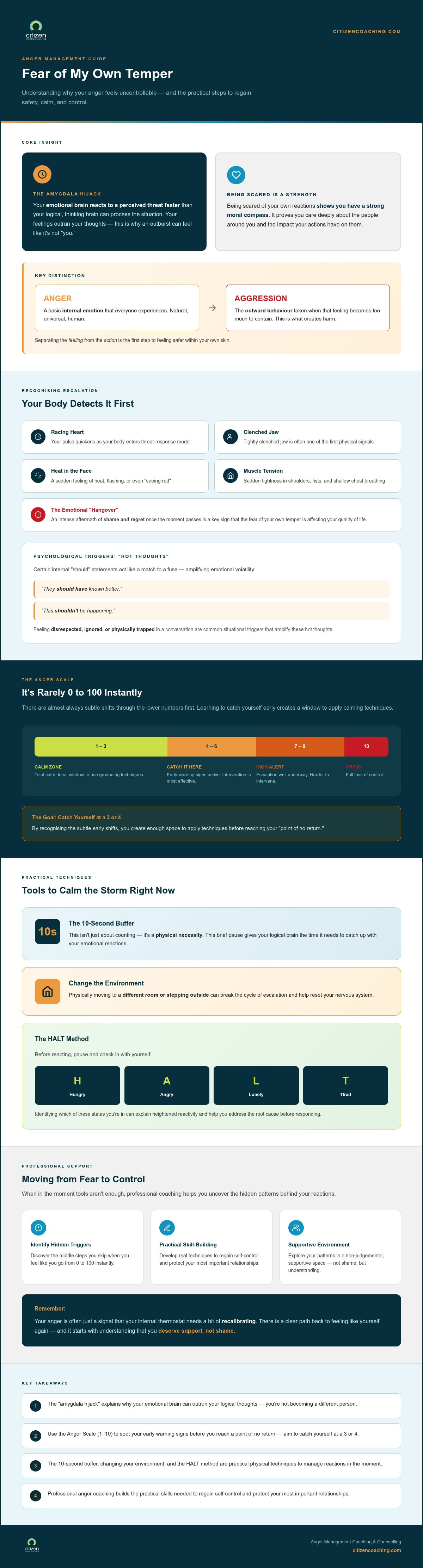
Inside your brain, a process sometimes called an "amygdala hijack" occurs. This happens when your emotional brain reacts to a perceived threat faster than your logical, thinking brain can process the situation. Essentially, your feelings outrun your thoughts. While this can feel overwhelming, being scared of these reactions actually shows you have a strong moral compass. It proves that you care deeply about the people around you and the impact your actions have on them. Anger itself is a natural human emotion, but it's the unpredictable expression of that anger that creates the fear.
The Difference Between Anger and Aggression
It's common to confuse the feeling of anger with the act of aggression. Anger is a basic internal emotion that everyone experiences. Aggression, however, is the outward behaviour or action taken when that feeling becomes too much to contain. We often conflate the two, which makes us fear the emotion itself. By learning to separate the feeling from the action through anger management courses, you can start to feel safer within your own skin.
Signs Your Temper is Impacting Your Wellbeing
When emotional volatility takes over, your body often gives you clear signals. You might notice physical symptoms like a racing heart, a sudden feeling of heat in your face, or even "seeing red" during an argument. The most telling sign is often the emotional aftermath. If you experience an intense "hangover" of shame and regret once the moment passes, it's a sign that the fear of my own temper is affecting your quality of life.
Identifying Your "Point of No Return": The Signs of Escalation
One of the most effective ways to manage the fear of my own temper is to visualise an "Anger Scale" ranging from 1 to 10. On this scale, a "1" represents a state of total calm, while a "10" is a complete loss of control. Many people feel they jump from 0 to 100 in a split second. However, it's rarely an instant leap. There are almost always subtle shifts through the lower numbers first. By learning to catch yourself at a 3 or 4, you can apply techniques for controlling anger before it controls you. If you find yourself hitting a 10 too quickly to react, speaking with an Anger Management Therapist Birmingham can help you identify those hidden middle steps.
Physical Cues to Watch For
Your body usually detects rising frustration before your conscious mind does. These early indicators often include a tightly clenched jaw, shallow breathing that feels tight in the chest, or sudden muscle tension in your shoulders and fists. Recognising these physical signals early provides a vital window of opportunity to pause before an emotional hijack occurs.
Psychological Triggers and "Hot Thoughts"
Certain situations act as immediate fuel for emotional volatility. You might feel a surge of heat when you feel disrespected, ignored, or even physically trapped in a conversation. These feelings are often amplified by "hot thoughts." These are internal "should" statements, such as "they should have known better" or "this shouldn't be happening," which act like a match to a fuse. Identifying these specific triggers is a vital step in managing the fear of my own temper and regaining your sense of calm. If you're ready to explore these patterns in a supportive environment, you can get in touch with our Birmingham team to discuss how we can help.
Practical Tools to Calm the Storm Right Now
When you live with a fear of my own temper, generic advice like "just relax" often feels dismissive. You need practical tools that work when your heart is racing and your thoughts are spinning. One of the most effective strategies is the "10-second buffer." This isn't just about counting; it's a physical necessity. This brief pause gives your logical brain the time it needs to catch up with your emotional reactions. During this window, try the "change the environment" rule. Physically moving to a different room or stepping outside can break the cycle of escalation and help reset your nervous system.
We also encourage the "HALT" method. Before reacting, ask yourself if you're Hungry, Angry (from earlier events), Lonely, or Tired. These physical states lower your threshold for frustration and make outbursts more likely. We dive deeper into these practical skills in our Online Anger Management Course UK, which provides a structured way to build these habits from home.
The Power of "I" Statements
Communication often breaks down when we use "you" statements that sound like accusations. Shifting to "I" statements allows you to express your needs without making others defensive. For example, instead of saying "You make me so angry," try "I feel overwhelmed right now and need a moment to think." This small shift keeps the conversation safe and prevents the situation from spiralling into the volatility you fear.
Sensory Grounding Techniques
If you feel the "red mist" descending, use the 5-4-3-2-1 method. Identify five things you see, four you can touch, three you hear, two you smell, and one you can taste. This pulls your focus away from the internal storm and back to the present moment. For an immediate reset, splashing cold water on your face or holding an ice cube can provide a sensory "shock" that brings you back to a state of calm quickly.
Moving from Fear to Control: Professional Anger Coaching
Transitioning from a constant fear of my own temper to a place of self-assurance doesn't have to mean years of clinical therapy. While traditional counselling is valuable for exploring the past, the programmes at Counselling Anger Management Birmingham Citizen Coaching focus on the here and now. It's a practical, skill-building approach designed to give you immediate control. Many people find great relief in our group sessions, where they realise they aren't alone in their struggles. Sharing experiences in a non-judgmental environment helps de-escalate the shame often tied to the fear of my own temper. We provide a safe space to learn these life-changing techniques without the pressure of a medical diagnosis.
Why a Social Enterprise Approach is Different
Counselling Anger Management Birmingham Citizen Coaching operates as a social enterprise, which means we prioritise community impact and accessibility over clinical labels. We've been based in Birmingham since 2005, offering local residents expertise that feels neighborly rather than institutional. You won't find cold, medicalised jargon here. Instead, you'll find a team of real people who understand the specific stresses of modern life in the West Midlands. We believe that everyone should have access to high-quality support without the barrier of a daunting medical intervention.
What to Expect in an Anger Coaching Session
Our sessions are designed to be straightforward and helpful. We don't spend all our time rehashing old memories; we focus on the practical tools you need to stay calm today. You'll learn how to identify your triggers and apply the grounding techniques we've discussed in earlier sections. The ultimate goal is simple: we want you to feel safe with yourself again. Taking that first step can feel difficult, but we're here to make it as easy as possible. If you're ready to start your journey, please consider reaching out for a confidential chat with our team today.
Taking Control of Your Emotional Future
Living with a constant fear of my own temper is a heavy weight, but it doesn't have to be your permanent reality. You've learned that these intense reactions are often just your emotional brain moving faster than your logical one. By spotting early physical warning signs and using tools like the 10-second buffer, you can start to feel safe in your own skin again. Understanding your triggers is the first step toward lasting change.
Since 2005, our team has provided trusted Birmingham support through jargon-free, non-judgmental coaching. We don't believe in complex clinical labels; we believe in practical skills that work. Whether you prefer group sessions, individual coaching, or an online course, there is a path forward that fits your life. You've already taken a brave step by seeking out this information. Now, let's turn that knowledge into action. You deserve to feel calm, in control, and like yourself again.
Frequently Asked Questions
Is it normal to be scared of my own temper?
Yes, it is very common to feel this way. Feeling a fear of my own temper shows that you have a strong moral compass and care about the people around you. You aren't a "bad" person for having these intense feelings; you're simply reacting to internal pressure. Many of our Birmingham clients describe a similar sense of losing control before they start their journey with us.
How do I know if I need professional anger management?
You might need support if your reactions are affecting your relationships, work, or self-esteem. If you experience intense guilt after an outburst or feel like you're constantly walking on eggshells, professional coaching can help. We've supported people in Birmingham since 2005 who feel their emotional reactions no longer match the situation. If you're searching for ways to manage the fear of my own temper, taking a proactive step is a sign of strength.
Can anger management really help if I’ve always been "hot-headed"?
Yes, managing your emotions is a skill that can be learned regardless of your past. Being "hot-headed" is often just a set of ingrained habits rather than a permanent personality trait. Our structured programmes focus on practical techniques to recalibrate your internal thermostat. Whether you choose our Birmingham group sessions or an individual programme, you'll learn that you can change your reactions through consistent practice and professional guidance.
What is the difference between anger coaching and traditional counselling?
Anger coaching is a practical, skill-building approach focused on the present. While traditional counselling might explore deep-rooted past experiences, our coaching sessions provide immediate tools to manage your emotions today. We focus on "how" to stay calm rather than just "why" you feel angry. This makes it feel like a practical tool for personal development rather than a daunting medical intervention. It's about building a toolkit for real-world situations.
How long does it take to see results from anger management sessions?
Many clients report feeling a greater sense of control after just a few sessions. While everyone's journey is different, our programmes are designed for immediate impact. You'll begin using practical strategies from your very first meeting. Lasting change comes from applying these skills consistently in your daily life. Our goal is to help you feel like yourself again as quickly as possible through accessible, jargon-free support.

Article by
Martin Hogg
Counselling and Anger Management in Birmingham. Articles by Martin Hogg, counsellor MBACP (Reg.) and Founder and CEO of Citizen Coaching and Counselling, a social enterprise based in Birmingham, UK. Martin also helps counsellors struggling to set up and grow their Private Practice to gain clarity and confidence in their marketing and systems.
Disclaimer
The information provided on this blog is for general informational purposes only and is not intended to be a substitute for professional medical or mental health advice, diagnosis, or treatment. Reading this content does not create a therapist-client relationship.


