Depression Therapy Birmingham: A Jargon-Free Guide to Local Support in 2026
Did you know that as of April 2025, data from the ONS shows that 18% of adults in Great Britain are experiencing moderate to severe depressive symptoms? That is nearly one in every five people you see walking through the city centre. If you feel low, you aren't alone, and searching for depression therapy birmingham shouldn't feel like another source of stress in your life.
It's completely normal to feel anxious about your first session or worry that you'll be stuck on a waiting list for years. We know that taking the first step is often the hardest part of the journey. This guide is here to help you find a clear, jargon-free path to feeling like yourself again. We'll show you how to access local support that fits your needs and your budget.
You'll discover free options like the Living Well Consortium, where 92% of clients were seen within six weeks according to their 2023 report. We also cover low-cost private sessions at St. Martin's Counselling that start from £15. You'll learn how to navigate the local system without the clinical confusion, finding a friendly professional who is ready to listen and guide you forward.
Key Takeaways
- Understand how to find depression therapy birmingham that uses simple, everyday language to help you regain your emotional balance and find local support.
- Learn how different talking therapies work to change your thoughts or improve your connections with people without the confusing clinical jargon.
- Decide between the free NHS pathway and private support by weighing up waiting times and your personal choice of therapist.
- See why choosing a local social enterprise helps bridge the gap between overstretched public services and expensive private clinics.
- Find out what to expect in your very first session so you can feel more confident and less anxious about starting your journey and finding the right guide.
Recognising the Need for Depression Therapy in Birmingham
Living in a city as busy as Birmingham can feel surprisingly lonely. While the streets are crowded, the internal experience of depression can make you feel completely disconnected from the world around you. Depression therapy is a guided process designed to help you rediscover emotional stability and hope. It isn't about being "broken" or "fixed." Instead, depression therapy is a collaborative partnership between you and a professional guide.
The pressures of our city are real. A Mental Health Needs Assessment for Birmingham and Solihull released in October 2025 shows a marked increase in conditions like depression over the last ten years. Whether it's the grind of work stress in the city centre or the quiet weight of urban isolation, these feelings are valid. Engaging in Psychotherapy offers a practical way to manage these pressures with a professional who understands the local landscape.
Common Signs It Is Time to Talk
Recognising when you need support is a sign of strength, not weakness. You might notice:
- A persistent low mood or feeling "empty" for more than two weeks.
- Loss of interest in local activities you used to love, like socialising in the Jewellery Quarter or visiting city centre landmarks.
- Physical fatigue that doesn't improve with rest. This is often a sign of deep mental exhaustion.
The "First Step" Philosophy
We believe that the hardest part of any journey is the very beginning. This is why we focus on making the start of depression therapy birmingham as gentle as possible. You won't be treated as a "patient" with a list of symptoms to be cured. Our approach moves away from clinical labels toward personal growth and understanding. We're here to walk alongside you as you find your feet again. By choosing a local guide, you're taking a manageable step toward feeling like yourself in the city you call home.
Jargon-Free Therapy Options: What Actually Happens?
When you look for support, you often run into a wall of acronyms. It feels like you need a medical degree just to understand the menu of options. Let's strip that away. In depression therapy birmingham, the goal isn't to label you; it's to help you understand your own mind. You're looking for a way forward, not a textbook definition. Navigating depression therapy birmingham should feel like a relief, not a chore.
Cognitive Behavioural Therapy (CBT) is really just about understanding how your thoughts affect your day. If you find yourself in a loop of negative thinking, CBT helps you spot those patterns. Interpersonal Therapy (IPT) focuses on the outside world. It's about improving how you connect with the people around you, whether that's family, friends, or colleagues. You don't need a doctor's note or a formal diagnosis to start. If you feel like things aren't right, that's reason enough. Choosing private counselling Birmingham gives you the flexibility to start when you're ready. As of November 2025, private sessions in the city typically range from £95 to £120, offering a tailored approach without the wait.
Talking Therapy vs. Clinical Intervention
Talking therapy is different from a standard medical appointment. While NHS depression treatments can include medication or clinical assessments, talking therapy focuses on your story. It looks at your future rather than just managing symptoms. It provides a safe, non-judgmental space away from the sterile feel of a hospital or GP surgery. If you're unsure which path is right, you can talk to our friendly team to find the best fit for your situation.
Individual vs. Group Support
One-to-one sessions are perfect for deep, personal exploration. You have the full attention of your guide to work through complex feelings. However, group settings are also powerful. They help reduce the feeling of isolation in our local community. Seeing that others in the city share your struggle can be incredibly healing and reminds you that you aren't alone.
Navigating Local Support: NHS vs. Private & Social Enterprise
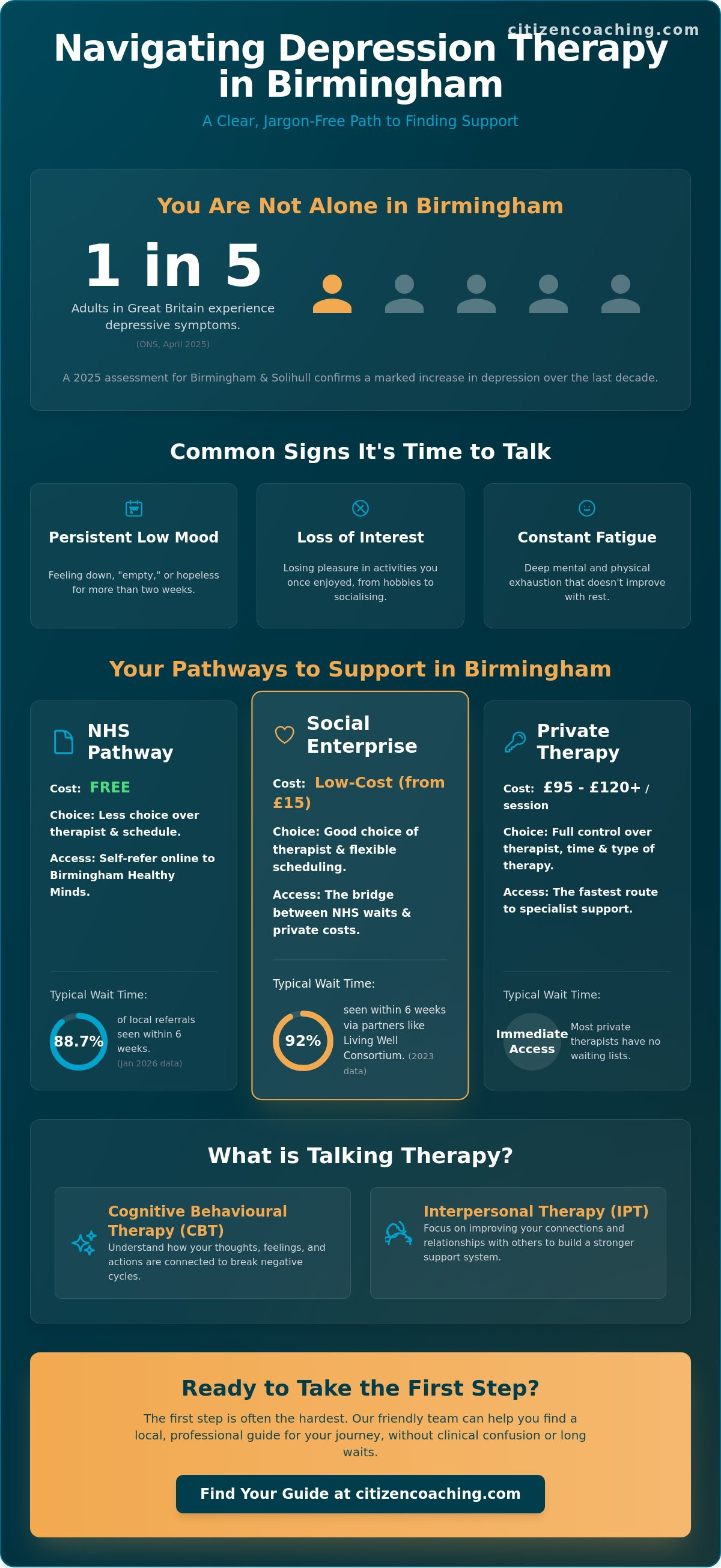
Choosing the right route for depression therapy birmingham often comes down to a choice between cost and time. The local NHS path usually starts with Birmingham Healthy Minds. You can self-refer to this service online without needing to see a GP first. While national targets aim for 75% of people to be seen within six weeks, data from January 2026 shows that 88.7% of referrals actually met this timeframe. It's a reliable, free service, but you might have less choice over which therapist you see or when your sessions happen.
If you need to talk sooner, private therapy or social enterprises offer a faster alternative. Private support typically means no waiting lists and the ability to pick a guide who feels like the right fit for your personality. Many people find that their struggle isn't just with low mood; anxiety support Birmingham is often a key part of the same conversation. Practically, many local therapists are based near Birmingham New Street or are easily accessible via West Midlands Railway. This makes it much easier to fit sessions into a busy work day or commute.
What to Look for in a Birmingham Therapist
You should feel heard from the very first phone call or email. Trust your gut. If a professional doesn't feel like a good match during your initial contact, it's okay to look elsewhere. For peace of mind, check that your guide belongs to a professional body like the BACP or UKCP. These organisations ensure therapists follow high standards of safety and ethics, giving you a foundation of trust before you even sit down.
Preparation for Your First Session
Your first session is simply a conversation to see how you feel. You might want to ask how they've helped others with depression or how they structure their sessions. Remember, you are in total control of the pace. You don't have to talk about anything before you're ready. If you're feeling overwhelmed by the options, contact our team to discuss how we can help you take that next step toward feeling like yourself again.
Why Choosing a Birmingham Social Enterprise Matters
Choosing a social enterprise for depression therapy birmingham means your care supports the wider community. We operate as a Community Interest Company (CIC), which is a specific type of business designed for social good. Instead of profits going to shareholders, every penny we make is reinvested back into local mental health services. This model allows us to bridge the gap between overstretched NHS services and expensive private clinics. We provide a professional, reliable alternative that keeps the focus on people rather than just numbers.
Social enterprises are the backbone of Birmingham's community support. For example, the Living Well Consortium, a major local network, reported in their 2023 impact report that 92% of their clients were seen within six weeks. By choosing this route, you get faster access to care while supporting a system that helps your neighbors. We also believe in stopping problems before they start. Our commitment to workplace wellbeing training Birmingham helps local teams stay healthy and prevents depression at the source. This creates a stronger, more resilient city for everyone.
Accessible Support for All Ages
Support should be available to everyone, regardless of age. ONS data from April 2025 shows that young adults aged 16 to 29 experience the highest rates of depressive symptoms at 26%. We offer tailored counselling for both young people and adults across the city. Whether you're a student at the University of Birmingham or a professional in the city centre, our doors are open. Our "Jargon-Free" promise is our commitment to you. We keep things simple, human, and grounded in the reality of your life. We won't hide behind clinical terms; we'll just listen and guide.
Taking the Next Step
Taking the first step can be the hardest, but you don't have to do it alone. We've made the process of starting depression therapy birmingham as easy as possible. You can book a friendly, professional consultation today to see how we can help. There's no pressure and no complex forms. Just a simple conversation to find the right path for you. You deserve to feel like yourself again, and we're here to help you get there. Reach out today and let's start talking.
Start Your Path to Feeling Like Yourself Again
Finding the right local support shouldn't be a struggle. We've explored how to navigate Birmingham's mental health landscape, from understanding NHS waiting times to the benefits of choosing a community-focused social enterprise. You now have the tools to move past clinical labels and find a guide who speaks your language. Therapy is simply a collaborative partnership designed to help you regain your emotional stability and hope.
Since 2005, we've operated as a Birmingham-based Community Interest Company (CIC) dedicated to our city's well-being. Our BACP-registered practitioners are here to provide depression therapy birmingham that feels human, professional, and entirely jargon-free. We know that taking the first step is often the hardest part of the journey, but you're already closer to feeling better than when you started reading this guide. You deserve to feel supported in a space where you're truly heard.
Start your journey with a friendly, jargon-free consultation at Citizen Coaching. You don't have to carry this weight alone. We're ready to walk alongside you whenever you're ready to begin.
Frequently Asked Questions
Do I need a GP referral for depression therapy in Birmingham?
No, you don't need a referral from your doctor to start talking to a professional. You can self-refer directly to NHS services like Birmingham Healthy Minds through their website. Private providers and social enterprises also allow you to book a consultation directly, which helps you skip the wait and start your journey whenever you feel ready.
How much does private depression counselling cost in the West Midlands?
Private therapy sessions in the city typically range between £95 and £120 per session as of November 2025. For those who need more affordable support, local charities like St. Martin's Counselling provide subsidized sessions for £15 to £25. The Meridian Centre also offers a sliding scale based on your income, with fees starting at £25 as of February 2026.
What is the difference between a counsellor and a psychiatrist?
A counsellor is a professional guide who uses talking therapy to help you explore your feelings and find practical ways forward. A psychiatrist is a medical doctor who can provide a formal diagnosis and prescribe medication. If you're looking for depression therapy birmingham, a counsellor focuses on your personal story and emotional growth rather than medical interventions.
How many sessions of therapy will I need for depression?
Most people find that a block of 6 to 12 sessions is a helpful starting point for making real progress. The exact length of your support depends on your personal goals and how you feel as you go along. You're always in control of the pace, and your guide will work with you to decide when you feel strong enough to move forward independently.
Can I get depression therapy online if I cannot travel to Birmingham city centre?
Yes, almost all local practitioners now offer support via video calls if you can't make it to a physical office. This is a popular choice for people who find travelling to the city centre stressful or have busy work schedules. Online depression therapy birmingham offers the same friendly, professional guidance as in-person sessions, allowing you to talk from a space where you feel most comfortable.
Disclaimer
The information provided on this blog is for general informational purposes only and is not intended to be a substitute for professional medical or mental health advice, diagnosis, or treatment. Reading this content does not create a therapist-client relationship.


