
Constant Anger and Irritability: A Practical Guide to Reclaiming Your Calm in 2026
You've just snapped at your partner over a misplaced set of keys, and the look of hurt on their face makes your heart sink. It's a familiar cycle: the sudden flash of heat, the sharp words you can't take back, and the crushing guilt that follows. You aren't a bad person, but you're likely living in a constant state of high alert that leaves you physically exhausted. Finding constant anger and irritability help shouldn't feel like another source of stress. We understand that behind every outburst is often someone who is simply overwhelmed and looking for a way back to their calm self.
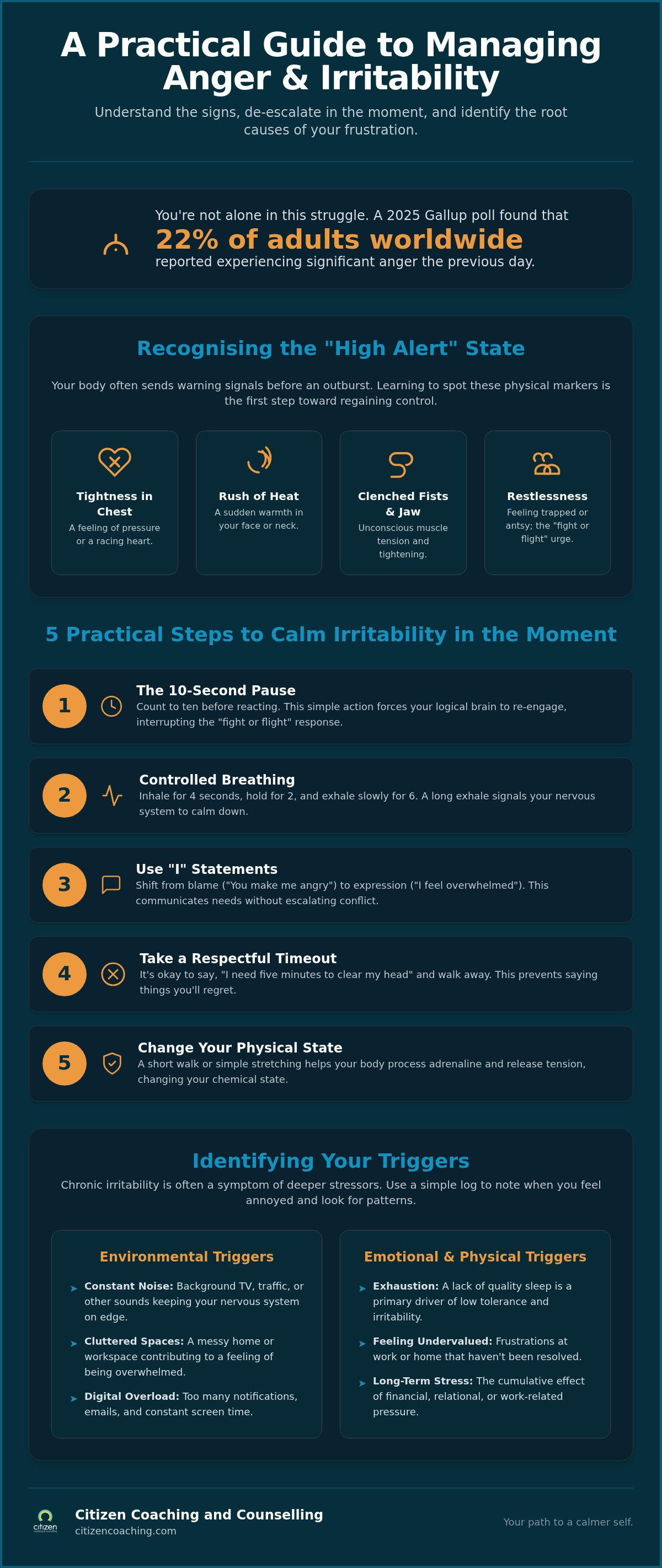
In a 2025 Gallup poll, 22% of adults worldwide reported experiencing anger "a lot of the previous day," so you're certainly not alone in this struggle. This guide will help you discover why your internal alarm system feels stuck on high. You'll learn practical, jargon-free steps to regain control of your emotions and find a clear, supportive path toward professional coaching that feels manageable and human.
Key Takeaways
- Learn to spot the early physical warning signs of chronic irritability, such as chest tightness and heat, before they lead to an outburst.
- Discover five simple, non-technical techniques to de-escalate tension immediately when you are looking for constant anger and irritability help.
- Find out how to use a simple trigger log to identify the hidden roots of your frustration, such as exhaustion or long-term stress patterns.
- Explore how to choose the right path forward in Birmingham, whether through supportive group programmes or individual coaching tailored to your needs.
Recognising the Signs of Constant Anger and Irritability
Living in a state of constant irritability feels like having a hair-trigger alarm that never shuts off. You might snap at small inconveniences like a slow kettle or a red light. Understanding and Recognising the Signs of Constant Anger and Irritability is the first step toward reclaiming your peace. It isn't just about a bad mood; it's a persistent feeling of being on edge. If you've been searching for constant anger and irritability help, acknowledging this mental toll is where your journey begins.
Your body often knows first. Physical markers of this "high alert" state are often subtle before they become overwhelming. You might notice:
- Tightness in your chest or a racing heart.
- A sudden rush of heat in your face or neck.
- Clenched fists or a locked jaw.
- The "fight or flight" response, making you feel restless or trapped.
The Difference Between Healthy Anger and Chronic Irritability
Anger is a natural emotion that tells us when something is wrong. However, chronic irritability is a habituated response where your brain stays in a defensive loop. This often begins to bleed into your daily life, causing strained conversations with your partner or creating a tense atmosphere at home. It's no longer a reaction to a specific event; it's a baseline state of being. Recognising this shift is vital for protecting your relationships.
The Physical and Mental Impact of Staying Angry
Staying in this state is hard on your body. The NHS highlights that long term stress and anger are linked to physical health concerns, including high blood pressure. Beyond the physical, there's the emotional hangover. This is the heavy mix of guilt, fatigue, and resentment that settles in after an outburst. Finding constant anger and irritability help involves breaking this cycle and allowing yourself to finally breathe.
5 Practical Steps to Calm Your Irritability in the Moment
When the heat rises, you need a toolkit that works in real-time. These aren't just quick fixes; they're practical skills to help you navigate the storm. If you've been looking for constant anger and irritability help, these five steps provide a clear, jargon-free path to de-escalation. Think of these as tools you carry with you, ready to use whenever that familiar tension starts to build in your chest.
Step 1 & 2: The Physical Reset
Start with the 10-second pause. It sounds simple, but it gives your brain a moment to catch up. When you're annoyed, your "fight or flight" system takes over. Counting to ten forces your logical brain to re-engage. While you count, focus on controlled breathing. Try to inhale for four seconds, hold for two, and exhale slowly for six. This long exhale is the key. It signals your nervous system to lower your heart rate and physically dampens the "high alert" state we discussed earlier.
Step 3, 4 & 5: Mental Reframing
Once the physical fire is lower, use "I" statements to communicate. Instead of saying "You're making me angry," try "I feel overwhelmed when the kitchen is messy." This shift allows you to express your needs without starting a conflict. If the situation still feels too heavy, use the "Timeout" strategy. It's perfectly okay to say, "I'm feeling a bit on edge and need five minutes to clear my head," then walk away. It's a respectful way to prevent a snap.
Finally, use physical movement to change your chemical state. A short walk or even just stretching can help process the adrenaline in your system. Finding constant anger and irritability help often starts with these small wins. If you find yourself needing more than just moment-to-moment tools, you can get in touch with us to discuss a more tailored approach to reclaiming your calm.
Identifying Your Triggers and Long-term Patterns
Chronic irritability rarely appears out of thin air. It's usually the final result of hidden roots like long-term stress or physical exhaustion. When you're looking for constant anger and irritability help, understanding "the why" behind your reactions makes "the how" of fixing them much easier to manage. It's about moving from a place of confusion to one of clarity.
A practical way to start is by keeping a simple trigger log. For a few days, jot down every time you feel that familiar spike of annoyance. Note what happened, who was there, and how you felt physically. You'll likely see patterns emerging that you hadn't noticed before, such as feeling more on edge during the school run or after a long day of meetings.
Common Triggers in Everyday Life
Triggers can be environmental or emotional. Environmental factors like background noise, a cluttered living space, or digital overstimulation can keep your nervous system on high alert. Emotional triggers are often deeper. You might feel undervalued at work or be carrying past frustrations that haven't been talked through. Gallup's 2023 survey found that 49% of people frequently experience stress, which is a 16-point rise over two decades. This high baseline means it takes very little to tip you into irritability.
Breaking the Cycle of Reactivity
The goal is to spot a trigger before it leads to an outburst. If you know that lack of sleep or a busy office makes you snappy, you can plan for it. You might choose to take a quiet lunch break or delay a difficult conversation until you've had a chance to rest. Our anger management courses are designed to help you identify these deep-seated patterns in a non-judgmental environment. By learning to recognise the "spark," you can prevent the "fire" from ever starting.
Choosing the Right Support: Anger Management in Birmingham
Choosing the right support is a deeply personal decision, but it's often the most important step you'll take. Seeking professional constant anger and irritability help isn't about admitting defeat. It's about deciding that your relationships, your health, and your peace of mind are worth the effort. In Birmingham, you have access to community-focused support that feels like a supportive conversation rather than a cold medical intervention. This is the beginning of a new journey toward reclaiming your calm.
Individual vs. Group Support: Which is Best for You?
Group sessions are incredibly powerful because they break the isolation of chronic anger. There's a unique relief in realising "it's not just me" within a safe, non-judgmental environment. Sharing experiences with others who truly understand your frustration can lower your stress levels immediately. Alternatively, 1-to-1 coaching offers tailored, private support for specific personal or professional challenges. If you aren't sure which path fits your life, reading about an anger management therapist Birmingham can help you compare these options in more depth.
How Citizen Coaching Can Help
As a social enterprise founded in 2005, we focus on making support accessible and human. We provide a jargon-free space where you can learn practical tools for life. Whether you join our Birmingham-based group sessions or choose our specialist online course, our goal is to help you find a clear path forward. We don't offer temporary fixes; we help you build a foundation for long-term calm. Reaching out for constant anger and irritability help is a sign of strength, marking the start of a better relationship with yourself and those you love.
Taking Your First Step Toward Lasting Calm
You've taken a significant step today by learning to identify the physical and emotional patterns that keep you feeling on edge. Reclaiming your calm isn't about perfection; it's about having the right tools to navigate life's frustrations without losing control. By using simple techniques like the 10-second pause and keeping a trigger log, you can begin to break the cycle of reactivity that strains your relationships and leaves you exhausted.
Finding constant anger and irritability help is a journey best shared with a supportive, Birmingham-based community. As finalists for Social Enterprise of the Year, we pride ourselves on a jargon-free, non-clinical approach that puts your well-being first. Whether you prefer group sessions or private coaching, we're here to provide a safe space where you can grow.
You don't have to manage this alone. A calmer, more connected version of yourself is within reach.
Frequently Asked Questions
Is constant irritability a sign of a mental health condition?
Constant irritability is often a symptom of underlying stress, anxiety, or depression. A 2026 Rula Health report found that anxiety and depression rates rose by 9.3% and 10.6% between 2025 and 2026. While we don't provide medical diagnoses, we help you manage how these feelings affect your life. Recognising these signs is a vital part of finding constant anger and irritability help and beginning your journey toward a more peaceful daily routine.
How is anger management coaching different from traditional therapy?
Our coaching is more practical and action-oriented than traditional talk therapy. While some therapies focus heavily on your past, we provide tools you can use immediately to de-escalate tension. It's a jargon-free approach that feels like working with a mentor rather than a patient-doctor relationship. We don't use medicalised verbs; instead, we focus on personal development and building a foundation of trust through clear, simple steps.
Can I attend anger management sessions online if I'm not in Birmingham?
Yes, you can access our specialist online anger management course from anywhere in the UK. Although we have deep roots as a Birmingham social enterprise, we want our support to be accessible to everyone. The online sessions provide the same non-judgmental and supportive environment as our face-to-face groups. This is an ideal option if you have a busy schedule or simply prefer to learn from the comfort of your own home.
How long does it typically take to see results from anger coaching?
You might notice a difference as soon as you start using our physical reset tools. However, creating lasting change usually takes a few weeks of steady progress. Our programmes are designed to move you from uncertainty toward calm competence at a measured tempo. Like any skill, the more you practice these practical steps in your daily life, the more natural and effective they'll become. Consistency is the key to reclaiming your calm.
What should I do if my partner is the one struggling with constant anger?
Supporting a partner who is always on edge is exhausting. It's best to wait for a quiet moment to express your concerns using "I" statements. You might suggest that constant anger and irritability help is available through our non-clinical coaching or couples counselling. We focus on lowering the barrier to entry, so the process feels supportive rather than intimidating. Remember that professional help is a practical tool for improving your communication and relationship dynamics.

Article by
Martin Hogg
Counselling and Anger Management in Birmingham. Articles by Martin Hogg, counsellor MBACP (Reg.) and Founder and CEO of Citizen Coaching and Counselling, a social enterprise based in Birmingham, UK. Martin also helps counsellors struggling to set up and grow their Private Practice to gain clarity and confidence in their marketing and systems.
Disclaimer
The information provided on this blog is for general informational purposes only and is not intended to be a substitute for professional medical or mental health advice, diagnosis, or treatment. Reading this content does not create a therapist-client relationship.


