
Conflict Resolution for Couples: Better Communication
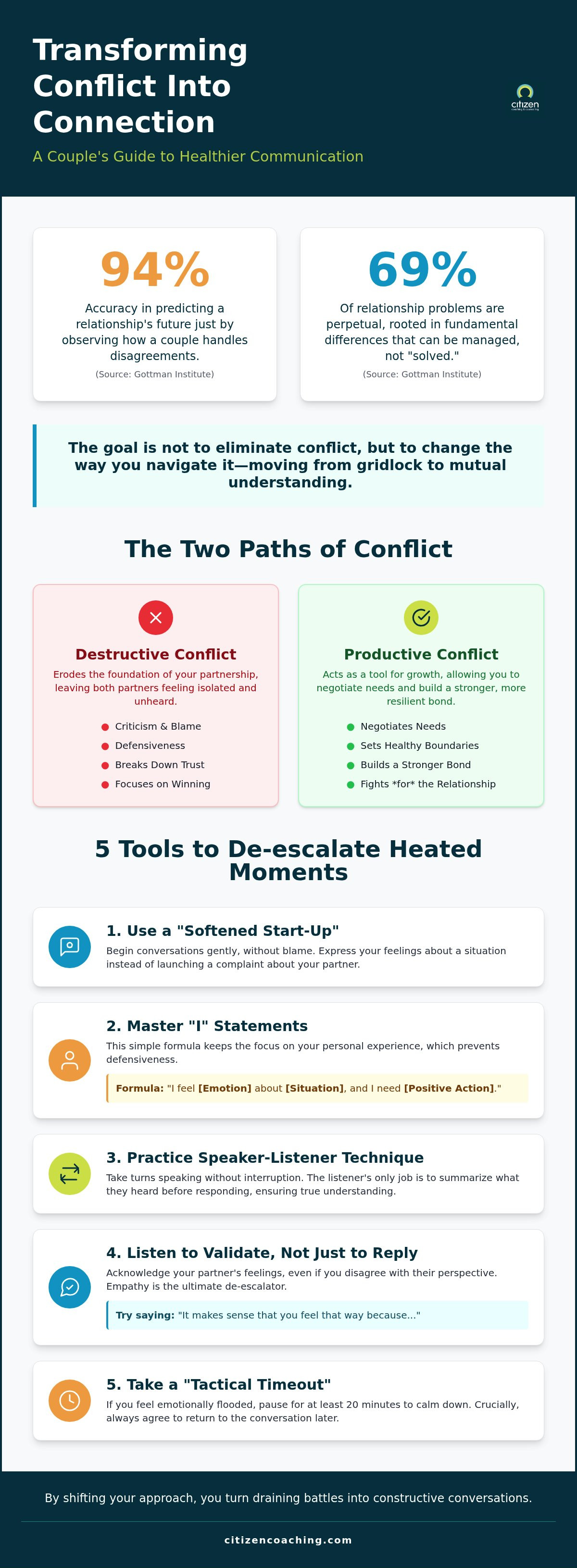
Did you know that researchers can predict the future of a relationship with 94% accuracy just by watching how a couple handles a disagreement? According to the Gottman Institute, the presence of friction isn't the problem; it's the way we communicate during those tense moments. If you've spent nights feeling unheard or walking on eggshells to avoid another blowup, you're not alone. Many partners in Birmingham and beyond fear that constant arguing is a sign their relationship is failing. However, learning specific conflict resolution techniques for couples can transform these moments from draining battles into opportunities for deeper connection.
It's exhausting to feel like you're on opposite sides of a fence, especially when you just want to feel like a team again. We understand that taking the first step toward better communication feels vulnerable, but it's a journey worth starting. In this guide, we'll share practical, research-backed tools to help you lower the temperature of your arguments at home. We'll explore how to de-escalate tension and validate each other's feelings. You'll discover how to move toward a more supportive partnership using a straightforward, non-medical approach that prioritizes your comfort and growth.
Key Takeaways
- Understand why 69% of relationship issues are perpetual and how to navigate these natural differences without feeling like your partnership is failing.
- Master practical conflict resolution techniques for couples, including the "softened start-up" and "I" statements, to prevent defensiveness and keep conversations productive.
- Identify your personal emotional triggers to help you stay calm and regulated even when a discussion starts to feel heated.
- Learn how a neutral, supportive guide can help you rebuild your connection in a non-judgmental environment through local couples counselling.
Understanding Relationship Conflict: Why We Argue and How it Helps
Conflict isn't a sign of failure. It's what happens when two people with different backgrounds and histories try to build one life together. Every person brings their own unique expectations to a relationship. When these perspectives collide, friction is inevitable. Developing a foundational understanding of conflict resolution helps partners see that these moments aren't threats. Instead, they are often misunderstood requests for connection or change.
Research from the Gottman Institute shows that 69% of relationship problems are perpetual. This means they are unsolvable issues rooted in personality differences or core values. You might find yourselves arguing about the same topics for years. The goal isn't to "fix" these problems once and for all. Success comes from learning how to manage the dialogue around them. When you stop trying to "win" and start trying to understand, the temperature of the room drops. It's about moving from a state of gridlock to a place of mutual respect.
We know that starting this journey feels incredibly vulnerable. It's hard to admit that your communication has hit a wall. Looking for conflict resolution techniques for couples is a brave first step toward a healthier future. You aren't seeking a medical label; you're simply looking for practical tools to make your home feel like a sanctuary again. Our team is here to guide you through this process with a steady, neighborly hand.
The Difference Between Productive and Destructive Conflict
Destructive conflict erodes the very foundation of your partnership. When arguments are filled with blame and criticism, they leave both people feeling defensive and isolated. This cycle quickly breaks down trust. In contrast, productive conflict serves a vital purpose. It allows you to negotiate your needs and set healthy boundaries. Productive arguments focus on the issue at hand rather than attacking a partner's character. It’s about fighting for the relationship, not against each other. By shifting your approach, you turn a draining battle into a constructive conversation that builds a stronger bond.
Practical Communication Tools to De-escalate Heated Moments
How you start a conversation often determines how it will end. Using a "Softened Start-up" is one of the most effective conflict resolution techniques for couples. Instead of leading with a complaint or a "you" statement, try to express your feelings without blame. This approach keeps your partner from feeling attacked, which makes them much more likely to listen to your needs.
A simple template for this is the "I" statement. Try saying: "I feel [emotion] about [event] and I need [action]." For example, you might say, "I feel overwhelmed when the kitchen is messy and I need some help tidying up tonight." This keeps the focus on your personal experience rather than your partner's perceived flaws.
To ensure both partners feel fully heard, use the Speaker-Listener Technique. One person holds the "floor" and speaks while the other listens without interrupting. The listener then summarizes what they heard before the roles switch. For those who want more personalized guidance on these tools, exploring private counselling Birmingham can provide a safe, jargon-free space to practice.
The Power of Active Listening
Listening isn't just about waiting for your turn to speak. It's about genuine understanding. Validation is the most important part of this process. Even if you disagree with your partner's perspective, you can still acknowledge their feelings. Using phrases like, "It makes sense that you feel that way because..." helps lower defensiveness immediately and builds a bridge of empathy.
Taking a "Tactical Timeout"
When your heart rate rises during an argument, your brain can enter a state of "flooding." You literally cannot process information or solve problems rationally in this state. If a discussion becomes too heated, call for a 20-minute timeout. During this break, don't dwell on the argument; instead, do something relaxing to calm your nervous system. Always commit to returning to the conversation once you've both cooled down. If you're finding it difficult to break the cycle of heated arguments, you can reach out to us for support.
Managing Triggers and Emotional Regulation in Your Relationship
Arguments often spiral because of "raw spots." These are sensitive triggers from our past or current stressors that cause us to react with explosive anger or complete withdrawal. When a partner hits a raw spot, even the best intentions can vanish. Understanding these personal triggers is one of the most vital conflict resolution techniques for couples. It moves the focus from the surface-level argument to the underlying emotional need, allowing you to support each other rather than seeing each other as the enemy.
Your individual emotional well-being acts as the engine for your partnership. If one person is constantly operating in a state of high stress, the relationship will inevitably feel the strain. We view personal growth as a gift to your partner. This is why we often suggest exploring anger management courses as a proactive way to protect your connection. These sessions aren't about medical diagnoses. They are about gaining practical tools to stay in control of your reactions, ensuring your home remains a safe place for both of you.
One immediate way to manage high-tension moments is by using a "Safe Word." This is a neutral word or phrase that either partner can use to pause a conversation instantly. Unlike a standard timeout, a safe word is a pre-agreed signal that says, "I have hit a trigger, and I need us to stop before we say something hurtful." It’s a simple, jargon-free way to keep your communication respectful and prevent a shouting match before it starts.
Recognising the "Anger Iceberg"
Anger is rarely the only thing we're feeling. It's often a secondary emotion that acts like the tip of an iceberg. Beneath the surface, there's usually a much larger mass of hurt, fear, or deep exhaustion. When you find yourself reacting with heat, try to look beneath the surface of your own reaction. Are you actually feeling lonely? Are you afraid of being let down? By identifying these primary feelings, you can communicate what you truly need instead of just expressing the frustration on the surface.
How Couples Counselling in Birmingham Can Rebuild Your Connection
Sometimes, even with the best intentions, it's hard to implement new communication habits on your own. A counsellor acts as a neutral "wise guide" or mentor for your relationship, helping you navigate the complex emotions that bubble up during disagreements. They don't take sides or look for who is "right." Instead, they provide a structured environment to practice conflict resolution techniques for couples in real-time. This professional mentorship helps you move past the "blame game" and toward a partnership built on mutual respect and shared goals.
We pride ourselves on offering a jargon-free environment where you can feel at ease. You won't find cold, clinical labels or daunting medical terminology here. Our local Birmingham sessions are designed to feel like a supportive conversation rather than a medical intervention. As a Community Interest Company (CIC) founded in 2005, we are deeply rooted in our local community. Choosing our services means you are also helping us reinvest in mental health support for others across the city. For a deeper look at your options, you can read our Couples Counselling Birmingham Guide.
What to Expect in Your First Session
The thought of your first session can feel daunting, but we work hard to lower the barrier to entry by validating your vulnerability. We start at a steady, inviting pace that mirrors a calm, supportive conversation. There are no high-pressure tactics or forced confessions. Instead, the focus is entirely on reflection and steady progress at a speed that feels right for you both. We'll help you identify the specific patterns that keep you stuck and determine which conflict resolution techniques for couples will work best for your unique situation. It's a safe, non-judgmental space where you can finally feel like a team again.
Building a Stronger Future Together
Conflicts don't have to be the end of your story. By understanding that many disagreements are perpetual, you can shift your focus from winning to simply managing the conversation with respect. Implementing practical conflict resolution techniques for couples, like softened start-ups or tactical timeouts, helps lower the temperature at home. It's about moving from a place of defense to a place of team-based problem solving. You're learning to value the relationship over the need to be right.
Since 2005, our social enterprise has provided accessible, jargon-free support for Birmingham residents. Our qualified practitioners are here to act as your wise guides, offering a safe space to grow without the pressure of medical diagnoses. You don't have to navigate these difficult emotions alone. We're here to help you find a supportive path forward together.
Every small step you take toward better communication brings you closer to the connection you deserve. We're ready to help you turn those disagreements into a foundation for lasting growth.
Frequently Asked Questions
Is it normal for couples to argue every single day?
While occasional friction is natural, arguing every day often signals a breakdown in how you communicate. It isn't about the frequency of the disagreement but the way you handle it. If these daily clashes leave you feeling drained or misunderstood, it's time to try new conflict resolution techniques for couples. Shifting from criticism to curiosity can help lower the frequency of these arguments.
What is the "5-to-1 ratio" in healthy relationships?
The 5-to-1 ratio is a finding from the Gottman Institute stating that stable relationships have at least five positive interactions for every one negative interaction during conflict. Positive interactions include showing interest or expressing affection. In contrast, couples headed for divorce often have a ratio of nearly 1-to-1. Maintaining this balance is one of the most powerful conflict resolution techniques for couples.
How can I get my partner to try conflict resolution techniques?
Lead by example rather than making it a demand. Start using "I" statements yourself to see how the dynamic shifts. When you're both calm, explain that you want to improve communication because you value the connection, not because they're doing something wrong. Inviting them to join you for a local, jargon-free session can feel less like a medical intervention and more like a team effort.
Can anger management coaching help if only one partner attends?
Individual coaching is incredibly effective for improving your relationship. When you learn to regulate your own emotions and manage triggers, you change the entire dynamic of your home. You don't need both people present to stop a cycle of escalation. By focusing on your personal growth, you often find that your partner begins to respond with more patience and less defensiveness in return.
How do I know if our relationship conflict requires professional counselling?
You might need support if your arguments feel like a "broken record" where nothing ever changes. Other signs include feeling isolated, avoiding certain topics to keep the peace, or losing the ability to have fun together. You don't need a medical diagnosis to seek help. Our Birmingham team offers jargon-free sessions to help you identify these patterns and start your journey toward a more supportive partnership.

Article by
Martin Hogg
Counselling and Anger Management in Birmingham. Articles by Martin Hogg, counsellor MBACP (Reg.) and Founder and CEO of Citizen Coaching and Counselling, a social enterprise based in Birmingham, UK. Martin also helps counsellors struggling to set up and grow their Private Practice to gain clarity and confidence in their marketing and systems.
Disclaimer
The information provided on this blog is for general informational purposes only and is not intended to be a substitute for professional medical or mental health advice, diagnosis, or treatment. Reading this content does not create a therapist-client relationship.


