
Angry Over Small Things? Help for Birmingham Residents
You drop a spoon on the kitchen floor and suddenly you're shouting at the walls. It feels like a tidal wave of rage over something that should only be a minor annoyance. If you've ever found yourself asking, "why do I get angry over small things?" you are certainly not alone. UK reports indicate that more than one in ten people have trouble controlling their anger, so your experience is shared by many others.
It's exhausting to live with that constant simmer of irritability. You might feel a deep sense of guilt after an outburst, especially when it affects your partner or your children. You aren't "crazy" or a bad person; you're likely just carrying an emotional bucket that's already full to the brim. It is a heavy weight to carry every day, but it doesn't have to stay this way.
This article will help you discover why minor frustrations trigger major reactions and offer practical, jargon-free strategies to regain your calm. We'll look at the root causes of irritability and provide tools to stop an outburst before it starts. For those here in Birmingham, learning to manage these feelings is a vital step toward a more peaceful life.
Key Takeaways
- Discover why do I get angry over small things by exploring the "emotional bucket" analogy and how minor daily stressors eventually lead to an overflow.
- Learn to identify the hidden undercurrents of irritability, such as high-functioning stress and unmet physical needs, that lower your frustration threshold.
- Gain practical de-escalation tools that help you pause and engage the logical part of your brain before a reaction takes over.
- Find out how professional anger coaching in Birmingham can help you move beyond venting toward lasting, manageable personal growth.
The 'Last Straw' Effect: Why Tiny Triggers Cause Big Reactions
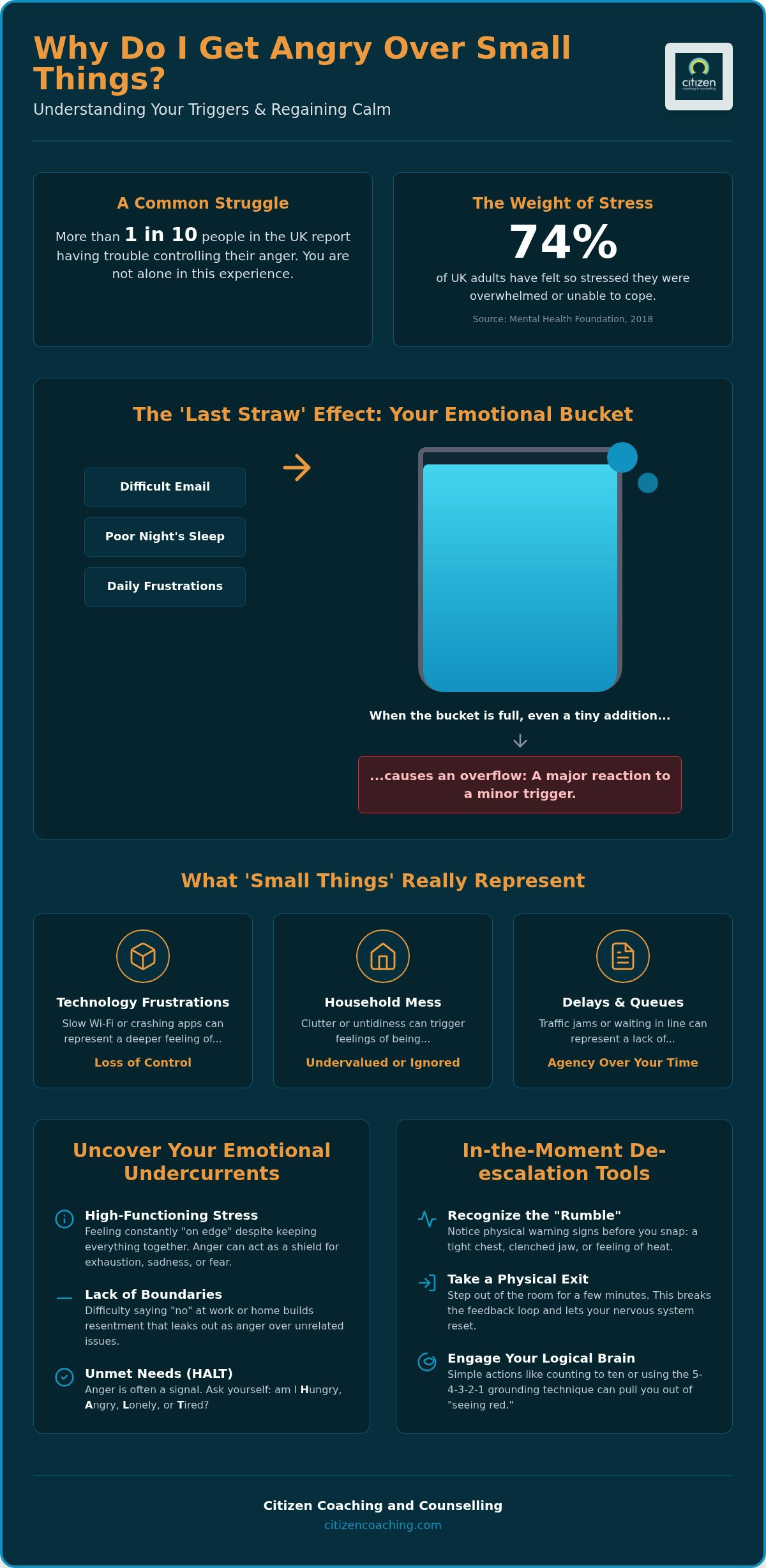
When you find yourself shouting at a slow Wi-Fi connection or a pile of laundry, it's rarely about the internet speed or the clothes. You might wonder, why do I get angry over small things so suddenly? The truth is that these minor frustrations are usually just the final drop in what we call your "emotional bucket." Every stressor you face during the day, from a difficult email to a poor night's sleep, adds a drop of water. When the bucket is already full, even a tiny addition causes it to spill over instantly.
Snapping doesn't make you a bad person. It's a signal from your brain that you've reached your limit. This feeling is incredibly common. According to a 2018 survey by the Mental Health Foundation, 74% of UK adults reported feeling so stressed at some point that they felt overwhelmed or unable to cope. This state often leads to displaced aggression, where you redirect your frustration from a major stressor toward a safer, smaller target. It's a natural, though painful, reaction to being overloaded.
Common 'Small' Triggers and What They Represent
Small triggers often mask deeper feelings. Identifying what they represent is a key part of our anger management courses. Understanding these patterns helps you see that the reaction isn't random. Here are three common examples:
- Technology frustrations: Slow devices often represent a loss of control or a threat to your efficiency.
- Household mess: Messy rooms can trigger feelings of being undervalued or ignored by family.
- Traffic or queues: Delays often represent a lack of agency over your own time and schedule.
Identifying Your Emotional Undercurrents: Stress, Burnout, and Unmet Needs
It's hard to understand why do I get angry over small things when you feel like you're keeping it all together. Often, the reason lies beneath the surface in your daily habits and stress levels. If you aren't sleeping well or you're skipping meals, your frustration threshold drops. Your brain simply lacks the fuel it needs to stay calm and regulated.
Many people in Birmingham experience what we call high-functioning stress. You do everything right at work and home, yet you feel constantly on edge. In these moments, anger often acts as a shield for other feelings like sadness, fear, or deep exhaustion. If you feel your irritability is part of a larger emotional pattern, private counselling Birmingham can help you explore these hidden layers. If you'd like to talk about your specific situation, feel free to reach out to us for a supportive conversation.
The Physical Warning Signs of an Outburst
Your body usually knows you're about to snap before your mind does. We call this the "rumble before the storm." Look for a tight chest, a clenched jaw, or a sudden feeling of heat in your face. Recognizing these signs early gives you a chance to pause. When you notice the rumble, you can use "stop and breathe" techniques to prevent the outburst from happening. Understanding these physical roots helps answer the question of why do I get angry over small things so frequently.
Unmet Needs: The Silent Anger Trigger
Anger is often a loud way of saying you have an unmet need. A simple way to check this is the "HALT" acronym. Ask yourself: Am I Hungry, Angry, Lonely, or Tired? Often, addressing a physical need like hunger or exhaustion can lower your stress instantly. Resentment also grows when you lack clear boundaries. If you struggle to say "no" at work or home, that pressure eventually leaks out as anger over small, unrelated issues.
Practical Strategies to Manage Your Response in the Moment
When you're "seeing red," your brain's logical center effectively goes offline. Deep psychological work is best saved for later; right now, you need immediate de-escalation. Simple actions like counting to ten actually work because they force your brain to engage its logical side. If a situation feels too intense, try a "Physical Exit." Stepping out of the room for a few minutes breaks the feedback loop of an argument and gives your nervous system a chance to reset. For those looking for long-term skills, our online anger management course can provide a structured toolkit of practical steps.
The 5-4-3-2-1 Grounding Technique
This technique pulls you out of an angry trance by focusing on your senses. It interrupts the "fight or flight" response by grounding you in the present moment. Try to name five things you can see, four you can touch, three you can hear, two you can smell, and one you can taste. This shift in focus calms the nervous system and helps you stop wondering why do I get angry over small things and start feeling back in control.
Communicating Your Needs Without Shouting
Shouting often happens when we feel unheard. To change this, use "I" statements. Instead of saying "You always leave the kitchen messy," try "I feel overwhelmed when the house is cluttered." This reduces defensiveness in others. Once everyone is calm, have a "Post-Game Review." Talk about the trigger without the heat of the moment clouding the conversation. This helps you address the root of why do I get angry over small things without damaging your relationships.
Taking the First Step: How Professional Anger Coaching Can Help
Understanding the root causes of your irritability is a powerful start. However, moving from insight to action often requires professional guidance. There's a big difference between venting your frustrations and actually managing them. Venting might feel good for a moment, but it doesn't empty your "emotional bucket" for good. Coaching provides you with the practical tools to change your reactions permanently.
For those living in our local community, finding an Anger Management Therapist Birmingham can provide the face-to-face support needed to make real progress. Citizen Coaching isn't a cold clinical institution. We're a social enterprise founded in 2005 with a mission to make personal growth accessible to everyone. We want to remove the barriers that stop people from seeking help. This community focus ensures you're supported by real people who understand the local environment.
Group vs. Individual Sessions: What to Expect
Choosing the right format depends on your comfort level and goals. Group sessions are incredibly helpful for realizing that you aren't alone. Hearing others share their struggles with why do I get angry over small things can reduce the shame you might feel. It builds a sense of community. Individual sessions offer a deep-dive personal focus tailored specifically to your triggers and life circumstances.
Both options provide a confidential and non-judgmental environment. You won't find any medical jargon here; just real people ready to help. Seeking support isn't a sign of weakness. It's a sign of strength and a deep commitment to your own peace and your family's wellbeing. You're taking a vital step toward becoming the partner or parent you want to be. When you address why do I get angry over small things, you're investing in a calmer future for everyone you love.
Move Toward a Calmer and More Controlled Future
You've already taken a significant step by exploring the reasons behind your reactions. Understanding why do I get angry over small things is the first step toward reclaiming your peace and protecting your most important relationships. We've seen how an "overflowing bucket" and unmet physical needs can shorten your fuse, but these patterns don't have to define your future.
Citizen Coaching is here to help you move from simply surviving these outbursts to truly managing your emotional well-being. With over 15 years of experience in Birmingham and a team of BACP-registered practitioners, we provide a safe, non-judgmental space for your development. As Social Enterprise of the Year finalists, we're dedicated to making this life-changing support accessible to everyone in our community.
Remember that seeking help is a sign of strength and a commitment to your family. You don't have to carry this weight alone. A calmer, more balanced life is well within your reach, and we're ready to help you begin that journey.
Frequently Asked Questions
Is it normal to get angry over small things?
Yes, it's a common experience for many adults. Snapping over a minor trigger usually means you've reached your capacity for stress. Statistics show that more than one in ten people in the UK report having trouble controlling their anger. You aren't alone in wondering why do I get angry over small things. It's a signal from your brain that you're overwhelmed and need better tools to manage daily pressures.
Could my anger be a sign of depression or anxiety?
Anger and irritability are frequent symptoms of other emotional struggles. Research indicates that over 60% of people with depression experience mood instability, which can include displays of anger. While we don't provide medical diagnoses, we often see clients whose frustration is a mask for underlying anxiety or exhaustion. Professional coaching or counselling can help you untangle these feelings and find a clearer path forward in a non-judgmental setting.
What should I do immediately after I lose my temper?
Focus on immediate repair and self-regulation. First, take a physical exit to allow your nervous system to cool down. Once you're calm, acknowledge what happened without making excuses. A simple apology like, "I'm sorry I shouted, I felt overwhelmed," goes a long way. Check your "HALT" needs: are you hungry or tired? Taking care of these basics prevents a second outburst from happening shortly after.
How do I explain my anger issues to my partner?
Use "I" statements to share your experience during a calm moment. You might say, "I've been struggling with why do I get angry over small things lately, and I want to work on it." Explain that your reactions aren't their fault but a sign that you're feeling overloaded. Sharing that you're seeking support, like our Birmingham sessions, shows your commitment to the relationship and your shared future.
Does anger management really work for 'minor' irritability?
Absolutely. Anger management isn't just for people with "explosive" rage. It's a form of coaching that provides practical tools for anyone feeling constantly on edge. You'll learn to recognize physical warning signs early and build a toolkit of de-escalation strategies. Our jargon-free approach helps you lower daily stress levels, making "minor" triggers much easier to handle. It's about personal growth and improving your quality of life every day.

Article by
Martin Hogg
Counselling and Anger Management in Birmingham. Articles by Martin Hogg, counsellor MBACP (Reg.) and Founder and CEO of Citizen Coaching and Counselling, a social enterprise based in Birmingham, UK. Martin also helps counsellors struggling to set up and grow their Private Practice to gain clarity and confidence in their marketing and systems.
Disclaimer
The information provided on this blog is for general informational purposes only and is not intended to be a substitute for professional medical or mental health advice, diagnosis, or treatment. Reading this content does not create a therapist-client relationship.


