
Anger Management Techniques for Adults: 2026 Guide
The 2026 Heart Disease and Stroke Statistics Update highlights that persistent emotional stress and unmanaged anger are significant drivers for heart disease. It's a heavy thought, but it reflects a reality many face. If you've ever felt the sting of shame after a heated outburst or worried about the damage done to your family and career, you aren't alone. Most people want to be the calm version of themselves, but finding effective anger management techniques for adults often feels like finding a path through a storm. We understand that taking this first step is hard. We're here to help you navigate it without any medical jargon or judgement.
You can regain control and protect your wellbeing. This guide provides proven strategies to help you de-escalate tension and improve your communication with loved ones. We'll explore how to handle triggers in the moment and look at long term lifestyle changes that lower your daily stress levels. From simple breathing exercises to understanding your reactions, you'll find practical tools to help you feel steady and confident again.
Key Takeaways
- Master the "Stop, Breathe, Reflect" method to act as an immediate circuit breaker when you feel tension rising.
- Explore practical anger management techniques for adults that transform reactive outbursts into calm, "I" statement-led conversations.
- Learn how maintaining your physical health through better sleep and nutrition creates a buffer against emotional triggers.
- Identify the clear signs that indicate when professional group or individual coaching programmes could help you reach your goals faster.
Immediate De-escalation: Techniques to Calm Anger in the Moment
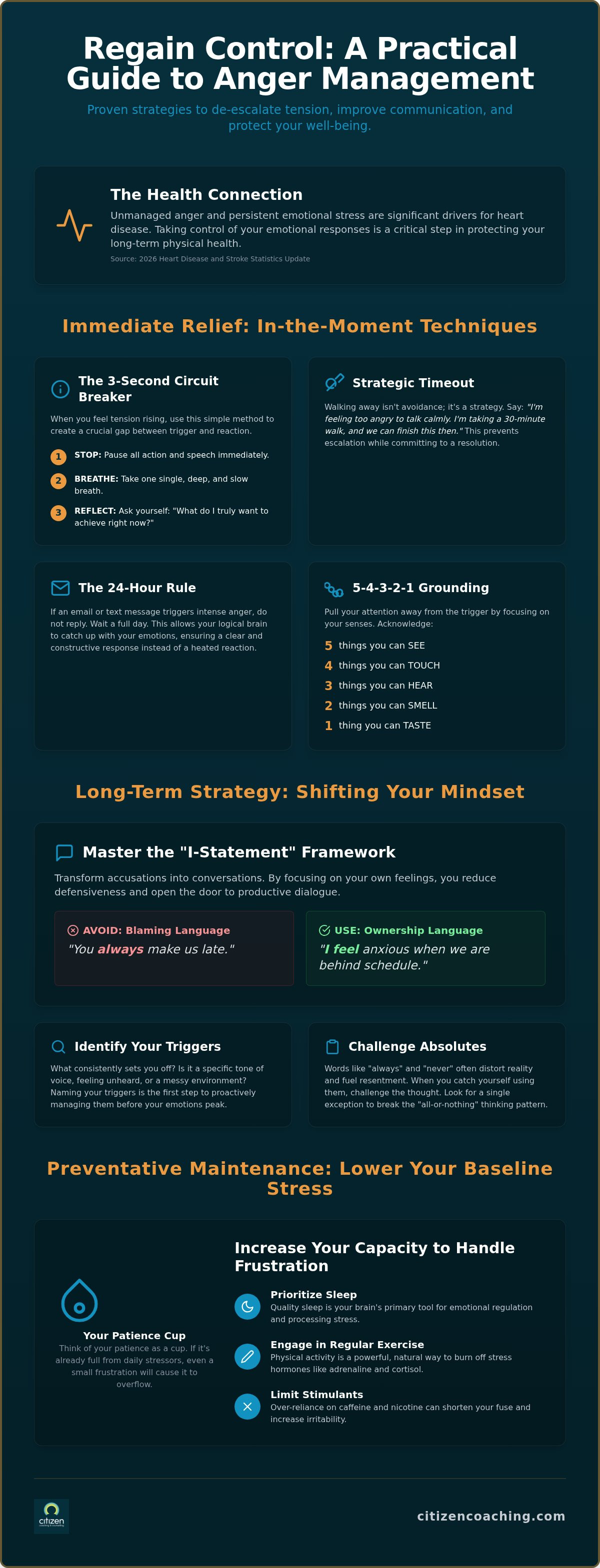
When you feel your heart racing and your face getting hot, you're in the middle of a biological storm. Learning effective anger management techniques for adults starts with having a "circuit breaker" for these moments. The Stop, Breathe, Reflect method takes just three seconds. You stop what you're doing, take one deep breath, and ask yourself what you want to achieve. This small gap prevents your "fight or flight" response from taking over. By oxygenating your blood through controlled breathing, you signal to your brain that you aren't in physical danger.
In our digital world, it's easy to send a message you'll regret. If an email or text makes your blood boil, apply the 24-hour rule. Don't reply. Don't even save a draft. Wait a full day to let your logical brain catch up with your emotions before you hit send. This allows you to respond with clarity rather than reacting with heat.
The Power of the Strategic Timeout
Sometimes the best way to handle a conflict is to walk away. This isn't about avoiding the problem; it's about a strategic timeout. Tell the other person, "I'm feeling too angry to talk calmly right now. I'm going for a walk, but I'll be back in thirty minutes to finish this." Setting a return time ensures the issue gets resolved without the conversation turning into a shouting match. Our anger management courses can help you practice setting these boundaries effectively.
Physical Grounding Exercises
If your mind is racing, use the 5-4-3-2-1 technique to ground yourself. Acknowledge five things you see, four you can touch, three you hear, two you smell, and one you can taste. This shift in focus is a core part of Anger management because it pulls your attention away from the trigger. Splashing cold water on your face or moving your body also helps reset your nervous system. Physical sensations provide a strong enough signal to distract the amygdala from its emotional spiral.
Shifting Your Mindset: Communication and Cognitive Tools
While immediate de-escalation stops the fire, shifting your mindset prevents the sparks from catching. This starts with identifying your specific triggers. Perhaps it's a messy house, a specific tone of voice, or feeling unheard. When you name these triggers, you move from being reactive to being proactive. Knowing what sets you off allows you to use anger management techniques for adults before your emotions peak. You don't need complex technical terms to change how you think. These shifts are central to many 10 anger management tips that focus on long term change.
One common trap is "all or nothing" thinking. Words like "always" or "never" fuel resentment and shut down productive conversation. Try to challenge these thoughts by looking for exceptions. Developing empathy for the other person also helps. When you consider their stress, the situation feels less like a personal attack and more like a hurdle you can clear together.
The "I-Statement" Framework
Communication is where many struggles begin. Using the "I-statement" framework is one of the most effective anger management techniques for adults for improving daily interactions. You can transform "You always make me late" into "I feel anxious when we are behind schedule." This focus on your feelings rather than the other person's faults reduces defensiveness. It's a gentle way to ask for change that works well with partners and colleagues alike.
Reframing Frustration
Try visualising the problem as a separate entity rather than a personal slight. If there's a recurring argument, see it as a puzzle you and your loved one are solving together. This approach makes it easier to stay calm because you aren't fighting each other; you're fighting the situation. If you feel these patterns are becoming a habit, you can explore Couples Counselling Birmingham to rebuild these vital communication bridges.
Preventative Maintenance: Lifestyle Habits to Lower Your Baseline
Effective anger management techniques for adults aren't just about what you do during a crisis. They're about lowering your baseline stress so you don't get triggered as easily. Think of your patience like a cup. If it's already full of stress from poor sleep or too much caffeine, even a small drop will make it overflow. By managing your daily habits, you increase your capacity to handle life's frustrations calmly.
Sleep is your brain's primary tool for emotional regulation. Data from the 2026 Heart Disease and Stroke Statistics Update shows that persistent emotional stress, which is often worsened by lack of rest, contributes significantly to adverse health outcomes and heightened irritability. Similarly, relying on stimulants like nicotine and caffeine keeps your nervous system on high alert. You can find more on managing these physiological factors in the APA's guide to controlling anger.
Lowering Your Emotional Threshold
The "Emotional Cup" metaphor helps you visualise your daily capacity. When you're well-rested and active, your cup is large and can hold more. When you're stressed, it shrinks. Regular physical activity acts as a release valve for accumulated tension, letting out the pressure before it reaches a breaking point. This creates a buffer that makes it easier to stay in control during difficult moments.
The Importance of Daily Reflection
Spend ten minutes each evening in quiet reflection. Use a simple journal to spot patterns in your reactions. Do you feel more reactive on Tuesday afternoons? Is a certain work environment causing tension? Noticing these trends helps you apply anger management techniques for adults before a situation escalates. This proactive approach prevents a late-afternoon outburst by addressing the tension early.
Moving from Self-Help to Professional Anger Coaching
Sometimes, even the best anger management techniques for adults need outside structure to truly stick. If you find that your outbursts are still straining your relationships or you feel a constant sense of shame, it's a sign that you might need more than just a self-help guide. Professional coaching provides the accountability and tailored feedback that solo practice often lacks. It helps you see blind spots in your reactions that are hard to spot on your own.
As a Community Interest Company founded in 2005, we operate as a social enterprise. This means our support is accessible and grounded in the community rather than feeling like a cold, clinical institution. We focus on being a team of real people ready to help you navigate your journey. By removing the medicalised feel of traditional services, we make it easier for you to take that vital first step toward a calmer life.
What to Expect in Professional Coaching
Our coaches act as trusted mentors who guide you through the process of personal development. You won't face a medical diagnosis or a lecture. Instead, you'll find a non-judgmental space where you can be vulnerable and honest. Whether you prefer one-on-one sessions or our specialised Anger Management Courses, the focus remains on practical, everyday tools that work in the real world.
Birmingham Support and Beyond
For those who value shared experiences, our Anger Management Birmingham group programmes offer a safe environment to learn alongside others. If your schedule is tight or you aren't ready for a group setting, a flexible Online Anger Management Course allows you to progress at your own pace. Taking action is what matters most. We are here to ensure you have the right support, whichever path you choose.
Start Your Journey to Lasting Calm
You've taken a brave first step today by learning how to regain control of your reactions. Mastering effective anger management techniques for adults involves a balance of immediate de-escalation and long term lifestyle changes. Whether you're practicing the "Stop, Breathe, Reflect" method or improving your communication through "I" statements, every small change builds a stronger foundation for your future. These tools aren't just about stopping outbursts; they're about protecting your health and your relationships.
Since 2005, our team has supported the Birmingham community as a social enterprise. We believe that professional support should be accessible and non-judgmental. Our expert coaches specialise in adult emotional regulation, acting as mentors rather than clinical figures. We understand that starting this journey is often the hardest part, but you don't have to navigate it alone. Our experience ensures that you have a steady, reliable path forward.
You deserve to feel in control of your reactions and at peace with those you love. We are ready to help you move forward whenever you feel prepared to begin.
Frequently Asked Questions
Is anger management just for people who are violent?
No, it's for anyone who feels their reactions are out of sync with their values. Many people seek support because they feel constantly on edge or regret things they say during arguments. It's about learning to communicate needs before they turn into frustration. Whether you're dealing with "silent" anger or verbal outbursts, these tools help you regain control and improve your quality of life.
How long does it take for anger management techniques to start working?
You can see immediate results with de-escalation tools like the 5-4-3-2-1 grounding method. However, changing long-term habits usually takes several weeks of consistent practice. Most people in our programmes report feeling more in control after four to six sessions. Success depends on applying the anger management techniques for adults in real-world situations. It's a journey of steady, manageable progress rather than an overnight fix.
Can I learn anger management techniques online or do I need to go in person?
You can choose the format that best fits your lifestyle. Our Online Anger Management Course is a popular first step for those who need flexibility or aren't ready for a group setting. If you prefer face-to-face interaction and peer support, our Birmingham-based group and individual sessions are excellent options. Both paths teach the same proven strategies to help you manage your triggers and improve your relationships.
What is the difference between anger management coaching and traditional therapy?
Coaching is a practical, solution-focused approach that teaches specific anger management techniques for adults. While traditional therapy might focus on clinical history, our coaching is more like having a mentor. We focus on the "here and now," helping you identify current triggers and develop actionable strategies for the future. It's a developmental tool designed to help you navigate daily life with more confidence and less stress.
Will my employer find out if I attend an anger management programme?
Your privacy is a priority for us. Attending a programme is a confidential process, and we don't share your information with your employer without your explicit consent. Many people worry about professional consequences, but taking proactive steps to manage your emotions often leads to better performance at work. We provide a safe, private space where you can focus on your personal development without fear of judgement.

Article by
Martin Hogg
Counselling and Anger Management in Birmingham. Articles by Martin Hogg, counsellor MBACP (Reg.) and Founder and CEO of Citizen Coaching and Counselling, a social enterprise based in Birmingham, UK. Martin also helps counsellors struggling to set up and grow their Private Practice to gain clarity and confidence in their marketing and systems.
Disclaimer
The information provided on this blog is for general informational purposes only and is not intended to be a substitute for professional medical or mental health advice, diagnosis, or treatment. Reading this content does not create a therapist-client relationship.


