
Anger Management at Work UK: Guide to Professional Calm
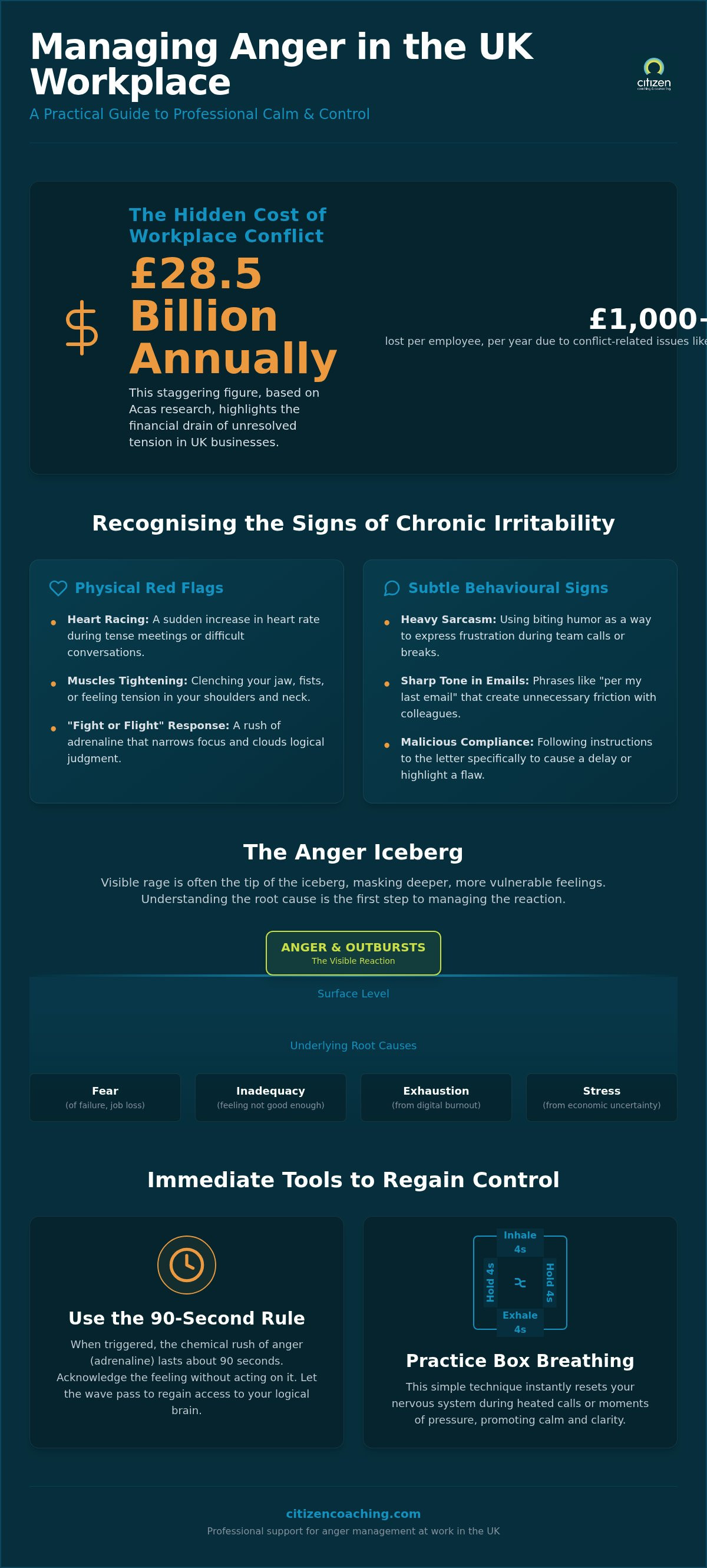
Did you know that workplace conflict costs UK employers an estimated £28.5 billion every year? According to research from Acas, that is equivalent to over £1,000 per employee, often driven by the same stress and tension you might be feeling right now. It is incredibly draining to spend your day masking frustration, only to feel a surge of guilt after sending a "heated" email or worrying about an HR disciplinary meeting. Seeking help for anger management at work in the UK isn't about admitting a medical flaw. Instead, it is about gaining a vital professional skill that protects your career and your reputation.
We understand that starting this journey can feel vulnerable, but you deserve a workplace experience that doesn't leave you exhausted. This guide provides a supportive, non-judgmental path toward professional calm using everyday language. We will look at how to handle specific triggers, navigate the impact of the Employment Rights Act 2025, and use practical tools to regain control. By the end, you will have a clear plan to stay composed and confident, even when the pressure is on.
Key Takeaways
Spot the physical red flags of chronic irritability early to prevent the fight or flight response from clouding your judgment during important meetings.
Use the 90-second rule to manage chemical surges and practice box breathing to instantly reset your nervous system during heated office calls.
Understand why the "stiff upper lip" myth often leads to sudden outbursts and how to protect your career from the stress of the 2026 economic climate.
Learn how to access professional anger management at work uk through supportive coaching that focuses on practical tools rather than medical labels.
Table of Contents
Recognising the Signs of Chronic Anger at Work
Workplace anger isn't always a dramatic outburst or a slammed door. For many UK professionals, it shows up as a state of 'chronic irritability' that hums in the background of every task. This is a persistent feeling of being annoyed or frustrated that goes beyond having a single bad morning. When you are in this state, your "baseline" shifts. Being on edge becomes your new normal, making it harder to access the calm, logical part of your brain when you need it most.
Physical red flags are often the first sign that things are reaching a tipping point. During a tense meeting, the "fight or flight" response floods your system with stress hormones that narrow your focus, making it difficult to consider long-term consequences or creative solutions. You might notice your heart racing or your muscles tightening before you even realise you're angry. Anger management techniques often start with identifying these bodily signals before they turn into actions you regret.
Sometimes, the signs are quieter and hide in your daily habits. You might spot them in:
Heavy sarcasm during team coffee breaks or Zoom calls.
"Malicious compliance," where you follow instructions to the letter specifically to highlight a flaw or cause a delay.
That sharp, "per my last email" tone that creates unnecessary friction with colleagues.
The Professional Toll of a Short Fuse
In UK firms, your "promotion readiness" depends heavily on emotional intelligence and how you handle pressure. If colleagues feel they have to walk on eggshells around you, it damages team dynamics and can quietly stall your career growth. Many people also experience the sheer mental exhaustion of "masking" their frustration all day, only to reach a boiling point the moment they walk through their front door at home.
When Frustration Becomes a Liability
It's vital to distinguish between a healthy professional disagreement and destructive workplace rage. In the 2026 UK workplace, hybrid work has added a new layer of difficulty to our interactions. Without face-to-face cues, it's incredibly easy to misinterpret a short message or a blunt email as a personal attack. This misunderstanding can quickly turn a small frustration into a career liability. Gaining support for anger management at work uk helps you bridge these communication gaps and stay in control of your professional narrative.
The Root Causes of Workplace Friction in the UK
The traditional "stiff upper lip" is a cultural myth that often does more harm than good in a professional setting. We're frequently encouraged to bottle up minor annoyances, but these feelings don't simply vanish. They simmer under the surface until a small trigger causes a disproportionate outburst. This is particularly evident in the 2026 economic climate, where rising costs and job uncertainty have lowered our collective emotional thresholds. Finding the right support for anger management at work uk starts with understanding these hidden cultural pressures.
It's also helpful to look at the "Anger Iceberg," where visible rage is merely the tip of a much larger structure. Beneath the surface, anger often acts as a protective shield for more vulnerable feelings like fear, inadequacy, or exhaustion. If you find yourself snapping at a colleague, it might actually be your brain's way of reacting to a perceived threat to your security or status. When these feelings lead to formal friction, you may need to solve a workplace dispute through official channels, but addressing the underlying emotional cause is the only way to find lasting peace.
Societal Triggers and Digital Burnout
Back-to-back video calls and the "always-on" digital culture have removed the natural decompression time we once had during commutes or office walks. This work-life blur leads to chronic sleep deprivation and emotional fatigue, which makes it much harder to stay calm. UK office culture often discourages showing vulnerability, which forces that internal pressure to come out as irritability instead. Without a clear boundary between home and the office, your brain never feels truly "off" the clock.
Learned Behaviours and Protection Modes
Our brains can get stuck in "protection mode" during times of restructure or when receiving tough feedback. We start seeing every comment as an attack rather than an opportunity for growth. Learning how to navigate these triggers is a key part of effective anger management at work uk. You can unlearn these defensive patterns and replace them with calmer, more productive responses. Explore how our Online Anger Management Course UK helps unlearn these patterns. If you're ready to start that journey, feel free to reach out to our team for a supportive chat.
Immediate Tools to Manage Your Temper in the Office
When you feel a surge of frustration during a meeting, it's helpful to remember the 90-second rule. This is the approximate chemical lifespan of an anger spike in your brain. If you don't "feed" the emotion with more angry thoughts, the physical rush will naturally start to fade after about a minute and a half. Mastering these quick techniques is a core part of effective anger management at work uk, allowing you to respond with logic rather than impulse.
Physical grounding is one of the fastest ways to regain control. Box breathing resets the nervous system during a heated call by physically interrupting the stress response through a steady, rhythmic pattern of inhales and exhales. Along with this, don't be afraid to use a "Professional Time-Out." Simply saying, "I'd like five minutes to review these notes before we continue," gives you a safe exit to cool down before saying something you might regret.
Digital hygiene is just as vital for maintaining your reputation. If a message leaves you fuming, use the "Draft and Delete" rule. Write exactly what you're feeling in a blank document, then delete it entirely. This lets you vent the emotion without ever hitting send. These small habits prevent temporary feelings from causing permanent career damage.
Shifting from Aggression to Assertiveness
There's a big difference between "shouting to be heard" and "speaking to be understood." In professional settings, using 'I' statements helps you express your needs without triggering a colleague's defences. Instead of saying "You always miss deadlines," try "I feel pressured when I don't receive the reports on time." This keeps the focus on the workflow rather than launching a personal attack.
Daily Resilience Habits
Building long-term calm requires looking at stress in the workplace through a wider lens. Simple habits, like taking a walk during your lunch break, help "burn off" residual cortisol that builds up throughout the morning. This physical movement clears your head and resets your emotional threshold for the afternoon. You can explore more team-wide strategies through our Workplace Wellbeing Training Birmingham. Gaining these tools for anger management at work uk ensures you stay resilient, no matter how busy the office gets.
Speak with a coach today about managing workplace triggers
Finding Professional Anger Management Support in the UK
Choosing the right path for anger management at work UK depends on your specific needs, your timeline, and your budget. You have several options. Many people start by speaking with their GP about NHS Talking therapies, which often focus on clinical treatments like CBT. While this is a vital resource, wait times in 2026 can be significant. Private coaching or a social enterprise model offers a faster, more practical alternative for those who need immediate tools to protect their career.
At Counselling Anger Management Birmingham Citizen Coaching, we focus on jargon-free support that prioritises "tools for the future" over simply "analysing the past." We don't use cold, medical labels. Instead, we offer a supportive environment where you can learn to navigate the pressures of a modern office. Group work is particularly effective here. It helps reduce the heavy sense of isolation by proving you aren't the only professional struggling with these triggers. Sharing a journey with others builds a unique sense of community and perspective.
What to Expect in Your First Session
Your first session is designed to be a safe, non-judgmental space. You can be honest about your frustrations and your vulnerability without any fear of professional repercussions or HR involvement. It's a chance to identify your specific triggers with a guide who understands the UK corporate landscape. If you're looking for an Anger Management Therapist Birmingham, our local roots ensure you receive grounded, specialised support that feels neighbourly rather than clinical.
Taking the Next Step Confidently
You can access professional support as an individual or through your company’s wellbeing programme. Many UK employers now recognise that emotional control is a vital professional skill and are happy to support staff in gaining these tools. The key is choosing a provider that understands the specific stresses of the British workplace. Taking this step isn't a sign of weakness; it's a proactive investment in your future and your peace of mind.
Contact us today to start your journey toward a calmer workplace presence
Building Your Path to Professional Peace
Regaining control of your workplace presence is one of the most rewarding steps you can take for your career. By understanding your unique triggers and using simple grounding techniques, you can transform frustration into professional calm. You don't have to navigate this journey alone or feel like the "only angry person" in your office.
Our team at Citizen Coaching brings over 20 years of experience to every session, helping people across Birmingham and the UK find practical solutions. As a Social Enterprise (CIC), we're committed to providing accessible, mentor-led support that focuses on your future. We don't believe in medical labels; we believe in giving you the tools you need to succeed. Seeking support for anger management at work uk is a sign of professional maturity that protects your reputation and your wellbeing.
Start your journey to a calmer professional life with our jargon-free courses
You've already taken the first step by learning more about how your mind works under pressure. A calmer, more confident version of yourself is within reach, and we're ready to help you get there.
Frequently Asked Questions
Can I get anger management on the NHS in the UK?
Yes, you can access support through NHS Talking Therapies by speaking to your GP or self-referring online. While this is a free service, wait times can be quite long, often leading professionals to seek private anger management at work UK for faster access. NHS support usually focuses on clinical methods like CBT. This is a great starting point, but many find coaching more tailored to specific workplace scenarios.
Will my employer find out if I attend an anger management course?
No, your employer won't find out unless you choose to tell them or they are funding the sessions as part of a formal referral. Professional coaching and counselling are strictly confidential. We prioritise your privacy so you can explore your triggers without worrying about your professional reputation or HR records. You deserve a safe space to work through these feelings without fear of any repercussions.
What is the difference between anger coaching and counselling?
Anger coaching is future-focused and prioritises practical tools to handle immediate triggers in the office. Counselling often looks deeper into the past to understand the roots of your emotions. At Citizen Coaching, we focus on a jargon-free, mentor-led approach that gives you a clear plan for your next meeting or call. Both approaches are valuable, but coaching is often faster for your professional development.
Is it normal to feel angry at work for no specific reason?
It's quite common to feel on edge without a single obvious cause, often due to a baseline shift caused by chronic stress or burnout. Small, unrelated annoyances can pile up until your brain stays in a state of high alert. Recognising this as emotional exhaustion rather than a personal flaw is the first step toward recovery. Understanding these patterns helps you regain control before the frustration boils over.
How long does it take for anger management tools to start working?
You can start using physical tools like box breathing or the 90-second rule immediately to de-escalate a surge of rage. However, unlearning deep-seated habits and building long-term resilience usually takes a few weeks of consistent practice. Most people notice a positive change in their reactions after completing a structured course in anger management at work UK. Consistency is key to making these new responses feel natural.

Article by
Martin Hogg
Counselling and Anger Management in Birmingham. Articles by Martin Hogg, counsellor MBACP (Reg.) and Founder and CEO of Citizen Coaching and Counselling, a social enterprise based in Birmingham, UK. Martin also helps counsellors struggling to set up and grow their Private Practice to gain clarity and confidence in their marketing and systems.
Disclaimer
The information provided on this blog is for general informational purposes only and is not intended to be a substitute for professional medical or mental health advice, diagnosis, or treatment. Reading this content does not create a therapist-client relationship.


