
What to Expect in Individual Counselling: A Clear, Reassuring Guide
What if your first counselling session didn’t require you to have everything figured out? If you’re wondering what to expect in individual counselling, it’s understandable to feel unsure about what to say or worry about being judged or misunderstood. You might even wonder whether asking for support means something is seriously wrong. It doesn’t have to. Counselling can begin with a conversation, not a test or a fixed script, and you can take things at your own pace.
This guide explains how a counselling relationship can develop, what you might choose to bring to a session and how to share only what feels comfortable. You’ll also learn what the first steps may involve and how to explore individual counselling in Birmingham. Counselling Anger Management Birmingham Citizen Coaching provides individual counselling in Birmingham and online. Whether you arrive with a clear concern or simply a sense that something feels difficult, you can start by talking about what matters to you.
Key Takeaways
- Learn what to expect in individual counselling, from sharing concerns to exploring what kind of support may feel useful.
- Sessions can include listening, questions and reflection, but they don’t have to follow a fixed script.
- To feel more prepared, notice what prompted you to seek support and think of any questions. You don’t need to bring a complete personal history.
- Explore individual counselling with Citizen Coaching and Counselling, a Birmingham-based Community Interest Company that reinvests profits into community mental health.
Individual Counselling: A Supportive Space to Begin
Individual counselling is a one-to-one space to talk with a practitioner about what’s troubling you, make sense of your feelings and explore what might help. You don’t need to arrive with a clear plan. Feeling nervous, uncertain or unsure where to start is understandable, especially when you’re talking about personal experiences with someone new.
Put simply, individual counselling is a supportive conversation about your concerns. It isn’t a test, an interrogation, a medical diagnosis or emergency crisis support. You’re not expected to explain everything perfectly or share more than feels manageable. For a broad introduction to therapy and its different forms, see What is Psychotherapy?
What can someone bring to individual counselling?
You can bring whatever feels important, even if it seems ordinary or hard to explain. It might be stress at work, tension in a relationship, bereavement, low self-esteem or a change that has left you unsettled. You could begin with a question, such as “Why do I keep feeling this way?” or describe how the past few days have felt. A defined goal can take shape later. You don’t need to have one before you begin.
Does counselling have to follow a set script?
No single script fits every person. The conversation can follow what feels most relevant to you, and you can say if a subject feels difficult or you’d rather pause. A practitioner may listen, ask questions or invite you to reflect, but you don’t have to answer everything at once. You might start with one recent situation, then talk about how it affected you and what you’d like to understand better. The pace and focus can vary from person to person.
How the Counselling Relationship and Sessions Can Develop
Over time, counselling can give you space to look more closely at what’s been weighing on you. The practitioner may listen, ask questions or reflect back what they’ve heard, helping you consider your experience from another angle. These are possibilities, not a fixed formula. The conversation is guided by your concerns and priorities rather than a standard agenda.
For example, you might arrive talking about an argument and notice that similar situations leave you feeling overlooked. Exploring that connection may help you recognise a feeling, pattern or need. There’s no guaranteed outcome or set pace. The work can focus on understanding what’s difficult and considering what support feels useful. SchoolSafety.gov’s Mental Health Support Strategies offers a broader look at mental health support approaches.
What if it is hard to talk at first?
You can take your time. If a topic feels difficult, you can say so, pause or start with what feels easier to put into words. “I’m not sure where to begin” is a useful place to start, too. A practitioner can explore that uncertainty with you rather than expecting a polished explanation. You remain involved in deciding what to discuss.
Can the focus change over time?
Yes. As you reflect on what’s happening, a different concern may feel more pressing, or you may understand an earlier difficulty in a new way. You can bring that change into the conversation. Counselling doesn’t have to follow identical steps for everyone. Its focus can respond to what matters to you as your needs become clearer.
If you’re considering individual counselling, you can get in touch with Citizen Coaching and Counselling to start a conversation about support.
How to Feel More Ready for Individual Counselling
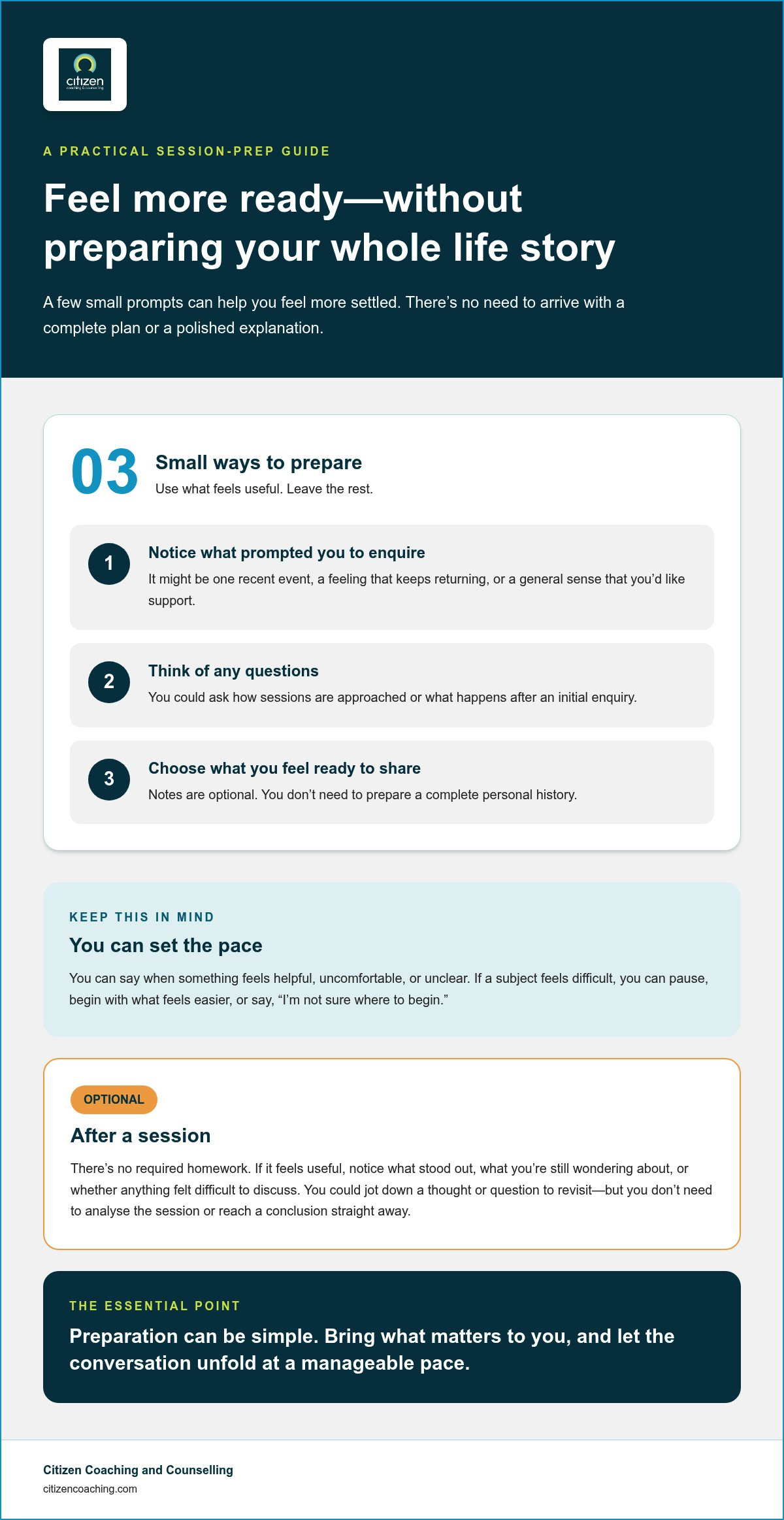
You don’t need to prepare a full account of your life before getting started. If you’re thinking about what to expect in individual counselling, a few small steps can help you feel more settled while leaving room for the conversation to unfold naturally.
- Notice what prompted you to enquire. It could be one recent event, a feeling that keeps returning or a general sense that you’d like support.
- Think of any questions. You might want to know how sessions are approached or what happens after an initial enquiry.
- Choose what you feel ready to share. Notes can help if you like having them, but they’re optional. You don’t need to prepare a complete personal history.
It’s reasonable to say during a conversation that something feels helpful, uncomfortable or unclear. Sharing that gives the practitioner a chance to understand how the discussion is affecting you. For a wider look at counselling practice, the American Mental Health Counselors Association’s Research in Mental Health Counseling features writing on the field.
What can I ask before getting started?
Ask what the first step involves and how the practitioner approaches sessions. You can also describe the support you’re hoping to find, even if you’re still working out what that means. For a local perspective, Citizen Coaching and Counselling’s Private Counselling Birmingham guide explores the subject in relation to Birmingham.
What can I do after a session?
There’s no required homework. If it feels useful, take a quiet moment to notice what stood out, what you’re still wondering about or whether anything felt difficult to discuss. You could jot down a thought or question to revisit next time, but you don’t need to analyse the session or reach a conclusion straight away.
Exploring Individual Counselling with Citizen Coaching and Counselling
Citizen Coaching and Counselling provides individual counselling in a supportive space shaped around you, rather than a scripted process. Based in Birmingham, the organisation also offers counselling online. As a Community Interest Company, it reinvests profits into community mental health. Counselling can give you room to explore what’s on your mind at a manageable pace, without promising a particular outcome.
Knowing what to expect in individual counselling can make reaching out feel less daunting, but you don’t need to have everything worked out first. You can begin by describing what has prompted you to consider support, or by saying you’re not sure what you need yet. Getting in touch can start a conversation about individual counselling and what a next step could look like.
Finding a first step that feels manageable
Reaching out may feel vulnerable. It’s reasonable to take the decision at your own pace and start with a small question rather than a complete explanation. If you’re in Birmingham, individual counselling with Citizen Coaching and Counselling offers a local option for one-to-one support. You can consider whether this kind of support feels right for you.
When counselling is not emergency support
It’s important to understand what this service is for. Citizen Coaching and Counselling does not provide emergency crisis intervention, medical diagnosis or prescriptions. Individual counselling offers a space to explore personal concerns with a practitioner; it isn’t a substitute for urgent crisis support or medical care. If you’re looking to begin a conversation about counselling, you can contact the team to discuss the next step without committing to a particular outcome.
Take a Gentle First Step Towards Support
Deciding whether to begin can take time. You don’t need to feel completely certain before exploring support, and reaching out doesn’t mean you have to explain everything at once. If you’re still wondering what to expect in individual counselling, let that question be part of the conversation. You can share what you hope might change, what feels difficult or simply that you’re unsure.
A first conversation can help you consider whether individual support feels like a suitable next step. Take it at your own pace. You’re allowed to ask questions, think things over and decide what feels right for you without having every answer in advance.
Small steps count. When you’re ready, contact Citizen Coaching and Counselling to start a conversation about individual counselling in Birmingham or online.
Frequently Asked Questions
Do I need to know what to talk about in individual counselling?
No, you can begin without a prepared topic. If you’re unsure what to expect in individual counselling, mention one thing you’ve noticed lately, such as putting off a conversation or finding it hard to switch off after work. A specific example gives you both somewhere concrete to start. You can then decide whether it feels useful to explore further.
What if I feel nervous or emotional during counselling?
Feeling nervous, tearful or quiet can happen, and it doesn’t mean you’re doing anything wrong. If strong feelings arise, you could name what’s happening, ask for a moment or focus on a steady breath before continuing. You don’t have to hide your reaction or turn it into a clear explanation. Letting the practitioner know can help you decide what feels manageable next.
Can I go to individual counselling without having a specific problem?
Yes. You might want space to reflect even if nothing feels clearly “wrong”. Perhaps life is changing, your usual routines no longer feel satisfying or you’re curious about why certain choices keep coming up. You can bring that uncertainty as your starting point. Counselling doesn’t require you to label your experience before you begin exploring it.
What happens if I decide individual counselling is not right for me?
You can reconsider whether you want to continue. If something about the conversations doesn’t feel helpful, you can raise that with the practitioner and explain what isn’t working for you. You may decide to pause, stop or talk through what you’d hoped for instead. Starting counselling doesn’t mean you must continue indefinitely.
Is individual counselling the same as receiving a medical diagnosis?
No. Counselling is a form of therapeutic support, not a medical diagnosis. At Citizen Coaching and Counselling, sessions offer a place to explore concerns and emotional experiences with a practitioner. The service doesn’t provide diagnoses or prescriptions. If you’re asking whether a particular condition explains how you feel, that’s different from exploring your experiences through counselling.

Article by
Martin Hogg
Counselling and Anger Management in Birmingham. Articles by Martin Hogg, counsellor MBACP (Reg.) and Founder and CEO of Citizen Coaching and Counselling, a social enterprise based in Birmingham, UK. Martin also helps counsellors struggling to set up and grow their Private Practice to gain clarity and confidence in their marketing and systems.
Disclaimer
The information provided on this blog is for general informational purposes only and is not intended to be a substitute for professional medical or mental health advice, diagnosis, or treatment. Reading this content does not create a therapist-client relationship.


