
Trainee Counsellor Supervision in Birmingham: The Essential 2026 Checklist
What if your biggest worry about starting your placement isn't the clients, but the fear of getting your paperwork wrong? It's a common stress, especially when you're trying to balance BACP or NCPS requirements with a limited budget. Finding the right trainee counsellor supervision in Birmingham can feel like a full-time job in itself. You want to feel safe, supported, and confident that you're meeting every clinical standard without spending a fortune on private fees.
We know that taking the first step into clinical practice is often the hardest part of your journey. That's why we've created this jargon-free guide to help you manage your 2026 supervision requirements with ease. You'll learn exactly how to calculate your ratios, what questions to ask a potential mentor, and how to find local support that fits your needs. We're going to walk through a practical checklist that ensures you stay compliant while focusing on what really matters; your growth as a therapist.
Key Takeaways
- Understand how clinical supervision acts as a collaborative safety net to protect your clients and support your own mental wellbeing during your placement.
- Get a clear, jargon-free breakdown of BACP and NCPS requirements, including the essential 1.5-hour monthly minimum and the 8:1 clinical ratio.
- Learn how to find the right mentor for trainee counsellor supervision in Birmingham by prioritizing professional "chemistry" and strong boundaries.
- Use our 10-point essential checklist to navigate your first meeting with a supervisor and ensure your professional relationship is built on a solid foundation.
- Discover how a local Birmingham social enterprise can guide you through your journey with practical, plain-English support tailored to your development.
Why Trainee Counsellor Supervision is Your Safety Net
Starting your first clinical placement feels like a huge leap. It's the moment where textbooks become real people with real pain. This is where trainee counsellor supervision becomes your most valuable tool. Think of it as a collaborative guide rather than a boss checking your homework. It's a professional relationship designed to help you grow while keeping everyone safe. By using Clinical Supervision, you ensure that your practice meets high ethical standards while you develop your unique therapeutic voice.
The process serves a dual purpose. First, it protects the client by providing a second pair of eyes on the work. Second, it supports your emotional wellbeing. Many trainees carry a secret fear of being "found out" or judged by their supervisor for not having all the answers. A good supervisor knows you're still learning. They aren't there to catch you out; they're there to catch you if you stumble. This support prevents burnout and helps you manage the heavy emotional weight that often comes with clinical work.
The Emotional Transition to Clinical Placement
The jump from a classroom to a therapy room is intense. You aren't just reciting theory anymore; you're holding someone's life story. Supervision de-escalates the stress of those "first client" nerves by giving you a dedicated space to offload. It helps you move from the rigid structures of a course into the fluid reality of a session. Reflective practice is the ability to look back on sessions with curiosity rather than criticism.
Why Local Knowledge Matters in the West Midlands
Birmingham is a diverse, vibrant city with its own set of unique challenges. A local supervisor understands the specific demographics and social factors affecting clients in areas like Handsworth, Solihull, or Erdington. They know the regional placement landscape and the reputations of various providers across the West Midlands. This insight is vital when you're trying to understand the context of a client's life.
- Regional Context: Local supervisors understand the specific socio-economic pressures facing Birmingham residents in 2026.
- Placement Insights: They can help you navigate the expectations of well-known Birmingham charities and NHS trusts.
- Networking: You'll start building a professional network within the local counselling community from day one.
Choosing a supervisor who understands the Birmingham "patch" means you aren't just getting clinical oversight. You're getting a mentor who knows the streets, the services, and the people you're working with every day. It's about feeling grounded in your local community while you find your feet in a new profession.
Understanding the Requirements: BACP and NCPS Ratios Made Simple
Starting your placement in Birmingham is a huge milestone. It's the moment your training becomes real. Before you see your first client, you must get your trainee counsellor supervision hours right. The rules might seem like a maze of numbers, but they're actually there to protect you and your clients.
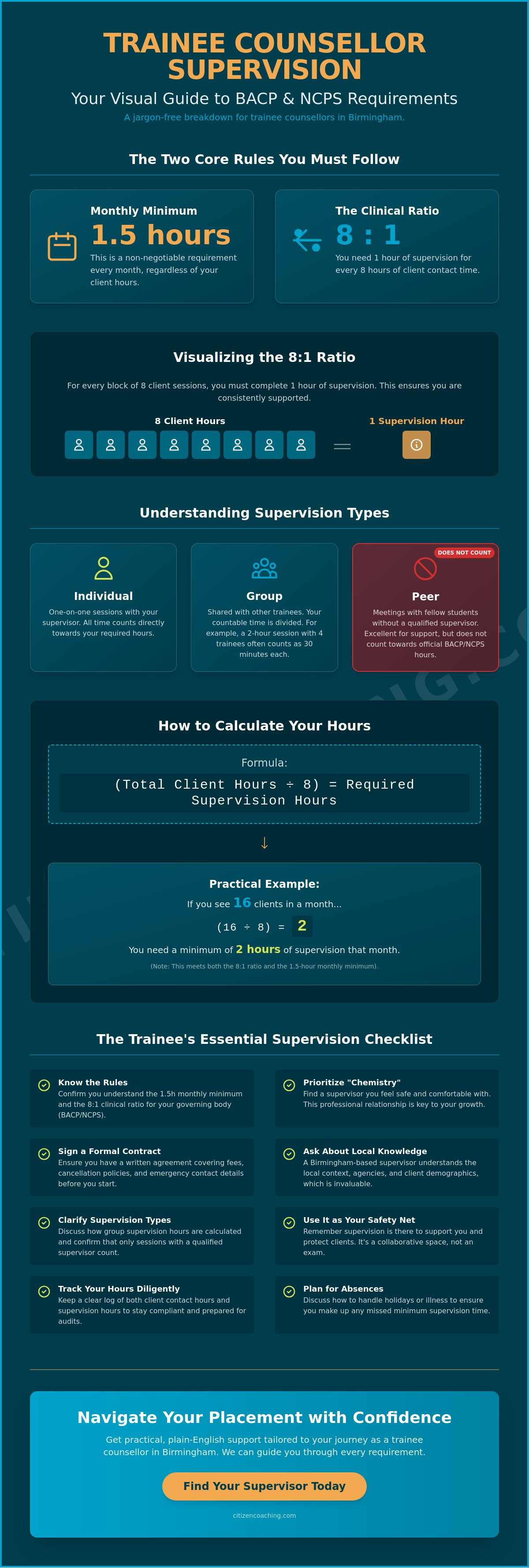
Most professional bodies require a minimum of 1.5 hours of supervision every month. This is a flat requirement. Even if you only see one client for one hour, you still need that 1.5-hour block of support. If you're following BACP guidelines, you also need to manage the 8:1 ratio. This means for every 8 hours you spend sitting with clients, you must have 1 hour of supervision. It acts as a safety net to ensure you aren't overwhelmed by the emotional weight of your work.
You'll usually choose between individual or group supervision. In a group, your time is shared. If four trainees meet for two hours, the BACP usually counts this as 30 minutes of individual time for each person. Peer supervision, where you meet with other students without a qualified supervisor, is great for support but won't count toward your official hours. Always sign a formal contract with your supervisor before you start. This document outlines your fees, cancellation policies, and emergency contact details. It's a vital step in your professional journey.
Calculating Your Supervision Hours
Tracking your time doesn't have to be a headache. Use this simple formula: (Total Client Hours ÷ 8) = Required Supervision Hours. If you see 16 clients in a month, you need at least 2 hours of supervision. Client contact time refers to any 50-minute session where you're the lead therapist. If you miss your monthly minimum because of a holiday or illness, talk to your supervisor immediately. You'll likely need to make up the time the following month to stay compliant with your course requirements for your 2026 qualification.
Paperwork and Professional Bodies
Your supervisor will eventually write a 'Supervisor's Report' for your college or professional body. This report is a friendly but professional assessment of your growth. It confirms you're practicing safely and ethically. Whether you're aiming for BACP or NCPS accreditation, the quality of your support matters. You can find out more about these ethical standards in the NCPS Code of Ethics.
Check that your supervisor is properly accredited and has their own professional indemnity insurance. In Birmingham, most reputable supervisors will have at least 2 years of experience post-qualification before they take on trainees. If you feel stuck or unsure about how to start, our team can guide you through the process of finding the right fit for your trainee counsellor supervision. Taking this first step correctly sets the foundation for your entire career.
Finding the Right Fit: Choosing a Clinical Supervisor in Birmingham
Finding the right supervisor is a major milestone in your professional journey. You spend hours building a strong bond with your clients, but your relationship with your supervisor is just as vital. This "supervisory alliance" creates the safety you need to talk about mistakes, doubts, or difficult emotions. If you don't feel a natural click, you might find yourself holding back during sessions. In Birmingham, you have plenty of choices, from the creative spaces in Digbeth to the professional hubs in Edgbaston or the Jewellery Quarter.
Cost is a practical reality for most students. Many supervisors in the West Midlands offer "trainee rates" to support those entering the profession. While a qualified therapist might pay £60 or more, student rates often range between £35 and £50 per session. Always ask about these discounts during your first phone call or email. It's a standard part of the process, so don't feel awkward bringing it up.
In-House vs. External Supervision
Many placements provide an in-house supervisor for free. This is convenient and keeps your supervisor close to the specific needs of the agency. However, it can create a conflict of interest. If your supervisor is also your manager, you might hesitate to admit you're struggling for fear it affects your placement report. External trainee counsellor supervision provides a neutral, objective space. You can speak freely without worrying about agency politics. If you decide to look elsewhere, ask your placement lead: "I'd like to work with an external mentor to gain a different perspective. What's the process for setting that up?"
Interviewing Your Potential Supervisor
Don't feel pressured to sign a contract with the first person you meet. Try to interview two or three supervisors to compare their styles. This helps you find someone who truly matches your way of working. Ask them about their theoretical orientation. If you're training in Person-Centred therapy but they focus heavily on CBT, their guidance might feel confusing. Ask specific questions like: "How many trainees have you guided through their first 100 hours?" You need a guide who remembers what it feels like to be a student. A good supervisor understands the unique pressures of Birmingham's diverse client base and the specific academic requirements of local institutions like Newman University or Birmingham City University.
Look for someone who feels like a trusted mentor. They should offer a balance of support and challenge. This ensures you grow into a confident, ethical practitioner while feeling fully supported through the inevitable anxieties of your first clinical hours.
The Trainee’s Essential Supervision Checklist: 10 Points for Success
Your first meeting with a potential supervisor is a vital step in your professional journey. It's more than just a chat; it's the moment you lay the foundation for your clinical safety and growth. Being proactive during this "get-to-know-you" session helps you take control of your learning. Use this 10 point checklist to ensure you have the support you need for your placement.
Logistics and Practicalities
- 1. Accreditation and Insurance: Always confirm your supervisor is registered with the BACP or NCPS. Ask to see their current professional indemnity insurance certificate to ensure it meets your training provider's standards for 2026.
- 2. The Schedule: Agree on a fixed monthly date. Most courses require at least 1.5 hours of supervision per month. Ensure your supervisor can commit to this consistently so you don't miss university deadlines.
- 3. Fees and Contact Rules: Clarify the cost per session and their policy on late cancellations. Ask what the rules are for "between-session" contact. Can you send a quick text if you're confused about a form, or is it strictly email only?
- 4. Paperwork Management: Establish how they prefer to handle your clinical logs and end-of-year reports. Some supervisors use digital signing software, while others prefer traditional paper documents.
The Supervisory Relationship
- 5. Theoretical Alignment: Ask about their primary way of working. If you're training in a person-centered model, working with a supervisor who uses a different approach can be helpful, but only if they understand your core training requirements.
- 6. Use of Self: Discuss how you'll explore personal triggers. You need to know that you can talk about your own emotional reactions to clients in a way that feels safe and non-judgmental.
- 7. Case Presentation: Agree on how you'll bring your work to the session. Will you use audio recordings, written process notes, or verbal summaries? Knowing this early helps you prepare your clients for the necessary consent.
- 8. Goal Setting: Define what you want to achieve in your first 50 hours of practice. This might include building confidence in your opening statements or managing silence more effectively.
Safety and Ethics
- 9. Emergency Procedures: This is the most critical point. You must have a clear plan for what to do if a client is in crisis or there's a safeguarding concern. Establish a protocol for immediate phone contact if an emergency happens between your scheduled sessions.
- 10. The Contract of Trust: Create an agreement where you feel safe to admit to mistakes. Effective trainee counsellor supervision relies on your ability to be honest about what went wrong in a room without fear of being "told off."
Taking these steps early creates a professional safety net that allows you to focus on your clients. If you're looking for a supportive environment to begin your journey, we can help you find the right path forward.
How Citizen Coaching Guides Birmingham’s Next Generation
Citizen Coaching has operated as a dedicated Birmingham social enterprise for over 15 years. We've supported hundreds of local students through their clinical journey. Our mission is to improve mental health across the city while supporting the people who provide that care. We've found that the best way to help you grow is through a jargon-free approach. This means we focus on real-world skills rather than just quoting textbooks. When you choose us for trainee counsellor supervision, you're joining a community that values your unique voice. Our supervisors aren't just teachers; they're practitioners working in the heart of Birmingham every day. They know the local landscape, the available resources, and the specific needs of our diverse population.
Accessible Support for Birmingham Trainees
Our community-focused model is specifically designed to lower the barriers for student counsellors. We know that the cost and complexity of professional development can be daunting. By staying rooted in the West Midlands, we keep our services accessible and relevant. Whether you're navigating the latest BACP requirements or preparing for 2026 accreditation changes, we provide the steady hand you need. You can see how we structure our sessions by visiting our Clinical Supervision Birmingham page for more details. We believe that high-quality trainee counsellor supervision should be available to everyone, regardless of their background.
- Direct experience with Birmingham-based clinical placements.
- A focus on practical, ethical decision-making in diverse settings.
- Flexible scheduling that respects your training commitments.
- Support from a team that understands the local mental health network.
Taking the First Step Toward Accreditation
It's helpful to remember that every senior practitioner was once a trainee. They also faced the pressure of balancing hours, ethics, and personal growth. Our role is to guide you through these challenges with calm competence. We don't just want you to pass your course; we want you to become a confident, resilient therapist. The journey might seem long, but you don't have to walk it alone. Reaching out for support is a sign of professional strength, not a lack of knowledge. We make the process simple by offering a friendly, professional chat to see if we're the right fit for your needs.
You don't need to have every detail of your career mapped out yet. Most trainees find that once they have the right supervisor, the path to accreditation becomes much clearer. We're here to help you turn your training into a rewarding career. Let's talk about how we can support your growth in the coming year.
Take the Lead in Your Professional Journey
Securing the right trainee counsellor supervision is the most important step you'll take before your final accreditation. You now have a clear roadmap to navigate BACP and NCPS ratios while ensuring your clinical hours are supported by a solid safety net. By using our 10 point checklist, you can confidently choose a supervisor in Birmingham who matches your therapeutic style and ethical needs. This isn't just about meeting a requirement; it's about building a foundation for your entire career.
Since 2005, Citizen Coaching has operated as a dedicated Birmingham-based Social Enterprise. Our team of BACP-aligned practitioners understands that the transition from student to professional can feel overwhelming. We're here to lower that barrier. We provide the steady, jargon-free guidance you need to focus on your clients and your personal growth. Your path to becoming a qualified therapist is a marathon, and having a trusted mentor makes all the difference in your success.
Explore Clinical Supervision in Birmingham with Citizen Coaching
You've already done the hard work by starting your training. Now, let's make sure you have the professional support you deserve to finish it with confidence.
Frequently Asked Questions
How much does trainee counsellor supervision cost in Birmingham?
Private trainee counsellor supervision in Birmingham typically costs between £40 and £60 for a one-hour session in 2026. While some local placements offer this support for free, many students choose to pay for an external guide to ensure they receive dedicated, one-on-one attention. It's important to check if your supervisor offers a student discount, as many professionals in the West Midlands reduce their rates for those still in training.
Can I have more than one supervisor during my training?
You can have more than one supervisor, and it's quite common if you're working at two different placement sites. The BACP requires you to nominate a primary supervisor who oversees your overall caseload and signs off on your final hours. Having multiple perspectives can be a great way to learn different therapeutic styles while you're still finding your own professional voice.
What happens if I don't get along with my supervisor?
If you don't feel a click with your supervisor, you should first try to discuss your concerns openly during your session. This is a professional relationship, and being able to handle conflict is a vital skill you'll use with your clients. If the situation doesn't improve, talk to your course tutor about finding a new guide who is a better match for your personality and learning needs.
Is online supervision allowed for BACP trainee hours?
Online supervision is fully accepted for BACP trainee hours as long as the sessions meet the standard requirements for frequency and duration. Since the industry shift in 2020, remote sessions have become a standard way to receive professional support. Many trainees in Birmingham find that online meetings make it much easier to balance their studies, placement hours, and home life.
How do I log my trainee counsellor supervision hours for my course portfolio?
You log your trainee counsellor supervision hours by using a standardized log sheet provided by your college or professional body. Each entry needs to show the date, the length of the session, and a summary of the client work discussed. You'll need your supervisor to sign these logs regularly, so it's a good idea to get them updated at the end of every month.
What is the difference between clinical supervision and line management?
Clinical supervision focuses on your therapeutic work and ethical practice, while line management is about your employment and office tasks. Your supervisor is there to guide your clinical growth and help you stay safe while working with vulnerable people. A line manager at your placement handles things like your holiday dates, office keys, and general building health and safety rules.
Can I count group supervision toward my 1.5-hour monthly requirement?
You can count group sessions toward your monthly 1.5-hour requirement, but you must calculate the time according to BACP or UKCP formulas. For example, if you're in a group of four people for two hours, you can usually claim one hour of supervision for your records. Group sessions are a fantastic way to hear about different client issues and learn from the successes of your peers.
What should I do if a safeguarding issue arises between supervision sessions?
You must follow your placement's emergency safeguarding policy immediately rather than waiting for your next scheduled supervision date. Most Birmingham clinics have a designated safeguarding lead who is available to help you make urgent decisions about client safety. Once you've followed the emergency steps, contact your supervisor to let them know what happened so you can process the event together later.
Disclaimer
The information provided on this blog is for general informational purposes only and is not intended to be a substitute for professional medical or mental health advice, diagnosis, or treatment. Reading this content does not create a therapist-client relationship.


