Mastering Your Moods: 5 Practical Emotional Regulation Techniques for 2026
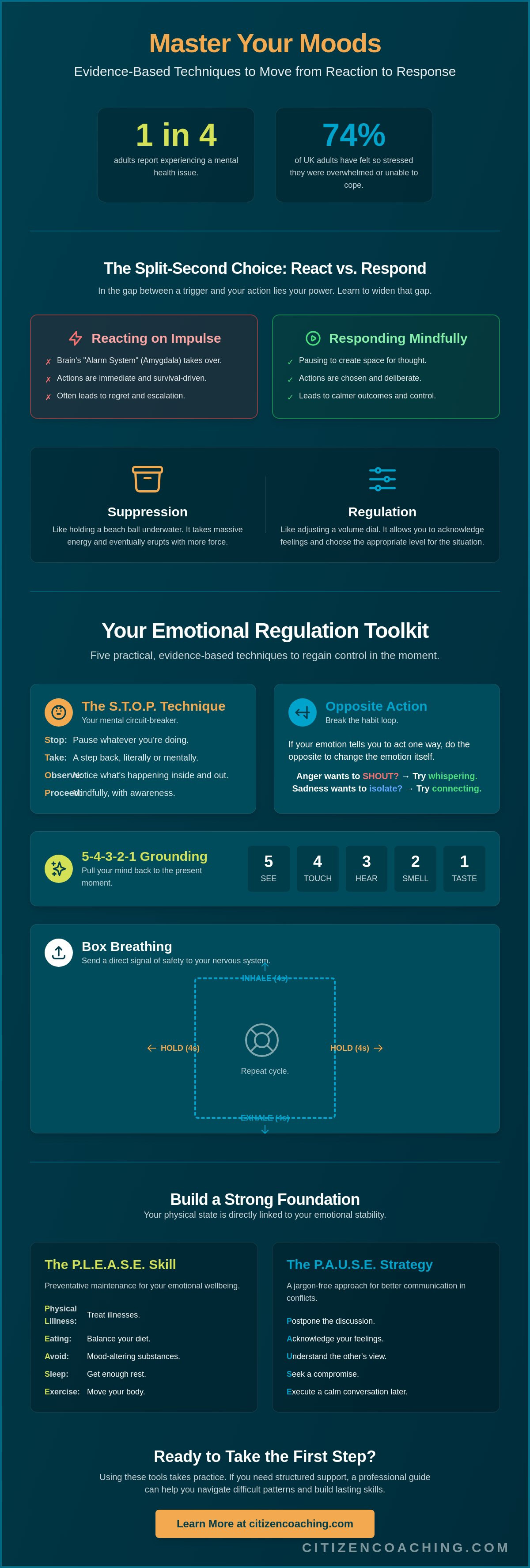
What if that "out of control" feeling during a heated argument isn't a character flaw, but simply a skill you haven't been taught yet? It's common to feel like your temper has a mind of its own, and you aren't alone in that struggle. According to Grow Therapy (April 2026), 1 in 4 adults report having experienced a mental health issue. You might feel exhausted from trying to "numb" your feelings or find yourself filled with regret after an outburst. Learning effective emotional regulation techniques is about moving from a state of sudden reaction to a place of steady, calm control.
We believe that managing your moods is a skill to be coached, not a medical condition to be cured. It's often said that taking the first step is the hardest part, and we're here to guide you through it. This article provides jargon-free, evidence-based strategies to help you understand why you react the way you do and how to stop an emotional hijack before it starts. We will explore five practical tools you can use in the moment to regain your sense of calm and move toward a more balanced life.
Key Takeaways
- Learn how to adjust your emotional volume so you can respond to stress with calm rather than reacting on impulse.
- Discover how to use the STOP technique and other evidence-based emotional regulation techniques to break the cycle of intense outbursts.
- Identify your personal triggers by tracking the specific body sensations and thoughts that lead to your reactions.
- Understand why suppression doesn't work and how to practice healthy ways to manage feelings without bottling them up.
- Find out how a professional guide can help you take the first step toward navigating difficult patterns with local support.
What is Emotional Regulation and Why Does it Matter?
Think of your emotions like the volume dial on a radio. Sometimes the sound is so loud it becomes distorted and overwhelming. Other times, it is so quiet you feel disconnected. What is Emotional Regulation? At its heart, it's your ability to adjust that volume so it suits the situation you are in. It isn't about becoming a robot or never feeling "bad" things. It's about having the control to turn the dial down when a situation starts to feel too intense.
Many people mistake regulation for suppression, which is the habit of "bottling things up." Suppression is like trying to hold a beach ball underwater. It takes a massive amount of energy to keep it down, and eventually, it's going to pop back to the surface with even more force. Using healthy emotional regulation techniques allows you to acknowledge your feelings without letting them take over. This is a biological skill that works much like a muscle. The more you practice, the stronger and more reliable your internal "volume dial" becomes.
You aren't alone if you find this process difficult. According to the Mental Health Foundation, nearly 74% of UK adults have felt so stressed they were overwhelmed or unable to cope (Mental Health Foundation, 2018). This sense of being overwhelmed is often a sign that your brain's natural regulation system needs a bit of support and coaching to get back on track.
The Difference Between Reacting and Responding
When you encounter a trigger, your brain's "alarm system," the amygdala, wants to take immediate control. It’s built for survival, not for logic. Regulation happens in the tiny, split-second gap between a trigger and your reaction. In that space, you have the opportunity to choose a response instead of just reacting on impulse. Learning to pause and widen that gap is what helps you stay calm during an argument and avoid the regret that follows an outburst.
5 Evidence-Based Emotional Regulation Techniques for 2026
Building a toolkit of reliable strategies can help you feel more in control when life gets loud. These 5 Evidence-Based Emotional Regulation Techniques are designed to be used in the heat of the moment or as daily habits. They help you step back from the edge of an outburst and choose a calmer path forward. It isn't about ignoring your feelings; it's about giving yourself the space to handle them with care.
- The STOP Technique: This is your mental circuit breaker. Stop what you're doing. Take a step back. Observe what's happening inside and around you. Proceed mindfully. It's a simple way to pause before you react.
- Opposite Action: If your anger tells you to shout, try speaking in a low, soft voice. Doing the exact opposite of your impulse can actually change the emotion itself. It breaks the link between the feeling and the habitual reaction.
- 5-4-3-2-1 Grounding: When your thoughts start to spiral, name five things you can see, four you can touch, three you can hear, two you can smell, and one you can taste. This pulls your brain out of "future-worry" and back into the room.
- Box Breathing: Breathe in for four seconds, hold for four, exhale for four, and hold for four. This rhythmic breathing sends a direct signal to your nervous system that you're safe.
Using these emotional regulation techniques takes practice. It's okay if you don't get it right every time. If you find yourself struggling to apply these on your own, you might consider how our online anger management course uk can provide more structured support for your journey.
The "P.A.U.S.E" Strategy for Better Communication
Relationship conflicts often trigger our deepest emotions. Before you say something you'll regret, try this jargon-free approach. Postpone the discussion, Acknowledge your feelings, Understand the other person's view, Seek a compromise, and Execute a calm conversation later. If you're finding it hard to communicate even with these tools, exploring online therapy benefits can help you find a guide from the comfort of your own home.
P.L.E.A.S.E: Physical Maintenance for Emotional Stability
Your body and mind are connected. The P.L.E.A.S.E skill reminds us to take care of physical illness, balance eating, avoid mood-altering substances, get enough sleep, and exercise. Think of this as preventative maintenance. When your body is well-rested and nourished, your "emotional volume" is much easier to manage. It's the foundation that makes all other skills possible.
Identifying Your Triggers and Breaking the Cycle
Many people feel like their temper has a hair-trigger, often saying, "I can’t help it, I just explode." This is where the "Boiling Frog" metaphor helps us understand the process. If you're dropped into boiling water, you jump out. But if the heat rises slowly, you don't notice the danger until it's too late. Your emotions often build up throughout the day in small increments. Noticing that rising temperature is essential for using emotional regulation techniques before you hit a boiling point.
Triggers aren't just random events. They are often "echoes" of past experiences or unmet needs, like a lack of respect or feeling ignored. To break the cycle, try tracking your "Body, Thought, Action" patterns. Notice where you feel tension in your body, what story your mind is telling you, and what your typical reaction looks like. Research into evidence-based emotion regulation strategies shows that simply naming these patterns can reduce their power over you. If you need a partner to help spot these patterns, our team at Citizen Coaching and Counselling can support you in finding a calmer way forward.
The "Red Zone": What to Do When You’re Past the Point of Calm
Sometimes, despite your best efforts, you might find yourself in the "Red Zone." This is the point where your survival brain has fully taken over. In this state, logic isn't available. The most professional tool you can use here is a "Time-Out." This isn't a punishment; it's a strategic pause to let your nervous system reset. Communicating this clearly to others, for example, saying "I need 20 minutes to cool down so we can talk about this properly," protects your relationships and prevents the regret that follows a Red Zone outburst.
Taking the First Step: How Professional Coaching Helps
Learning new emotional regulation techniques is a massive win for your mental well-being. However, we know that reading about these tools is very different from using them when you're actually stressed. Sometimes, a recurring pattern feels too heavy to handle on your own. That is where a professional guide comes in. At Citizen Coaching and Counselling, we offer a safe, friendly space to work through these challenges. Our approach to private counselling birmingham is entirely jargon-free. We don't use confusing medical terms. Instead, we focus on practical steps you can take to feel better today.
One of the most helpful things about professional support is seeing that you aren't alone. In our group sessions, people often find huge relief in hearing that others struggle with the same outbursts or feelings of regret. It removes the shame and makes the work feel possible. Whether you prefer one-on-one time or a group setting, having a team of real people behind you makes a world of difference. We prioritize your comfort and work to remove any obstacles to your care.
Why a Social Enterprise Model Benefits You
We aren't a cold, distant institution. Citizen Coaching is a Community Interest Company (CIC). This means we're a social enterprise dedicated to keeping mental health support accessible to everyone. We reinvest in our community to ensure our services remain affordable and high-quality. We believe that everyone deserves a guide, regardless of their situation. Whether you're looking for support right here in Birmingham or need our UK-wide online options, we're ready to help.
The first step is often the hardest, but you don't have to take it alone. We're here to guide you from that initial feeling of being overwhelmed toward a life of calm competence. Reach out today and let us help you find the right path forward.
Take Control of Your Emotional Future
You now have a toolkit of practical emotional regulation techniques to help you navigate life's more difficult moments. By identifying your triggers and practicing tools like the STOP technique, you're already moving toward a more balanced life. It's about building a muscle of calm that gets stronger every time you use it. We've been providing this type of support since 2005, bringing over 20 years of local expertise to every conversation. As a Community Interest Company, we're proud to reinvest in Birmingham's mental health to keep our services accessible and friendly.
Our professional coaching is always jargon-free and designed to fit into your real life. We know that taking the first step is often the hardest part, but you don't have to take it alone. Whether you're looking for individual support or want to learn at your own pace, we're here to guide you. Start your journey to calmer living with our Online Anger Management Course. You deserve to feel in control and at peace.
Frequently Asked Questions
What is the most effective emotional regulation technique?
The most effective technique is the one you can remember to use when you are actually stressed. For many, the STOP technique is a favorite because it provides an immediate mental circuit breaker. However, evidence-based methods like box breathing are often the most reliable for physically calming your nervous system in seconds. The key is to practice these tools when you are calm so they become a second nature habit.
Can emotional regulation be learned as an adult?
Yes, you can absolutely learn these skills at any age. Your brain remains capable of forming new pathways throughout your life, a process that allows you to replace old, reactive habits with calmer responses. While it might feel like your temper is just "who you are," it is actually a set of learned behaviors. With the right guide and consistent practice, you can strengthen your "emotional muscle" and change how you react to triggers.
How long does it take to see results from these techniques?
You may feel a sense of relief the very first time you use a tool like grounding or deep breathing. For long-term changes in your behavior, most people notice a difference after about three to four weeks of daily practice. It takes time for your brain to stop reaching for the "alarm" button and start reaching for a regulation tool instead. Consistency is more important than perfection during this initial phase.
Is emotional dysregulation a sign of a mental health condition?
Feeling out of control is a common experience that happens to many people when their stress levels outweigh their coping skills. While intense emotions can sometimes be linked to specific conditions, they are often just a signal that you need better tools. We don't provide medical diagnoses, but we focus on giving you the practical emotional regulation techniques needed to handle life's challenges without feeling overwhelmed or exhausted.
What is the difference between emotional regulation and anger management?
Emotional regulation is a broad set of skills used to manage all feelings, including anxiety, sadness, and even over-excitement. Anger management is a more specific application of these tools focused on de-escalating frustration and preventing outbursts. Both approaches aim to help you understand your triggers and choose a response that aligns with your values. Mastering one often helps you become much better at the other.
Disclaimer
The information provided on this blog is for general informational purposes only and is not intended to be a substitute for professional medical or mental health advice, diagnosis, or treatment. Reading this content does not create a therapist-client relationship.


