
Managing Anger in a Relationship: Practical Steps for Calmer Conversations
What if pausing an argument could help you feel heard, rather than shut the conversation down? Managing anger in a relationship doesn’t mean pretending you’re not upset or letting difficult issues go. It means noticing when anger is taking over and choosing what you do next. That can be hard when a disagreement is escalating, especially if stepping away might seem dismissive.
If arguments leave you with regret, withdrawal or tension that lingers, you’re not alone in finding the pattern difficult to change. This article explains how to recognise escalation, ask for a pause and return to the conversation with care. You’ll also find ways to express anger without insults, threats or blame while still being honest about what matters to you. If the same conflicts keep repeating, individual anger-management support or couples counselling may help you work towards calmer communication. In Birmingham, Citizen Coaching and Counselling offers both types of support, alongside an online anger-management course.
Key Takeaways
- Managing anger in a relationship starts with spotting familiar triggers, such as feeling criticised or misunderstood, before reactions take over.
- A clear pause-and-return plan helps you step back without leaving your partner uncertain about when you’ll continue talking.
- Use first-person language to explain what you feel and need, rather than relying on blame or assumptions.
- If conflict keeps escalating or causing harm, individual anger-management support and couples counselling offer different ways to explore what may help.
Managing anger in a relationship starts with recognising the pattern
It can feel unsettling when familiar disagreements keep escalating, especially if the conversation ends before either person feels understood. Managing anger in a relationship means noticing the feeling and choosing behaviour that protects respect and safety. Anger is an emotion; shouting, insults, threats and intimidation are behaviours. Exploring anger management approaches can help make that distinction clearer.
Feeling angry can help explain a reaction, but it doesn’t excuse behaviour that harms or frightens someone. Recognising this isn’t about judging yourself for having an emotion. It’s a way to take responsibility for what you do with it and notice when a familiar pattern is affecting the relationship.
When does anger begin to affect a relationship?
Look for patterns, not just one difficult conversation. Do voices often rise? Does one person resort to blame while the other goes quiet? Do arguments end without resolving the issue, only to resurface later? Consider how these interactions affect trust, communication and emotional safety over time. These questions can help you understand the impact without labelling or diagnosing either partner.
Is anger always a sign that something is wrong?
Not necessarily. Anger can signal frustration, hurt or a need that doesn’t feel acknowledged. The feeling alone doesn’t make someone a bad partner, and it doesn’t automatically mean the relationship is unhealthy. The response matters: a person can name their anger and explain what’s bothering them, or act in ways that shut down or frighten their partner. Each person remains responsible for their own behaviour.
Recognising the pattern is a useful first step, not a complete solution. It can help you notice when a disagreement is becoming less about the original issue and more about how you’re treating each other. That awareness creates room to choose a different response and, when needed, seek support to change repeated patterns.
Why anger escalates during relationship conflict
A disagreement can heat up quickly when either person feels criticised, dismissed, interrupted or misunderstood. One partner might hear “You forgot again” as an attack on their character, while the other may mean to raise a specific concern. Assumptions about what a comment means can prompt a fast, defensive reply. Then the conversation shifts from the original issue to proving who is right.
A trigger may help explain your anger, but you’re responsible for what you do next. Stress or past experiences can add context, but they don’t excuse controlling, threatening or abusive behaviour. Managing anger in a relationship means staying curious about what set off a reaction while still taking responsibility for your words and actions.
What can happen just before an argument gets heated?
Early signs differ from person to person. You might notice a tight jaw, a faster heartbeat, repeated thoughts such as “They never listen,” or an urge to interrupt or walk away. These signals aren’t a diagnosis. They can be useful clues. After a disagreement, privately note what was happening, what you noticed and how you responded. Recording the situation, your first signs of anger and what you did next may help you spot recurring triggers earlier.
How can a pause help without becoming avoidance?
A pause is easier to trust when it’s clearly for calming down, not punishment or a way to end the discussion. Say that you want to return to the issue and agree on a realistic time to talk again. Follow through where it’s safe to do so. Guidance such as these anger management tips can offer further ideas for responding thoughtfully. If you’re unsure where to begin changing a repeated pattern, you can contact Citizen Coaching and Counselling to ask about support options in Birmingham or online.
How to manage anger during an argument: a practical pause-and-return plan
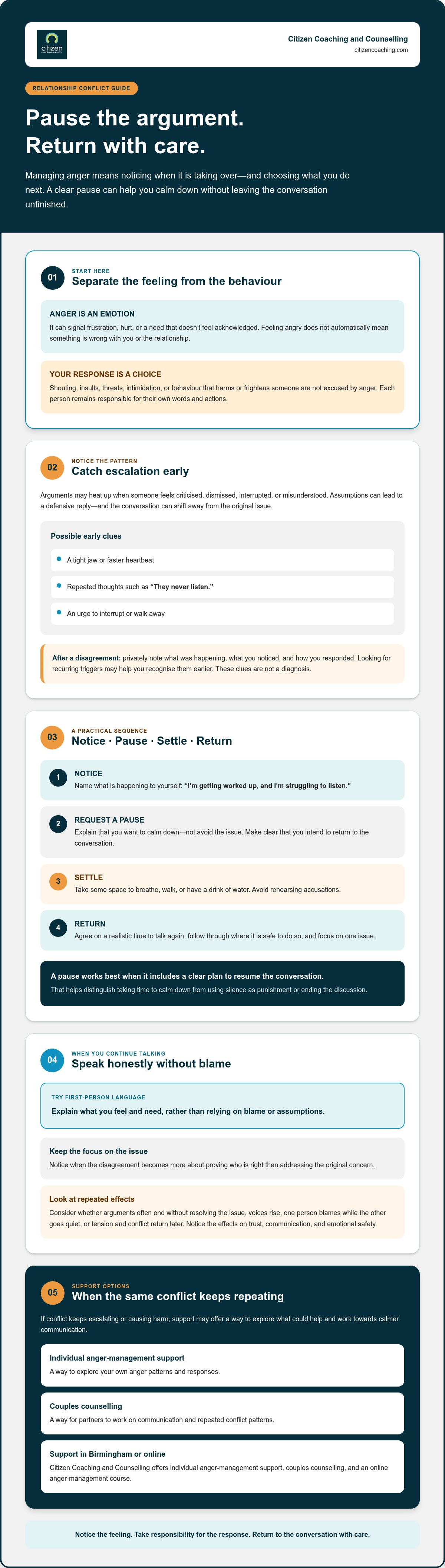
When you notice the conversation speeding up, use a simple sequence: notice, pause, settle, return. Managing anger in a relationship is easier to practise when you decide what you’ll do before the next disagreement begins.
- Notice: Name what’s happening to yourself. “I’m getting worked up, and I’m struggling to listen.”
- Request a pause: Explain that you want to calm down, not avoid the issue.
- Settle: Take some space to breathe, walk or have a drink of water. Avoid rehearsing accusations.
- Return: Come back at the time you agreed and focus on one issue.
A useful pause includes a clear plan to resume the conversation. For more ideas on responding constructively, read these anger management tips.
What can you say when you need time to calm down?
Try: “I’m feeling overwhelmed, and I need a little time so I can talk about this respectfully. I do want to come back to it. Can we continue after dinner?” Choose a return time you can realistically honour. Being specific can reassure your partner that the pause isn’t a punishment or a way to dismiss their concern.
How can you repair a conversation after anger?
Once you’re both ready to talk, keep to one issue at a time. Use a first-person statement to name your feeling and need: “I felt hurt when I was interrupted. I need to finish explaining before we respond.” Listen without planning your rebuttal, then check what you understood: “Have I got that right?”
If you crossed a line, acknowledge the specific behaviour and its impact without adding “but you made me”. For example: “I raised my voice, and I can see that made it harder to talk. I’m sorry.” Then agree on one manageable change for next time, such as taking a pause before either person responds. Small, clear agreements give you something practical to return to after a difficult conversation.
When relationship anger needs support, and where to begin in Birmingham
Self-directed strategies may not feel like enough if arguments keep escalating, apologies don’t lead to change or hurtful behaviour remains unresolved. Seeking support doesn’t mean you’ve failed. It can give you space to understand what’s happening and consider a different way forward. Support may be useful when managing anger in a relationship feels difficult to work on alone.
Should you seek individual support or couples counselling?
Individual anger-management support can help you explore your own reactions and how they affect relationship patterns. Couples counselling focuses on communication between partners and how each person experiences conflict. It isn’t a substitute for immediate safety. If you’re afraid or feel at risk, prioritise safety and seek appropriate help rather than relying on joint counselling to address that danger.
In Birmingham, Citizen Coaching and Counselling offers individual and group anger-management programmes, as well as an online anger-management course. It also provides couples counselling. The right option depends on what you want help with and whether you’d prefer individual or shared support. You can ask about support options and discuss what may fit your needs.
How can you take a first step towards support?
Before making an enquiry, write down what you’d like to change. For example, you might want to pause before raising your voice, express frustration without blame or find a way to discuss disagreements together. A clear starting point can help you explain what you’re looking for. You can ask the team about the anger-management course options and their current availability and delivery details.
If you’re considering support with communication as a couple, learn more about what couples counselling support in Birmingham may involve and whether it suits your situation. Taking the first step can feel unfamiliar. You can keep it simple and ask a question before deciding what to do next.
Take a steadier next step together
Managing anger in a relationship starts with noticing when a familiar conflict is escalating. Anger can be acknowledged without letting it decide what you say or do. A clear pause, a commitment to return to the conversation and careful listening can help protect respect while you work through a disagreement.
If the same pattern keeps repeating or the impact feels hard to repair, you don’t have to work it out alone. Citizen Coaching and Counselling offers anger-management programmes in Birmingham and online, as well as couples counselling. These are different forms of support. The right starting point depends on whether you want to focus on your own reactions or communication as a couple.
Change can begin with one honest conversation and a willingness to try a different response. Take it one step at a time.
Frequently Asked Questions
How can I calm down during an argument with my partner?
Pause the conversation when you notice you’re becoming too upset to listen or speak respectfully. Tell your partner you want to continue, then agree when you’ll return to the discussion. Use the break to settle rather than rehearse blame. When you resume, focus on one issue, describe your own feelings and needs, and check that you’ve understood each other.
Is anger normal in a relationship?
Anger is a human emotion and can arise when you feel frustrated, hurt or unheard. Feeling angry doesn’t automatically mean something is wrong with you or your relationship. What matters is how you respond. Shouting, insults, threats or intimidation can cause harm, and anger doesn’t excuse those actions. Each person is responsible for their own behaviour, even during conflict.
Can a relationship recover from anger issues?
A relationship may be able to move forward when both people acknowledge the impact of harmful behaviour and take consistent steps to change it. There’s no guaranteed outcome, and apologies alone may not repair trust. Honest conversations, clear boundaries and support such as couples counselling can help partners explore communication patterns and agree on practical changes.
When should I seek help for anger in a relationship?
Consider seeking help if arguments repeatedly escalate, harmful behaviour continues or you can’t resolve disagreements despite trying new ways to communicate. Support may also be useful if you feel anxious about raising concerns or the effects of conflict are lingering. If anyone feels unsafe, prioritise safety and seek appropriate help. You don’t need to wait until things feel unmanageable.
Can anger management help with relationship problems?
Anger management can help you understand your reactions and practise responding in ways that support calmer communication. It may be useful alongside relationship support, but it can’t guarantee a particular outcome or make another person change. In Birmingham, Citizen Coaching and Counselling offers group and individual anger-management programmes, as well as an online course. The organisation also provides couples counselling.

Article by
Martin Hogg
Counselling and Anger Management in Birmingham. Articles by Martin Hogg, counsellor MBACP (Reg.) and Founder and CEO of Citizen Coaching and Counselling, a social enterprise based in Birmingham, UK. Martin also helps counsellors struggling to set up and grow their Private Practice to gain clarity and confidence in their marketing and systems.
Disclaimer
The information provided on this blog is for general informational purposes only and is not intended to be a substitute for professional medical or mental health advice, diagnosis, or treatment. Reading this content does not create a therapist-client relationship.


