
How to Prepare for Relationship Counselling: 2026 Guide
The most successful couples don't go to therapy to win arguments or prove who is right. Instead, they shift their focus from scoring points to understanding the patterns that keep them stuck. If you're wondering how to prepare for relationship counselling, you probably feel a mix of anxiety and hope. It's completely normal to worry about opening up to a stranger, or to feel terrified that a professional will judge you. You might even feel stuck trying to get a reluctant partner to participate willingly.
We understand how vulnerable this step feels, but starting this collaborative journey doesn't have to be overwhelming. Discover how to prepare your mind, your partner, and your expectations for a successful relationship counselling journey. We'll outline exactly what happens in your first session and share practical steps to align your goals, bringing a sense of relief and calm before your first appointment.
Key Takeaways
- Understand that relationship counselling is a collaborative space where the therapist acts as a neutral guide rather than a judge.
- Learn how to prepare for relationship counselling by focusing on your own reflections and goals before the first session begins.
- Discover practical ways to address a partner's reluctance by validating their fears of being blamed or judged during the process.
- Find out how to choose the right environment and approachable support to ensure you feel secure throughout your therapeutic journey.
What to Expect: Understanding the True Goal of Relationship Counselling
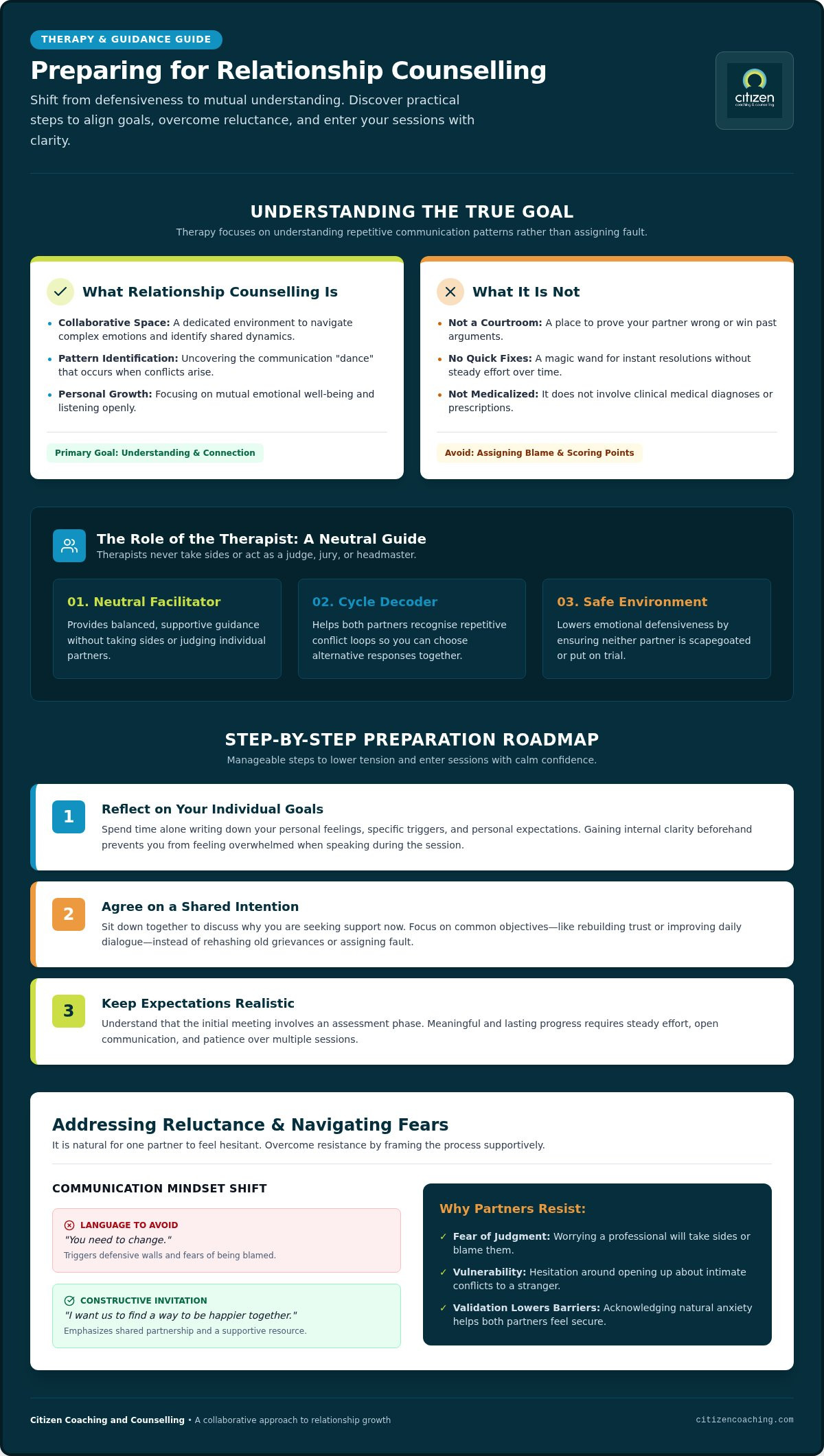
Relationship counselling is a tool for mutual understanding that helps partners navigate complex emotions together. It acts as a collaborative space where you can identify repetitive communication patterns instead of assigning blame. When you look at how to prepare for relationship counselling, the first step is realising that the process focuses on personal growth and emotional well-being within your partnership.
The role of your therapist is that of a neutral guide, not a judge or a jury. They don't take sides. Instead, they help you see the "dance" you and your partner perform when things go wrong. Couples therapy is designed to help you both understand these cycles so you can choose a different path forward together.
What Relationship Therapy Is Not
It's vital to know that these sessions aren't a place to prove your partner wrong or win old arguments. You won't find a magic wand or a quick-fix solution to deep-seated issues. Unlike a clinical medical intervention, our approach doesn't involve medical diagnoses or prescriptions. It's a supportive environment focused on practical communication and emotional connection.
Shifting Your Mindset Before the Journey Begins
Success often depends on your willingness to move from a defensive stance to a curious, open-minded perspective. Instead of preparing a list of your partner's faults, try to reflect on the dynamic you both share. Acknowledge the natural vulnerability that comes with initiating this new journey. It's okay to feel anxious. By validating these feelings, you lower the barrier to progress. Being prepared means being ready to listen as much as you are ready to speak.
Step-by-Step Guide: Preparing for Relationship Counselling
Preparing effectively helps lower anxiety and maximises the value of your initial sessions. When considering how to prepare for relationship counselling, it helps to view the process as a series of small, manageable steps. Instead of trying to fix the joint dynamic immediately, focus on individual reflection first. Keeping your initial expectations realistic is essential, as real progress takes time and steady effort.
Understanding what to expect in couples therapy can demystify the initial assessment phase. This grounding allows both of you to enter the room with a sense of calm competence rather than heightened tension.
Step 1: Reflect on Your Individual Goals
Take some time alone to write down your personal feelings, specific triggers, and what you hope to achieve. Consider how your own emotional well-being impacts the relationship dynamic. This internal clarity prevents you from feeling overwhelmed when it is your turn to speak in the session.
Step 2: Agree on a Shared Intention
Sit down with your partner to discuss why you are seeking professional support right now. Focus your conversation on shared desires, such as rebuilding trust or improving daily communication, rather than rehashing old arguments. Identifying these natural connection points gives you a solid foundation for your upcoming therapy sessions.
If you are unsure how to start this conversation, exploring our Couples Counselling Birmingham Guide can help you select the right approach together. Aligning your intentions early makes the transition into the therapeutic space much smoother. If you feel ready to begin this collaborative journey, you can reach out to our supportive team to discuss the next steps for your partnership.
Addressing Fears: Handling Reluctance and Avoiding the Blame Game
It is incredibly common for one partner to feel more anxious or reluctant than the other. Often, people resist seeking help because they fear being judged or blamed by a professional. If you are the one initiating the process, learning how to prepare for relationship counselling involves framing the sessions as a supportive resource rather than a punishment. It isn't about finding out who is "wrong," but about finding a way to move forward together.
Understanding what to expect in couples therapy can help lower these emotional barriers. When both partners realise the environment is safe and neutral, the defensive walls start to come down. This shift is essential for meaningful progress. You aren't being sent to the "headmaster"; you're meeting a guide who wants to help you both succeed.
How to Talk to a Reluctant Partner
Use gentle, non-accusatory language to invite your partner into the conversation. Instead of saying "you need to change," try saying "I want us to find a way to be happier together." Emphasise that the process is entirely confidential and safe. Knowing that their private matters won't leave the room can help a hesitant partner feel more secure about participating. It's about opening a door, not forcing them through it. This approach respects their autonomy while highlighting the shared benefits of the journey.
Overcoming the Fear of Being Judged
Many people worry they will be overwhelmed by professional jargon or clinical labels. At Counselling Anger Management Birmingham Citizen Coaching, our practitioners use everyday language that is easy to understand. As a social enterprise founded in 2005, we focus entirely on accessible, client-centered care. We aren't here to diagnose you; we are here to help you navigate your journey. By removing the technical barriers, we make the therapeutic process feel like a practical tool for your life. If you have questions about our approach, you can explore options via the Counselling Anger Management Birmingham Citizen Coaching Contact Page. Knowing how to prepare for relationship counselling starts with choosing a team that values your comfort as much as your progress.
Taking the First Step: Your Relationship Counselling Journey
Choosing the right environment is vital for both partners to feel completely secure. When you are figuring out how to prepare for relationship counselling, practical logistics shouldn't get in the way of your progress. Simple factors like a convenient location or online flexibility can significantly reduce initial friction. Look for local expertise combined with an approachable, mentor-like guidance style to help you feel at ease from your very first session.
A supportive space allows you to lower your guard. It helps you focus entirely on your partnership rather than worrying about the environment around you.
Finding the Right Support in Birmingham and Online
Counselling Anger Management Birmingham Citizen Coaching offers professional therapeutic support tailored specifically to couples and individuals. As a Community Interest Company operating since 2005, we do things differently. Our profits are reinvested directly into community mental health services. We provide jargon-free, accessible mental health and relationship support both locally in Birmingham and online. For those seeking broader emotional guidance, our Private Counselling Birmingham Guide offers an excellent starting point.
Ready to Begin Your Journey?
You don't need a medical diagnosis or a formal GP referral to get started with our team. We view therapy as a collaborative journey rather than a clinical medical intervention. Truly understanding how to prepare for relationship counselling is simply about making the joint decision to move forward. Reach out today to take a practical step toward emotional stability and healthier communication.
Starting Your Collaborative Journey Toward Connection
Understanding how to prepare for relationship counselling is the first step toward a healthier partnership. It's about moving away from assigning blame and focusing on the communication patterns that keep you stuck. By reflecting on your individual needs and agreeing on a shared intention, you create a foundation for real growth. Our team of qualified practitioners has been helping couples since 2005. As a Birmingham-based social enterprise, we pride ourselves on a jargon-free, accessible approach that removes the barriers to care. We're real people ready to guide you through this process with calm competence and respect.
You don't have to navigate these challenges alone. Taking this action today shows a deep commitment to your relationship's future and your own emotional well-being. We look forward to supporting you on this journey.
Frequently Asked Questions
What should you not say in relationship counselling?
Avoid using ultimatums or threats of ending the relationship as a way to control the conversation. While honesty is vital, using threats can shut down the vulnerability needed for progress. The practitioners at Counselling Anger Management Birmingham Citizen Coaching encourage you to speak your truth without using fear as a tool. Focus on expressing your own needs rather than attacking your partner's character to keep the space productive.
How do I prepare for my first couples therapy session?
Beyond the mindset shifts discussed earlier, ensure your logistics are settled. If you're meeting online, find a private space where you won't be interrupted and check your equipment. If visiting our Birmingham office, check the route beforehand to avoid unnecessary stress. Thinking about how to prepare for relationship counselling includes these small details. Having a few recent examples of communication struggles ready can also help the therapist understand your daily reality.
What happens if one partner refuses to attend counselling?
If your partner is hesitant, you might suggest attending a discovery session to meet the practitioner. At Counselling Anger Management Birmingham Citizen Coaching, we find that meeting a real person often demystifies the process. If they still decline, attending individual sessions is a powerful way to work on your own emotional well-being. This creates a ripple effect, improving the relationship dynamic even if only one person is initially present in the room.
Is relationship counselling confidential?
Your privacy is protected by strict professional standards and legal requirements. Everything discussed remains between you, your partner, and the therapist. We don't share information with third parties without your explicit consent. As a social enterprise, Counselling Anger Management Birmingham Citizen Coaching maintains rigorous confidentiality protocols. This ensures you can speak freely about private matters, knowing your story is handled with the highest level of professional integrity and care.
How many sessions of couples counselling do we usually need?
The duration of support varies depending on your specific situation and goals. Some couples notice a shift in their communication early on, while deep-seated patterns often require more sustained support. We suggest starting with a short block of sessions followed by a review to see what has changed. Knowing how to prepare for relationship counselling involves understanding that this is a steady process of development, not a one-off fix for long-standing issues.

Article by
Martin Hogg
Counselling and Anger Management in Birmingham. Articles by Martin Hogg, counsellor MBACP (Reg.) and Founder and CEO of Citizen Coaching and Counselling, a social enterprise based in Birmingham, UK. Martin also helps counsellors struggling to set up and grow their Private Practice to gain clarity and confidence in their marketing and systems.
Disclaimer
The information provided on this blog is for general informational purposes only and is not intended to be a substitute for professional medical or mental health advice, diagnosis, or treatment. Reading this content does not create a therapist-client relationship.


