
How to Get the Most Out of Therapy: A Guide to Progress
Getting more from therapy doesn’t mean having the perfect words ready. It can be hard to know where to begin, what to share or whether a session is helping when change feels slow. Learning how to get the most out of therapy isn’t about performing well or arriving with everything figured out. It starts with seeing therapy as a shared process, where your questions, hopes and feedback all have a place.
You might feel unsure how honest to be or worry that you’re not making enough progress. You don’t have to explain everything at once, and progress doesn’t need to be dramatic to matter. Small shifts in how you understand yourself, respond to challenges or talk about what you need can be worth noticing.
This guide offers practical ways to prepare for sessions, take an active role and talk openly with your therapist about what’s working. You’ll also find ways to recognise gradual change without expecting a quick fix or a perfectly straight path. If you’re looking for support in Birmingham, Counselling Anger Management Birmingham Citizen Coaching provides counselling for individuals, couples and young people, as well as anger management support.
Key Takeaways
- Set a personal direction for therapy, even if you’re still working out what you want to change.
- To understand how to get the most out of therapy, bring a short note of topics, questions or moments you’d like to explore.
- Awkwardness or challenge doesn’t automatically mean therapy isn’t working. Notice whether you feel able to speak up and be understood.
- After a session, reflect on what stood out and choose one small thing to revisit or notice before the next one.
Therapy Success Starts With What Matters to You
Feeling nervous, uncertain or unsure where to begin is understandable. You don’t need a complete explanation of what’s wrong before you speak with a therapist. Getting the most out of therapy means working together towards aims that matter in your life, rather than trying to meet someone else’s idea of progress. A useful session might help you see a situation more clearly or leave you with a question to consider, even if nothing feels dramatically different.
Therapy can take different forms and explore different aims. For a general introduction to understanding psychotherapy, you can read about its approaches and history. Your own starting point can be simpler: what’s been troubling you, and what would you like to understand or experience differently? In Birmingham, you can explore those questions through counselling with Citizen Coaching and Counselling.
What would you like to be different?
Try describing the concern in everyday language. It could be an argument that keeps repeating, a feeling you find hard to manage, a relationship that’s changed or a situation you’re avoiding. You might also name what prompted you to seek support now. Perhaps something happened, or you’ve noticed the same difficulty returning. You don’t need a polished explanation. Sharing the pieces you have gives you and your therapist a place to start.
It may help to turn a broad hope into something you can discuss. For example, instead of “I want everything to feel better,” you could start with “I want to understand why I shut down during difficult conversations.” Your aims may shift as you learn more about what you need. Therapy goals can grow and change as your understanding develops. You can talk with your therapist about whether the focus still feels right.
You do not need to arrive with the right words
Sometimes you may go quiet, feel uncertain or change the subject. These moments don’t have to stay unspoken. You could say, “I’m not sure where to start,” or “I notice I keep moving away from this topic.” That gives you both a chance to explore what’s happening, at a pace that feels manageable.
There’s no need to make each session dramatic or reach a breakthrough. A clearer sense of what matters, or a question you want to return to, can offer a useful direction for your next conversation.
How to take an active role during therapy sessions
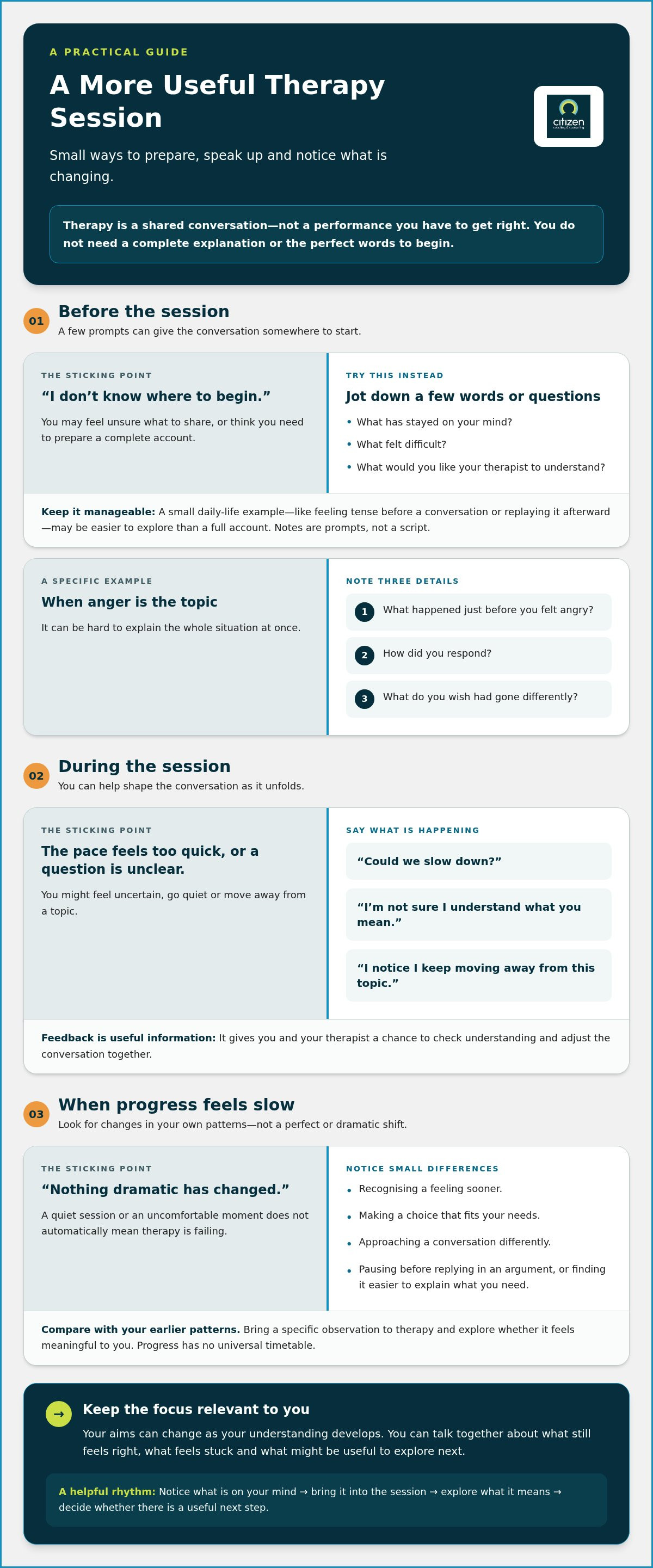
Taking an active role doesn’t mean leading every conversation or finding all the answers yourself. It means helping your therapist understand what matters to you, then exploring it together. A flexible rhythm can help: notice what’s on your mind, bring it into the session, explore what it means and decide whether there’s a useful next step. Some sessions may follow that pattern; others may take a different direction.
What should you bring to a therapy session?
Before you meet, jot down a few words or questions. You could note what has stayed on your mind, what felt difficult or what you want your therapist to understand. A small example from daily life, such as feeling tense before a conversation or replaying it afterwards, can be easier to explore than preparing a complete account. If you’re discussing anger, for instance, you might note what happened just before you felt yourself getting angry, how you responded and what you wish had gone differently. Choose what feels manageable to share. Your notes are prompts, not a script, and you can decide together what to focus on.
How can you talk with your therapist when something feels off?
If the pace feels too quick, a question is unclear or a topic feels difficult, you can say so. For example: “Could we slow down?” or “I’m not sure I understand what you mean.” Asking for clarification can help you both check that you’re following each other. Feedback isn’t a complaint; it gives the conversation a chance to adjust.
Therapy is a shared conversation, not a performance you have to get right. Your therapist helps guide the work, so you aren’t solely responsible for making progress. Citizen Coaching and Counselling offers counselling in Birmingham for individuals, couples and young people. If you’re considering counselling and would like to discuss support, you can get in touch about counselling.
Learning how to get the most out of therapy can include being honest about what is and isn’t helping. You might agree to return to a subject, try looking at it from another angle or leave it for now. The next step should feel relevant to what you’re working through, not like another test to pass.
What if therapy feels awkward, difficult, or slow?
A quiet session or an uncomfortable moment doesn’t automatically mean therapy is failing. You may be thinking through something unfamiliar, unsure how to respond or finding it difficult to put a feeling into words. At the same time, ongoing confusion or feeling unable to speak freely deserves attention. You can raise doubts with your therapist and discuss what might help sessions feel clearer, safer or more useful. Progress has no universal timetable, so it’s reasonable to review together what’s changing and what still feels stuck.
How do you recognise progress when change is gradual?
Look for small differences in how you notice and respond to familiar situations. Perhaps you recognise a feeling sooner, make a choice that fits your needs or approach a conversation differently. These shifts can be easy to overlook if you’re measuring yourself against an ideal version of how you think you should feel. Instead, compare what happens now with your own earlier patterns. You could note a specific example, such as pausing before replying in an argument or finding it easier to explain what you need. Bring those observations to therapy and explore whether they feel meaningful to you.
What can you do if the relationship does not feel right?
Notice what’s behind the discomfort. Is it hard to trust the conversation, understand your therapist or feel that the pace suits you? You might say, “I’m not sure I feel understood,” or “Could we talk about how quickly we’re approaching this?” Naming a concern gives you both a chance to clarify what’s happening and discuss an adjustment. It isn’t a personal failure. Your experience matters, and you don’t have to decide alone what it means for the work.
Part of learning how to get the most out of therapy is being able to talk about the process itself, including what feels useful and what doesn’t. If you’re in Birmingham and considering counselling, you can discuss your concerns and what you hope to get from support.
Make your next therapy session a clearer next step
A brief reflection can help you carry something useful from one session into everyday life. After a conversation, consider: What stood out? What remains unclear? Is there anything I’d like to return to? You might jot down a phrase, a feeling or a question. There’s no need to write a full account or decide what it all means straight away.
A simple routine before and after each session
Keep the routine flexible. Before a session, note one concern or question. During the conversation, notice what feels important. Afterwards, record one takeaway, even if it’s simply something you want to understand better. If reflecting feels tiring, skip it or keep it to a few words. Small reflections can help you carry learning between sessions without turning it into another task.
You could choose one manageable thing to notice before your next session, such as what happens when a familiar worry comes up. This isn’t homework to complete or a test of your commitment. It’s simply an option for gathering a little more understanding. Your aims can also change as life shifts and you learn more about what matters to you. Bring those changes into the conversation and decide together whether the focus still fits.
When you are ready to talk about support
Individual counselling can offer a supportive space to explore personal concerns and aims collaboratively, at a pace that feels manageable. Citizen Coaching and Counselling provides individual counselling in Birmingham, alongside counselling for couples and young people. You can read more about individual counselling and what counselling may involve.
There isn’t one perfect way to approach therapy. Learning how to get the most out of therapy can mean noticing what you need, sharing it when you feel ready and allowing room for your goals to develop. A clearer next step may be a question to bring along, a concern you want to discuss or simply deciding to explore support.
Take the Next Step at Your Own Pace
You don’t need to have everything worked out before you begin. A first step might simply be deciding that you’d like space to understand what’s going on or consider what you want to feel different. There’s no need to wait until you can explain it perfectly. Your starting point can be a question, a concern or a wish to talk things through.
Knowing how to get the most out of therapy can begin with finding support that gives your own priorities room to lead. Citizen Coaching and Counselling provides counselling for individuals, couples and young people in Birmingham, as well as anger management programmes. As a Community Interest Company, it focuses on making community support accessible. Take time to explore what feels important and consider what kind of support may suit you.
Starting a conversation is a meaningful step in itself. Move forward at a pace that feels right for you.
Frequently Asked Questions
What if I do not know what to talk about in therapy?
Start with what brought you to the session, even if it feels small or hard to explain. You could mention a decision you’re putting off, a conversation that’s bothering you or simply say, “I’m not sure what I need today.” If your mind goes blank, tell your therapist. That itself can help you work out what feels important in the moment.
How do I know if therapy is helping?
Consider whether the sessions are helping you make sense of something, feel heard or find a clearer way to approach a concern. You might ask yourself whether the conversation connects with what you hoped to explore, rather than expecting a sudden change in how you feel. If you’re unsure, ask your therapist how you might review what feels useful and what you’d like to focus on next.
Is it normal to feel uncomfortable during therapy?
It can happen, particularly when a conversation touches on something personal or difficult to put into words. You don’t have to keep going at the same pace if you feel overwhelmed. You could ask to pause, take a moment or talk about what feels uncomfortable without explaining the whole story. If you leave feeling unsettled, make that part of the next conversation.
How long does it take to get the most out of therapy?
There isn’t a set timetable, because what feels useful depends on your concerns, aims and circumstances. Rather than judging progress by a particular date, consider whether you and your therapist are clear about what you’re working towards and whether that focus still fits. If you’re wondering how to get the most out of therapy over time, bring that question into a session and review your aims together.
Can I benefit from therapy if I do not have a diagnosis?
Yes. You can seek counselling to talk through personal concerns, relationships or changes in your life without having a diagnosis. Counselling with Citizen Coaching and Counselling in Birmingham offers space to explore what matters to you; it isn’t a medical diagnosis service. You can begin by describing what you’d like support with, using your own words and without needing a label for it.

Article by
Martin Hogg
Counselling and Anger Management in Birmingham. Articles by Martin Hogg, counsellor MBACP (Reg.) and Founder and CEO of Citizen Coaching and Counselling, a social enterprise based in Birmingham, UK. Martin also helps counsellors struggling to set up and grow their Private Practice to gain clarity and confidence in their marketing and systems.
Disclaimer
The information provided on this blog is for general informational purposes only and is not intended to be a substitute for professional medical or mental health advice, diagnosis, or treatment. Reading this content does not create a therapist-client relationship.


