
Finding the Right Counsellor in Birmingham: A Practical Guide
What if the counsellor who looks best on paper isn’t the person who feels right for you? Finding the right counsellor in Birmingham means looking beyond a profile or list of qualifications. You’re looking for someone whose experience and way of working suit what you’re facing, and whose practical arrangements feel manageable.
Taking the first step can feel exposing. You may be unsure how to check a counsellor’s training and experience, or worried about opening up to someone you haven’t met before. Choosing between in-person or online sessions, or individual or couples support, can add to the uncertainty.
This guide offers a clear way to compare your options. You’ll learn what to ask about qualifications, experience, approach and session arrangements, and how to assess whether the support feels like a good fit. Take it one step at a time. You can explore your options without pressure to commit before you’re ready.
Key Takeaways
- Start finding the right counsellor in Birmingham by noting what you’d like support with and what you hope to explore. You don’t need to label or diagnose yourself.
- Compare counsellors on relevant experience, approach, session format, accessibility and practical arrangements, not just directory profiles.
- Check stated qualifications and professional memberships, then ask how the counsellor’s experience relates to your concerns.
- Shortlist potential counsellors, ask a few practical questions and take time to reflect on their responses before deciding whether to proceed.
Finding the Right Counsellor in Birmingham Starts With What You Need
Looking for support can feel personal, especially when you’re not sure what to say or who to trust. You don’t have to choose quickly. Taking time to work out what matters to you can make the search more manageable.
Start with what you hope to explore, rather than trying to find the perfect label for it. Counselling can offer space to talk through personal concerns and consider possible changes. If you’re new to the idea, this overview of what psychotherapy is introduces different approaches in accessible terms.
What would you like support with?
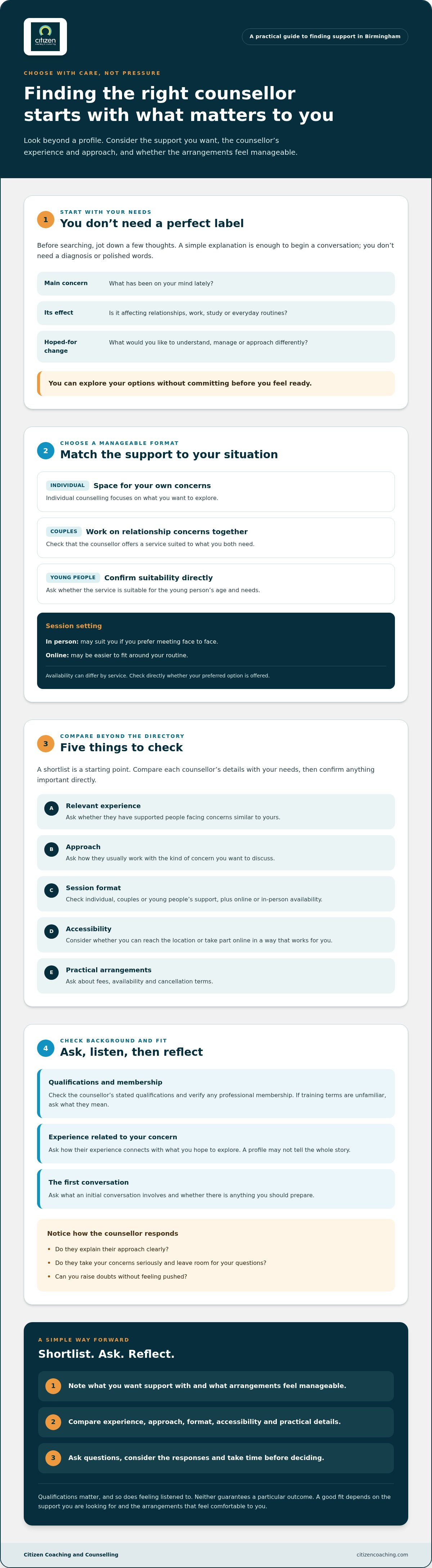
Before searching or making an enquiry, try jotting down a few notes:
- Your main concern: What’s been on your mind lately?
- Its effect: Is it affecting relationships, work, study or everyday routines?
- Your hoped-for change: What would you like to understand, manage or approach differently?
You don’t need a diagnosis or polished words. A simple explanation, such as “I’m finding it hard to manage tension at home,” is enough to begin a conversation about whether a counsellor’s experience may fit.
Which counselling format feels manageable?
Individual counselling gives you space to focus on your own concerns. Couples counselling involves working on relationship concerns together. Counselling for young people is intended for younger clients, so ask each provider whether its service is suitable for the young person’s age and needs.
Think, too, about what would make attending practical. In-person sessions may suit you if you prefer meeting face to face, while online sessions may be easier to fit around your routine. Availability can differ by service, so check directly whether your preferred option is offered.
A good fit depends on the support you’re looking for, as well as the format and arrangements that feel comfortable to you.
How to Compare Birmingham Counsellors Beyond a Directory Listing
A directory can help you make a shortlist, but a profile won’t always show what working with someone may feel like. When finding the right counsellor in Birmingham, compare each person’s experience, approach and practical arrangements with your needs. Qualifications matter, and so does feeling listened to. Neither guarantees a particular outcome.
| What to compare | What to ask or check |
|---|---|
| Relevant experience | Have you supported people facing concerns similar to mine? |
| Approach | How do you usually work with this kind of concern? |
| Format | Are sessions individual, for couples or suitable for young people? Is online or in-person support available? |
| Accessibility | Can I reach the location or take part online in a way that works for me? |
| Practical arrangements | What are the fees, availability and cancellation terms? |
Questions to ask before choosing
Ask what an initial conversation involves and whether there’s anything you should prepare. If training terms in a profile are unfamiliar, the National Careers Service overview of counsellor qualifications offers general background. Check a specific counsellor’s details directly rather than assuming a profile tells the whole story.
How to judge whether the approach feels right
Notice how the counsellor responds. Do they explain their approach clearly, take your concerns seriously and give you room to ask questions? You don’t need to feel certain straight away, but you should be able to raise doubts without feeling pushed. For more context, read Private Counselling Birmingham: A Jargon-Free Guide to Local Support.
Use your notes to compare options, then take time to reflect. If you’d like to clarify what support may fit, you can ask about counselling options.
Check Counsellor Qualifications, Professional Membership, and Boundaries
Before deciding, check a counsellor’s stated qualifications and verify any professional membership. Then ask about experience with concerns like yours. These steps can help you understand their background and whether their work may suit your needs. The NHS guidance on getting counselling also explains what to consider when looking for support.
What professional membership can, and cannot, tell you
A professional register is a searchable record that lets you check whether a practitioner is listed with a professional body and see their stated membership status. For example, you can check the British Association for Counselling and Psychotherapy (BACP) register directly. Professional bodies use different membership categories, so read what a particular status means rather than treating every membership as equivalent. Membership or a directory listing can help with checks, but it doesn’t confirm personal suitability or promise a particular result.
In the UK, professional membership and statutory regulation are not the same thing. If a counsellor’s qualifications or status aren’t clear, ask them to explain what their training involved and how their membership can be verified.
Check that the service matches your situation
Ask whether the practitioner works with your concern and offers the format you’re looking for, such as individual, couples or young-person counselling. Clarify how confidentiality works, including its limits, before beginning. A practitioner should be able to explain this in plain language and give you space to ask questions.
Counselling offers a place to talk and explore concerns. It isn’t medical diagnosis, prescription or emergency crisis intervention. If you need a different kind of support, ask what service is appropriate. These checks make finding the right counsellor in Birmingham more informed, while leaving room for your comfort and preferences to guide the choice.
Shortlist a Counsellor in Birmingham and Take a Comfortable Next Step
You don’t need to make a final decision before asking a question. Treat an enquiry as a chance to check whether the support, format and practical arrangements could suit you. A simple plan can make finding the right counsellor in Birmingham more manageable.
- Shortlist: Choose a few counsellors whose experience and service seem relevant to what you want to explore.
- Ask: Check how they work, which formats are available and what the next step involves.
- Reflect: Consider whether the response was clear, respectful and helpful. You can take time before deciding whether to proceed.
What to include in your first enquiry
Keep it simple. Briefly share the kind of support you’re seeking, whether you prefer in-person or online sessions, and any access needs you’d like the provider to know about. Ask whether the service may fit your situation, what availability is currently like and what would happen next. You don’t have to explain everything at once, and don’t assume a response time unless the provider confirms one.
Counselling Anger Management Birmingham Citizen Coaching is a Birmingham-based option offering counselling for individuals, couples and young people. It also provides anger management programmes, including group and individual support. If anger management is what you’re looking for, ask whether a structured programme may suit your needs. Check directly whether the service that interests you is suitable and available in your preferred format. The organisation’s social-enterprise background may be relevant to you, but the key question is whether the support fits your needs and preferences.
When a different service may be needed
Counselling is not emergency crisis intervention. If you or someone else is in immediate danger, contact the appropriate emergency service. For urgent distress, seek help from a suitable crisis service rather than waiting for a counselling enquiry. For general context about private support, see Private Counselling Birmingham: A Jargon-Free Guide to Local Support.
There’s no pressure to commit just because you’ve made contact. An enquiry can simply help you decide whether to take another step.
Take Your Next Step at a Pace That Feels Right
Finding the right counsellor in Birmingham is a personal choice. Take time to consider what feels comfortable and ask questions before deciding whether to proceed.
Citizen Coaching and Counselling is a Birmingham-based social enterprise focused on community mental health. It offers counselling for individuals, couples and young people, alongside structured anger management programmes. Contact the team to ask whether a service fits your needs and to confirm current arrangements.
There’s no need to have everything worked out before making an enquiry. Take the next step when you feel ready, at a pace that works for you.
Frequently Asked Questions
How do I find a good counsellor in Birmingham?
Start by noting what you’d like support with, then compare a shortlist of counsellors by experience, approach, qualifications, format and practical arrangements. When finding the right counsellor in Birmingham, check any professional membership with the relevant organisation rather than relying only on a profile. You can also ask an initial question and notice whether the response is clear, respectful and comfortable for you.
How can I check whether a counsellor is qualified in the UK?
Read the counsellor’s stated qualifications and professional memberships, then check membership with the named organisation’s current register where available. Ask what training and experience relate to the concerns you want to discuss. Membership categories can differ between professional bodies, so check what a particular status means. A directory listing can help you find practitioners, but it doesn’t by itself establish personal suitability.
What should I ask a counsellor before starting?
Ask whether they work with concerns like yours, how they approach this kind of support and whether sessions are available in your preferred format. You can also check fees, availability, cancellation terms, confidentiality and what an initial meeting involves. You don’t need to share more personal information than feels comfortable in an enquiry. These practical questions can help you decide whether to take another step.
Can I have counselling online or in person in Birmingham?
Available formats depend on the counsellor and the specific service, so check directly before deciding. Ask whether sessions are currently offered in person in Birmingham or online, and what taking part online involves. Consider whether you have a private space, whether the format is accessible for you and which option feels more comfortable. Confirm the arrangements with the provider rather than relying on a general service description.
What if I do not feel comfortable with my counsellor?
It’s reasonable to pause and consider what doesn’t feel right. If you feel able, raise your concern and ask whether a different approach is possible. You can also decide to look for another practitioner. A conversation about fit should leave you room to choose without pressure. If you feel unsafe or need urgent help, contact an appropriate emergency or crisis service rather than waiting for a counselling appointment.

Article by
Martin Hogg
Counselling and Anger Management in Birmingham. Articles by Martin Hogg, counsellor MBACP (Reg.) and Founder and CEO of Citizen Coaching and Counselling, a social enterprise based in Birmingham, UK. Martin also helps counsellors struggling to set up and grow their Private Practice to gain clarity and confidence in their marketing and systems.
Disclaimer
The information provided on this blog is for general informational purposes only and is not intended to be a substitute for professional medical or mental health advice, diagnosis, or treatment. Reading this content does not create a therapist-client relationship.


